




Articles
Numbers Do Lie: Rethinking Bright-Line Tests In Defining Control
Understanding “Control” under the SEBI SAST RegulationsThe concept “control” is regulated by Regulation 2(1)(e) of the SEBI (Substantial Acquisition of Shares and Takeovers) Regulations, 2011. The provision states that “control” means the right to appoint a majority of the directors or control the management or policy decisions of a company. Such control may be exercised directly or indirectly, individually or through persons acting in concert, and may be exercised through shareholding,...

When Should A Judge Step Aside? India Has No Answer !
On April 20, 2026, Justice Swarana Kanta Sharma of the Delhi High Court rejected a recusal plea filed by the accused in the liquor policy case. The grounds cited were that the judge's children serve as central government panel counsel, creating an apprehension of bias. Justice Sharma rejected the application, observing that “a politician cannot be permitted to judge judicial competence” and that “recusal has to stem from law, and not from narrative.”In July 2024, in a case arising from the same...

Restrictive Clauses In Construction Contracts: Lawful Bargain Or Unlawful Exclusion?
Most construction contracts in India often include clauses that restrict or completely negate a contractor's right to seek damages for delays even where the employer is at fault. By contractually offsetting the financial costs of delay, these clauses, which are often expressed as "no-claim," "no-damages-for-delay," or "extension of time (EOT)" as the only remedy, seek to ensure continuity of performance by the contractor without the employer having to worry about facing any claim for damages or...

Right To Refuse: - Why Indian Banking Needs A 'Consent Layer' To Protect Innocent Account Holders
Currently, an account holder has no legal or technical agency to accept or deny a payment before it hits their ledger. in the landscape of modern Indian jurisprudence, the rapid evolution of the UPI (Unified Payments Interface) is often hailed as a triumph of financial inclusion and digital efficiency. However, beneath the surface of this "ease of transaction" lies a perilous statutory lacuna, the absence of a consent mechanism for inbound payments. While digital social platforms are built on...
Remembering Soli Sorabjee: The Peerless Lawyer and Man
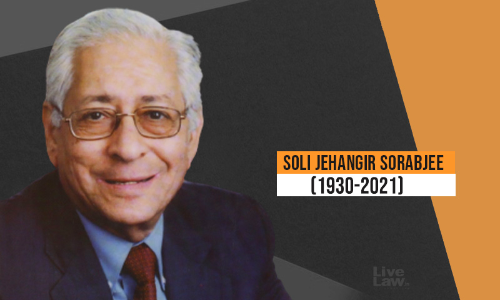
It is given to only a few to be endowed with great qualities of head and heart, don many hats and play many roles with distinction and elan, yet retain the human touch and be considered a legend. Soli Jehangir Sorabjee is certainly one among them whose personality was so warm and vibrant and career so versatile and glittering. He was one of the all-time greats both as a lawyer and a human being. A gentle colossus, his many splendoured life and work is a model. He is among the exceptional few...

Anti-Defection Law: Merger Or Mirage?
On 24 April 2026, the political developments involving Raghav Chadha and Aam Aadmi Party brought the anti-defection law back into sharp focus. Interestingly, the date carries a distinct constitutional significance. On 24 April 1973, the Supreme Court delivered its landmark judgment in Kesavananda Bharati v. State of Kerala, laying down the basic structure doctrine - a doctrine that safeguards the core features of the Constitution, including democracy itself.The present episode raises a very...
When Your Career Becomes The Lead While Reporting Crime
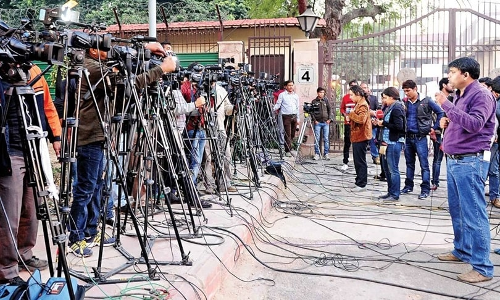
“A Highway Murder victim was a Teacher”, "A Kerala Doctor stabbed 27 times with scissors by school teacher in hospital; accused sentenced to life 3 years after murder" becomes national headlines only when the victim is labeled Teacher or Doctor allegedly murdered by a School Teacher. The crime remains the same; only the professional prefix makes it newsworthy. This is identity-baiting, a trend where media outlets weaponize a suspect's professional status to manufacture scandal out of mundane...
Paradox Of Green Progress: Solar Expansion And Limits Of Environmental Law In Rajasthan
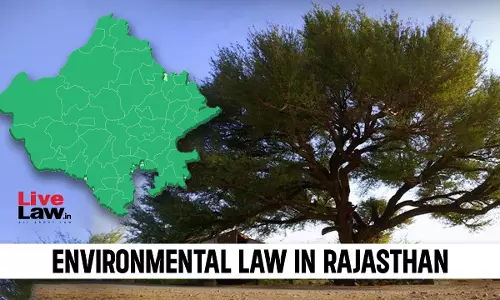
Reasserting Sustainable Development, Proportionality, and Community Participation in India's Renewable Energy PushWhat if the pursuit of clean energy begins by dismantling the very ecosystems it claims to protect?India's accelerated transition to solar energy is widely framed as an unqualified environmental good. Yet, recent developments in western Rajasthan complicate this narrative in significant ways. The large-scale felling of the Khejri tree for solar infrastructure has triggered sustained...

Between Misconduct And Crime: Legal Blind Spot In Workplace Sexual Harassment
In a country where a quarter of the urban workforce is women1workplace equity becomes extremely important, not just in terms of professional opportunities, but in terms of mental and emotional workload. Workplace harassment cases are a testament to how women have to disproportionately bear the burden of gender dynamics and power hierarchies in professional spaces. Numbers reflect reality. Nearly 48% of women report some form of workplace harassment, according to a survey report by the National...
Poems & FIRs - Standard Of Freedom Of Speech In India
An Analysis Of The Pratapgadhi Judgement and its precedentWhen a Rajya Sabha MP shared an Urdu poem on X, the Gujarat police saw incitement. however the Supreme Court saw poetry. But the more interesting story is not that the FIR was quashed — it is the standard the Court used to quash it. Resurrecting a 1947 pre-independence Nagpur High Court formulation, the Court held that speech must be judged through the eyes of a "reasonable, strong-minded, firm and courageous" person. This raises a...

Constitutionalising Road Safety Under Article 21
The Story So FarThe case of In Re: Phalodi Accident, delivered on April 13, 2026, concerns a series of very tragic incidents that happened in early November 2025, where two accidents in the States of Rajasthan and Telangana resulted in the death of 34 persons within two days. These accidents, which took place on Bharatmala Expressway at Phalodi in Rajasthan and in Rangareddy District in Telangana State, cannot be called isolated incidents because they revealed a certain trend of neglecting the...

AI In Digital Forensics: Are Indian Evidence Laws Equipped To Handle Machine-Generated Proof?
As algorithms begin to testify in our courtrooms, the scales of justice are facing a digital recalibration that challenges centuries of traditional jurisprudence. There is a need to move beyond the Section 65B straitjacket to frame AI not merely as a digital record, but as a distinct form of machine-generated expert opinion. By leveraging the historic transition from the Indian Evidence Act to the Bhartiya Sakshya Adhiniyam, a concrete statutory roadmap specifically a particularly designed...