




Chhattisgarh High Court
WhatsApp Chats Showing Mental Cruelty Cannot Be Ignored Merely For Non-Compliance With Evidence Act: Chhattisgarh High Court Grants Divorce
The Chhattisgarh High Court has held that unchallenged WhatsApp messages produced by a wife, which disclosed conduct falling within the ambit of mental cruelty, could not be brushed aside merely because the strict evidentiary requirements were not met. [2026 LiveLaw (Chh) 134]The Court observed that though the wife had not complied with the provisions of the Evidence Act in respect of...
Husband's Visits To In-Laws' House Doesn't Prove Wife Refused To Cohabit 'Without Reasonable Cause': Chhattisgarh High Court
The Chhattisgarh High Court has held that the mere fact that a husband made repeated visits to his wife's parental home or issued a legal notice expressing willingness to resume matrimonial cohabitation cannot, by itself, establish that the wife's refusal to return was without reasonable cause under Section 9 of the Hindu Marriage Act, 1955. [2026 LiveLaw (Chh) 133]The Court observed that...

Wife Allegedly Calling Husband "Black Complexioned" Or "Fatty Shaped" Not Sufficient To Grant Divorce: Chhattisgarh High Court
The Chhattisgarh High Court has held that a wife's alleged description of her husband as “black complexioned” or “fatty shaped” cannot, by itself, be treated as sufficient ground for granting him a decree of divorce. The Court observed that mere allegations, without any evidence substantiating them, cannot be the basis for granting divorce.[2026 LiveLaw (Chh) 132]A division bench...
Scheduled Castes Commission Cannot Adjudicate Criminal Charges Or Declare Offences Proved: Chhattisgarh High Court
The Chhattisgarh High Court has held that the State Scheduled Castes Commission exceeded its jurisdiction by recording that a charge under Section 3(1) of the Scheduled Castes and Scheduled Tribes (Prevention of Atrocities) Act, 1989 was proved and recommending registration of an FIR against the petitioner. The Court observed that such a determination rests with the criminal Court. [2026...
![[Motor Vehicles Act] Carriage Permit Applicant Cannot Cure Statutory Defects After Consideration Of Application: Chhattisgarh High Court](https://www.livelaw.in/h-upload/2024/01/18/500x300_516990-chhattisgarh-high-court.webp "[Motor Vehicles Act] Carriage Permit Applicant Cannot Cure Statutory Defects After Consideration Of Application: Chhattisgarh High Court")
[Motor Vehicles Act] Carriage Permit Applicant Cannot Cure Statutory Defects After Consideration Of Application: Chhattisgarh High Court
The Chhattisgarh High Court has held that once a statutory authority finds that a carriage permit application under the Motor Vehicles act is incomplete and suffers from defects going to its maintainability, the applicant cannot be allowed an opportunity to cure the defect by remitting the matter back. The Court observed that permitting the applicant to subsequently cure deficiencies...
Married Daughter Cannot Continue Pending Compensation Claim Filed By Mother Under Employees Compensation Act: Chhattisgarh High Court
The Chhattisgarh High Court has held that a married daughter, who is not a “dependant” under Section 2(1)(d) of the Employees' Compensation Act, 1923, cannot continue a pending compensation claim filed by her mother, who died before the award was passed. The Court observed that had the award been passed in favour of the mother during her lifetime, the daughter could have claimed it as part...
LiveLaw Chhattisgarh High Court Monthly Digest: August 2026
Citation: 2026 LiveLaw (Chh) 93 to 2026 LiveLaw (Chh) 120Nominal IndexSatpal Gandhi v. Girdharilal Agrawal & Anr. 2026 LiveLaw (Chh) 93Mohan v. State of Chhattisgarh & Ors. 2026 LiveLaw (Chh) 94Ashish Mandal v. State of Chhattisgarh & Ors. 2026 LiveLaw (Chh) 95Anupam Devnath v. Inspector General, Kendriya Audhogik Suraksha Bal & Ors. 2026 LiveLaw (Chh) 96M/s. Dynami Enterprises...
RTI: Inquiry Records Sought For Self-Defence Cannot Be Denied If No Third-Party Privacy Involved, Rules Chhattisgarh High Court
A Chhattisgarh High Court bench comprising Justice Amitendra Kishore Prasad held that the denial of information under Sections 8(1)(c) and 8(1)(j) of the RTI Act is impermissible when the requested information pertains to the petitioner's own departmental inquiry and is sought for self-defence, and it does not involve third-party privacy. [2026 LiveLaw (Chh) 128] Background Facts...

Sharia Body Can't Determine Muslim Woman's Marital Status Or Dissolve Marriage: Chhattisgarh High Court
The Chhattisgarh High Court has held that a private religious body styling itself as an “Idara-E-Shariya Islami Court” has no legal authority to adjudicate upon the marital status or legal rights and obligations of individuals. [2026 LiveLaw (Chh) 127]While leaving the constitutional validity of Talaq-e-Hasan open noting that some matters were pending before the Supreme Court, the...
Enquiry Officer Acting As Prosecutor Through Leading Questions Vitiates Disciplinary Proceedings: Chhattisgarh High Court
The Chhattisgarh High Court has held that while non-appointment of a Presenting Officer by itself does not vitiate a disciplinary enquiry, an Enquiry Officer cannot assume the role of the prosecutor by putting leading or suggestive questions to prosecution witnesses. The Court held that such conduct compromises the Enquiry Officer's position as an independent adjudicator, gives rise to a...
Centre Notifies Appointment Of Three Judicial Officers As Judges Of Chhattisgarh High Court
The Central Government on Tuesday (September 8) notified appointments of three judicial officers as judges of Chhattisgarh High Court. Union Law Minister Arjun Ram Meghwal took to X to notify the appointments:"In exercise of the powers conferred by the Constitution of India, in consultation with Chief Justice of India, the President is pleased to appoint the following Advocate/Judicial...
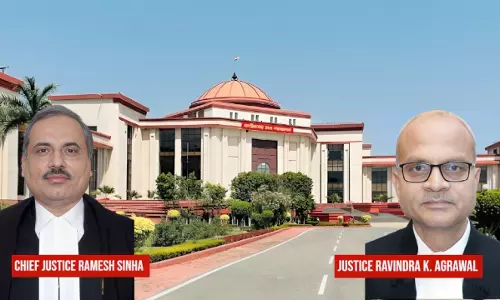
Qualifying Service For Promotion Is Counted From Calendar Year Of Joining Feeder Cadre, Not From Actual Date Of Joining: Chhattisgarh HC
A Division Bench of the Chhattisgarh High Court comprising Chief Justice Ramesh Sinha and Justice Ravindra Kumar Agrawal held that qualifying service for promotion is counted from the calendar year of joining the feeder cadre, not from the actual date of joining, as per the Rule 6(2) of the Chhattisgarh Public Services (Promotion) Rules, 2003. [2026 LiveLaw (Chh) 125] Background...