




Himachal Pradesh High Court

School Merger Can't Be Called Arbitrary When Students Have Easy Access To Nearby School: Himachal Pradesh High Court
The Himachal Pradesh High Court has upheld the Government's decision to merge Government Middle School, Sandyar, Bilaspur, with Government Senior Secondary School, Chhat, observing that the decision could not be termed arbitrary when the students had easy access to the nearby school. The Court noted that the students had been shifted to a school located just 1.5 kilometres away by road and...
Executing Court Cannot Revisit Issues Already Settled By Final Decree: HP High Court Dismisses Challenge To Execution Of 99-Year Lease
The Himachal Pradesh High Court has held that an executing court cannot re-consider or re-decide issues that have already been adjudicated by the trial and appellate courts and have attained finality. The Court observed that the jurisdiction of an executing court is confined to matters concerning the execution, discharge or satisfaction of the decree, and dismissed a challenge against...
'Penetration To Any Extent' Sufficient For Aggravated POCSO Assault: Himachal Pradesh High Court Upholds 20-Year Sentence
The Himachal Pradesh High Court has held that “penetration to any extent” is sufficient to constitute penetrative sexual assault under Section 3 of the Protection of Children from Sexual Offences Act, 2012 (POCSO Act), even in the absence of physical injuries on the child. The Court made the observation while dismissing an appeal filed by Shyam Veer against his conviction under Section 6...
Courts Cannot Reassess Interview Marks Or Comparative Merit Absent Proven Mala Fides Or Bias: Himachal Pradesh High Court
The Himachal Pradesh High Court has held that judicial reassessment of comparative merit, including marks awarded in an interview by a duly constituted Selection Committee, is impermissible in the absence of mala fides, bias or violation of statutory rules or the applicable policy. The Court observed that merely because an unsuccessful candidate was awarded fewer interview...
Easementary Right By Prescription Can't Be Claimed Without Specifically Pleading & Identifying Pathway: Himachal Pradesh High Court
The Himachal Pradesh High Court has dismissed a claim seeking recognition of a prescriptive right of way, holding that an easementary right by prescription cannot be established unless the alleged passage is specifically pleaded and clearly identified. The Court noted that the plaintiff had failed to sufficiently establish the pathway through the defendants' land, with the pleadings and...

Vehicle Without Valid Permit, Fitness Certificate Breaches Insurance Policy: Himachal Pradesh High Court
The Himachal Pradesh High Court has held that a transport vehicle being operated without a valid permit and fitness certificate amounts to a violation of the terms and conditions of the insurance policy. The Court accordingly held that the insurer could not be fastened with the ultimate liability for compensation, while applying the “pay and recover” principle to direct the Insurance...
Fresh Direct Appointment Confers No Promotional Increment Or Past-Service Benefits Absent Statutory Entitlement: HP High Court
The Himachal Pradesh High Court has held that past service rendered on a lower post cannot be counted towards service on a higher post for claiming service benefits unless the applicable Recruitment and Promotion Rules expressly permit such counting. The Court made the observation while dismissing a plea by a former Dai seeking to club her service as Dai with her subsequent service as...
HP High Court Directs DGP To Issue Guidelines On Proving Age Of Child Victims, Cites Repeated Investigative Lapses
The Himachal Pradesh High Court has directed the Director General of Police, Himachal Pradesh, to circulate Section 94 of the Juvenile Justice (Care and Protection of Children) Act, 2015 along with necessary guidelines to all Investigating Officers, after observing that prosecution cases have failed due to lapses in collecting evidence relating to the age of child victims.A Division Bench...
Parole Cannot Be Denied Merely Because Convict Is Citizen Of Nepal When Family Residing In India For Decades: HP High Court
The Himachal Pradesh High Court has held that a convict's Nepalese citizenship, by itself, cannot be a ground to deny parole when his family has been residing in India for several decades. The Court observed that where the prisoner's family has established long-standing residential and social ties in India, and his conduct in custody is satisfactory, apprehensions of absconding to Nepal...

Improved Marks In Revaluation Relate Back To Date Of Original Qualification & Must Be Considered In Merit: Himachal Pradesh High Court
A Division Bench of the Himachal Pradesh High Court comprising Chief Justice G. S. Sandhawalia and Justice Chirag Bhanu Singh held that improved marks obtained through re-valuation or re-examination relate back to the date of the original qualification and must be considered for eligibility/merit. Background Facts The appellant had applied for the post of 'Van Mitra'. He had...
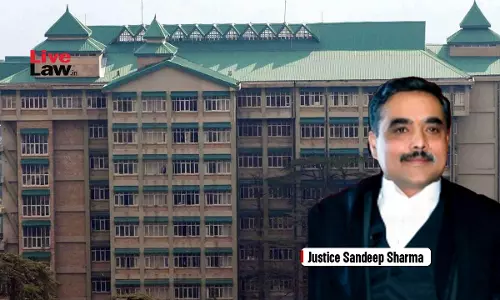
'Publishing News On True Facts Not Defamation': Himachal Pradesh High Court Quashes Case Against Newspaper Editor
The Himachal Pradesh High Court has quashed a defamation complaint against the editor of a newspaper, holding that publication of a news report based on true and undisputed facts, particularly where the complainant's clarification was also sought and published, could not amount to defamation. The Court observed that the report was based on factually correct information and that the newspaper...
Unemployment, Poor Business, Loan Repayments Can't Justify Failure To Pay Wife's Maintenance: HP High Court
The Himachal Pradesh High Court has held that a husband's financial constraints, lack of employment, poor business performance or outstanding loans cannot be used as an escape route to avoid his obligation to pay maintenance to his wife, including a divorced wife. The Court observed that the wife's right to maintenance cannot be sacrificed on account of financial difficulties arising from...