



Ambedkar – Enigma Of Fire, Unshackling India's Soul
Justice N. Anand Venkatesh
1 May 2026 6:00 PM IST
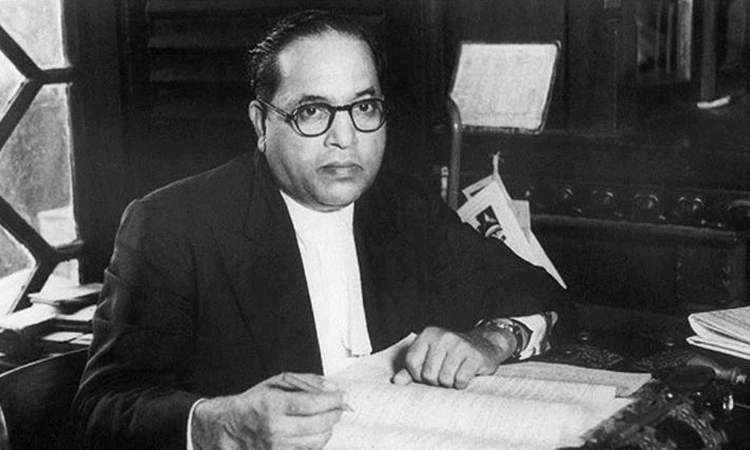
History has a habit of sanitizing its revolutionaries. It turns firebrands into statues and rebels into portraits. But Dr. B.R. Ambedkar was never meant to be a silent icon. He was a intellectual insurgent, a man who realized that in a land of graded inequality, a book is more dangerous than a bullet, and dignity is more sacred than the "unity" of a graveyard.
In the annals of human history, few weapons have proven as potent as the book. For Dr. B.R. Ambedkar, the library was his armory, and the written word was the chisel with which he carved a new identity for millions. He did not merely live a life; he lived a manifesto. To understand Ambedkar is to understand that education is not a tool for employment, but a weapon for emancipation.
Ambedkar's life was an odyssey of the mind. He was a polymath who sculpted himself through relentless study. His personal library, Rajgir, housed over 69,000 books—the largest private collection of its time. This was not a collection for vanity but was a sanctuary of intellect.
His commitment to the word was so absolute that he wrote the preface to his final masterpiece, The Buddha and His Dhamma, the very night before he breathed his last. For him, reading was not a passive act. He did not seek education for status, wealth, or comfort. Instead, he channeled his vast knowledge into a "social surgery," aiming to amputate the gangrenous growth of caste from the Indian psyche. He took the very education that society tried to deny him and turned it into a lash to strike back against systemic injustice.


A tragic reductionism exists in modern India. The moment Ambedkar's name is mentioned, he is pigeonholed as a "Dalit leader." This is a profound injustice to his legacy. Naming a child Gandhi, Nehru, or Kamaraj evokes no communal inquiry. But name a child Ambedkar, and the immediate question follows: "Which community do you belong to?"
This reflects the very sickness Ambedkar sought to cure. He does not belong to a single caste rather he belongs to the conscience of the nation. His greatest gift to India was the Preamble of the Constitution. While many argued that "Unity" should be the primary pillar of a new nation, Ambedkar
remained steadfast emphasizing that Dignity must come first. He understood a fundamental truth that you cannot have true unity in a nation where the individual is not respected. Real unity is not a forced handshake between unequals but it is the natural byproduct of mutual respect. To this end, he fought to include "Fraternity" in the Preamble. For Ambedkar, fraternity was the soul of democracy—a sense of brotherhood that transcends the barriers of birth.
In popular discourse, Ambedkar is often synonymous with "Reservation." However, he rarely used that word as a primary concept. His word was "Representation." There is a vital distinction here. "Reservation" can be misconstrued as a gift or a charity bestowed upon the weak. "Representation," however, is a matter of Right. Ambedkar argued that in a society where people are oppressed by the very accident of their birth, systemic representation is the only way to ensure they have a seat at the table of power. It is not a favor; it is a corrective measure for centuries of forced exclusion.
Ambedkar's most famous slogan—"Educate, Agitate, Organize"—is often misinterpreted. He did not just say "Study"; he meant "Educate yourself and then educate others." He saw caste not just as physical segregation, but as a psychological prison. India's caste system can be compared to South Africa's Apartheid, but with a chilling distinction. If Apartheid was "skin deep," the caste system in India is "soul deep." It is an internalised hierarchy that stunts the spirit. This is why Ambedkar is often depicted holding a book. The book represents the light required to see through the darkness of "soul-deep" discrimination.
Today, while the intensity of overt casteism may have shifted, the structure remains "alive and kicking." The fact that we must place cages around Ambedkar's statues to protect them from vandalism is a grim testament to the fact that his ideas still terrify the status quo.
The world has many reformers who seek to "fix" systems. Ambedkar was not one of them. He was a Revolutionary. While contemporaries like Gandhi or Patel sought to work within the existing social fabric, Ambedkar's seminal work, Annihilation of Caste, argued that the fabric itself was torn. He challenged the "sanctity" of the Shastras, arguing that as long as religious texts provided a divine mandate for inequality, caste could never be destroyed. He identified Endogamy (marrying within one's caste) as the mechanical tool that kept the caste system alive. Furthermore, he broke away from the romanticized view of the "Indian Village." While others saw the village as a site of purity, Ambedkar saw it as a "sink of localism, a den of ignorance, narrow-mindedness, and communalism." He urged the oppressed to migrate to cities, seeking the anonymity and opportunity of urban life to escape the watchful eyes of village tyrants.
For Ambedkar, democracy was not merely a system of "one man, one vote." It was a way of life. He integrated the French Revolutionary ideals of Liberty, Equality, and Fraternity into the Indian Constitution, but gave them a spiritual foundation rooted in Buddhist thought. He warned that without social and economic equality, political liberty would be a hollow shell.
Ultimately, Ambedkar's mission was the transition of the Marginalized to the Empowered. He understood that in a democracy, power is the only language that is heard. If you are not in a position of power, you are forever reduced to the role of a "petitioner," begging for rights that should have been yours by birth.
His definition of discrimination was expansive. While he fought primarily against caste, his philosophy provides a shield against gender discrimination, religious bigotry, and linguistic chauvinism. He was a champion for women's rights through the Hindu Code Bill, recognizing that the liberation of a society is measured by the degree of progress which women have achieved.
Every April 14th, social media teems with hashtags and tributes. But to celebrate Ambedkar merely as a historical figure or a "Dalit icon" is a betrayal of his intellectual depth. He was a "Jnani"—a sage who saw the structural rot of society and provided the blueprint for a new building.
Statues can be broken, and hashtags will fade with the news cycle, but the Independent Thought Ambedkar planted is indestructible. To truly honor him is to read him, to understand the "soul-deep" nature of our prejudices, and to strive for a society where "Fraternity" is not just a word in a book, but the pulse of the nation.
Ambedkar is not a man of the past; he is the necessity of the future. Until every individual can live with dignity, until representation is a reality, and until the "soul-deep" walls of caste are leveled, Ambedkar remains the most relevant revolutionary of our time.
He didn't just write the law; he challenged us to be worthy of it.
Author is a Judge at Madras High Court. Views are Personal.


