



Breaking Green Patent Bottleneck: Is it Time For A “Climate TRIPS Waiver”?
Shivam Kushwaha
20 Jun 2026 10:11 AM IST
I. The 2026 Dichotomy: Regulatory Sanctions Without Technological Solutions
As we navigate the second quarter of 2026, the intersection of international trade and environmental jurisprudence has reached a state of critical friction. The global community is no longer debating "if" climate change will disrupt trade, but "how" the law should mitigate the resulting economic disparities. The definitive implementation of the European Union's Carbon Border Adjustment Mechanism (CBAM) has fundamentally altered the landscape, effectively imposing carbon-linked tariffs on Global South exports. However, a profound legal paradox remains: while the Global North uses trade sticks to enforce decarbonization, it continues to hoard the "Green DNA" the proprietary intellectual property (IP) necessary for that transition.
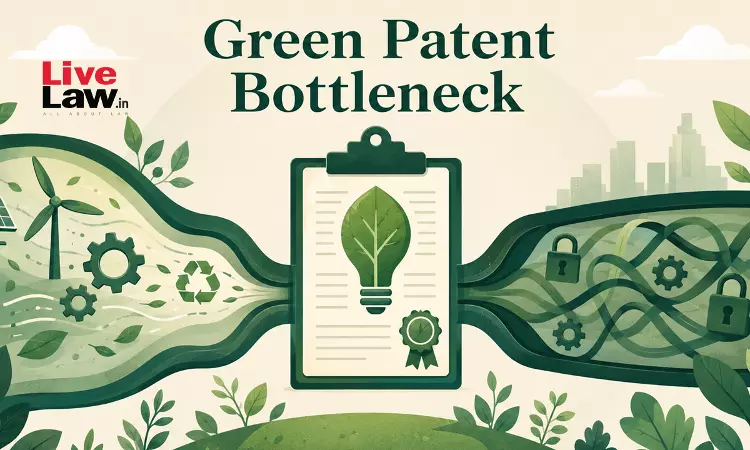
This creates what can be analytically termed a "Regulatory Pincer Movement." Developing nations are penalized for high-carbon production, yet the patented technologies required for mitigation such as high-efficiency green hydrogen electrolyzers and carbon-sequestration modules remain locked behind the exorbitant paywalls of the TRIPS Agreement. The "Green Patent Bottleneck" is thus not merely a commercial hurdle; it is a systemic failure of international law to reconcile the private rights of inventors with the collective survival of the planet.


II. The Jurisprudential Mirage of Article 66.2: A Critique of Voluntarism
An analytical critique of the current IP regime must begin with the systemic collapse of the "Grand Bargain" of 1994. Under Article 66.2 of the TRIPS Agreement, developed nations hold a hard legal obligation to provide incentives for technology transfer to Least Developed Countries (LDCs).[1] In the 2026 reality, however, Article 66.2 has devolved into a "dead letter." Developed states fulfill their reporting requirements by citing private-sector "voluntary" licenses agreements that are commercially prohibitive for South Asian manufacturers and rarely include the high-end innovation needed to meet 2026 emission standards.
This "Voluntarism Fallacy" ignores the structural power imbalance inherent in IP negotiations. By delegating the state's obligation to the private sector, the international community has allowed "Climate Capitalism" to supersede "Climate Justice." From a South Asian perspective, this is a breach of the fundamental principles laid out in Article 7, which dictates that the protection of IP should contribute to the "dissemination and transfer of technology."[2] When technology transfer becomes an act of corporate charity rather than a statutory mandate, the developmental goals of the Global South are effectively subverted.
III. The “Climate Emergency” Doctrine: Moving Beyond the Doha Precedent
To dismantle this bottleneck, legal scholarship must pivot toward a "Climate Emergency Waiver" that transcends the logic of the 2001 Doha Declaration on Public Health.[3] While the Doha model proved that the WTO could prioritize "Public Health over Patents" during a crisis, the climate emergency presents a more complex "Interface Problem." Unlike a vaccine, "Green Tech" is not a single product but a convergence of hardware, software, and industrial processes.
Therefore, a unique legal argument must be raised. In 2026, Climate-Essential Technologies (CETs) must be recognized as possessing a "Jus Cogens" character. These are obligations so fundamental to the preservation of the human race that they should override standard commercial IP protections. Under the "Public Interest" exception of Article 8.1, the Global South can argue that the existential threat of climate change constitutes a "State of Necessity," justifying a broad, time-bound waiver on IPR for technologies related to renewable energy and carbon mitigation.[4]
IV. The Trade Secret Trap: The Invisible Patent Wall
The final, and perhaps most insidious, barrier to green technology is the "Trade Secret Trap." In 2026, many green innovations are no longer shielded by patents which eventually expire and require public disclosure but by perpetual trade secrets under Article 39.[5] For a South Asian manufacturer, having a patent waiver for a solid-state battery is functionally useless without the proprietary "know-how" of the chemical stabilization process.
An analytical solution requires the WTO to adopt a "Forced Interoperability Standard" for CETs. The argument is simple: if a technology is marketed as "Green" to benefit from carbon credits or green subsidies in the Global North, its fundamental "know-how" must be contributed to a Global Green Commons. This would transform Article 39 from a shield for "Exclusive Control" into a conduit for "Compensated Access." The goal is not to abolish profit, but to prevent a scenario where a single corporation's trade secret becomes a bottleneck for the entire planet's survival.
V. The Enforcement Paradox: BNS 2023 and Digital Forensics
One must also view this through the lens of domestic enforcement and the Bharatiya Nyaya Sanhita (BNS) 2023. In the 2026 landscape, "electronic records" and digital forensics are central to proving IP infringement[6]. If the Global North continues to deny technology transfer, we may see a rise in "Compulsory Reverse Engineering."
If an Indian firm utilizes an AI-driven tool to "guess" a trade secret for carbon capture, does it constitute a criminal act under the new BNS framework, or is it a justified act of "Climate Survival"? By failing to provide a legal channel for tech transfer, the TRIPS Agreement is inadvertently pushing developing nations toward a digital "Gray Market" for innovation, where the line between "theft" and "necessity" becomes blurred by the urgency of the climate crisis.
VI. Reclaiming the South Asian Developmental Space
The "Green Patent Bottleneck" represents the ultimate test of technological sovereignty. The 2026 Amendments to the IT Rules and the broader evolution of the IPR regime must reflect a simple truth: you cannot tax the poor for their carbon while locking the tools to reduce it in a safe.[7]
A Climate TRIPS Waiver is not a radical demand for a handout; it is a corrective measure to restore the "Grand Bargain" of international trade. If the WTO cannot evolve from a protector of R&D rents into a facilitator of global resilience, it risks total delegitimization in the eyes of the Global South.
Agreement on Trade-Related Aspects of Intellectual Property Rights art. 66.2, Apr. 15, 1994, Marrakesh Agreement Establishing the World Trade Organization, Annex 1C, 1869 U.N.T.S. 299 [hereinafter TRIPS Agreement]. ↑
Id. art. 7 (emphasizing that IP enforcement must facilitate technology transfer in a manner conducive to social and economic welfare). ↑
See Declaration on the TRIPS Agreement and Public Health, WT/MIN(01)/DEC/2, 41 I.L.M. 746 (2002). ↑
TRIPS Agreement, supra note 1, art. 8.1 (allowing members to adopt measures necessary to protect public health and nutrition, and to promote the public interest in sectors of vital importance). ↑
See Sovereignty, Property and the Climate Crisis, 139 Harv. L. Rev. 1422 (2026) (analyzing the impact of trade secrets on South Asian decarbonization). ↑
Bharatiya Nyaya Sanhita, 2023, § 2(10), No. 45, Acts of Parliament, 2023 (India) (contextualizing the role of digital evidence in the 2026 legal landscape). ↑
See Google LLC v. Equustek Solutions Inc., [2017] 1 S.C.R. 824 (Can.) (discussing the technical challenges of global orders which can be applied to the "3-Hour Paradox" of green tech takedowns). ↑
Views are personal.


