



The Inimitable C.K. Daphtary
V. Sudhish Pai, Senior Advocate
1 April 2026 11:03 AM IST
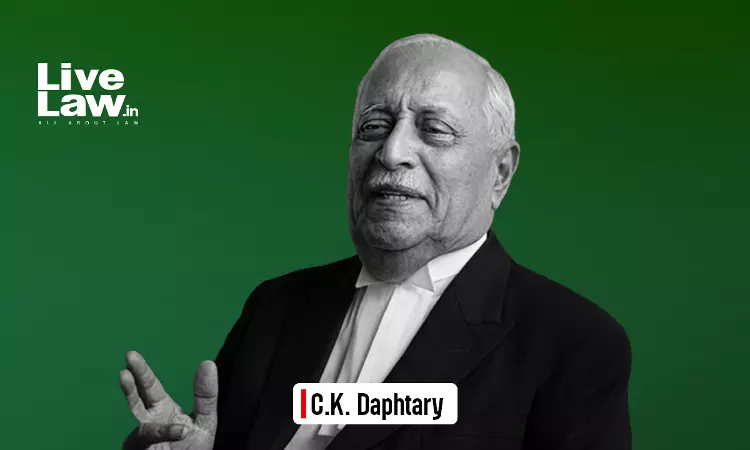
C.K. Daphtary is a jewel of the legal profession in India. He occupied the high offices of Solicitor General and Attorney General and by his superior powers of advocacy and the warmth of his personality carved for himself a unique niche amongst the immortals in the world of law. It is appropriate to remember him and salute his memory on his birth anniversary.
Chander Kishan Daphtary affectionately called C.K or Chandubhai was born on 1st April, 1893. It was Hanuman Jayanti according to the Hindu calendar. At a very young age he went to England and was under the care of an uncle. He had his education at St. Paul's and then at Magdalene College, Cambridge where he read Classics and graduated with a first class. He was called to the Bar from Lincoln's Inn in January 1917. Returning to India he joined the chambers of J.D. Inverarity, the doyen of the Bombay Bar and one of the greatest lawyers ever. Thus began a legal career bright and glittering as any and equally charming.
Chandu Daphtary by the force of his personality, his charming arguments and above all his ready wit, apart from his mastery of facts and law soon worked his way up and by the 1930s he was in leading practice. In the first Prohibition case in the Bombay High Court in 1940- Emperor v. Chinubhai Lalbhai, (1940) 42 Bom LR 669 Daphtary assisted M.C. Setalvad, then Advocate General of Bombay appearing for the Government. Thereafter there was no looking back. Daphtary succeeded N.P. Engineer as Advocate General of Bombay in 1945. He held that office with great distinction and success from 1945 to 1951.


Chief Justice Y.V. Chandrachud remembered that while Daphtary was Advocate General, he would rush to the court on being informed that his case was about to be called out. He would leave his cigar on the broad stone railings outside the court room and then go in. The argument over, he would pick up the cigar, light it and go back to his chamber. Young lawyers used to chase the cigar to seek Daphtary and hear his argument.
As Advocate General it fell to Daphtary, never a teetotaller, to defend the Prohibition Act—Balsara's case before a powerful Full Bench of Chief Justice Chagla and Justices Tendolkar and Gajendragadkar. It is well known that Daphtary had really no heart in defending the Government's stand. Indeed at a Bar function in 1950 to celebrate the event of India becoming a Republic, Daphtary, in the course of a brilliant speech that he made, jocularly said that our republic without a 'pub' was only a 'relic'! In Balsara's case Daphtary famously said, “Surely it is known and experience teaches us that alcohol is not the only thing which intoxicates, whether it be the weak or the powerful.” And then to a query from Chagla as to what was the greatest intoxicant, he replied, “Power, my Lords.” The Act was upheld as a whole but certain provisions were struck down.
In the appeal before the Supreme Court Justice Patanjali Sastri asked Setalvad when he was arguing for the State as to what a 'peg' was and what 'liqueurs' were and so on. Genuinely unaware of all that, Setalvad told the judge that Daphtary was fully familiar with all these matters and he would explain them completely to the judge's satisfaction. Daphtary rose and succeeded in answering all questions put to him by Sastri, J. amidst laughter in the court room. The State appeal was allowed.
In the Sausages case, as soon as the case was called, Chief Justice Chagla asked Advocate General Daphtary whether he would seriously suggest that cocktail sausages constituted a course. Daphtary with his usual fair mindedness immediately answered, 'No, my Lord, I cannot in honesty say so.' That finished the appeal and the conviction for breaching the sumptuary law by serving a course- cocktail sausages- at a dinner was set aside.
Daphtary was appointed as the first Solicitor General of India in May 1951 which office he filled with great dignity and eminence. Daphtary succeeded Setalvad as Attorney General and held that office with equal distinction from 2 March, 1963 to 30 October, 1968. He was thus a law officer at the State or Centre for a continuous period of over 23 years.
Daphtary was jovial and easy going. He enjoyed every moment of his appearances and arguments in court; his sense of wit and humour would never forsake him. He was simply charming all the way. Daphtary was aristocratic in his tastes and believed in the good things of life. Daphtary once told Chagla that his philosophy in life was minimum work in return for maximum result and he practised it to perfection. His arguments were always brief and to the point expressed in his inimitable style and always lightened up by an unfailing sense of humour. He never believed in overworking. Thus while he had no pretensions of burning midnight oil over his briefs, he was rarely taken by surprise by an unforeseen situation during arguments. It is said that he succeeded in his cases because he could make a wise choice of the points to be put in the forefront anticipating the queries and reactions of the court and he was thorough with those points.
Daphtary was an institution, numerous are the stories and anecdotes associated with him. It is said that there is hardly a courtroom in the Supreme Court and the major High Courts which has not a story to narrate of some lively remark or telling argument of Daphtary much to the discomfiture of a bloated person, whether at the Bar or on the Bench. He was a powerful advocate, dignified and unruffled, correct in his behaviour and deferential to the court, never throwing his weight around, but the abrasive and the rude, the pompous and the presumptuous had it, for, with such persons he was merciless and unsparing, a trait he shared with F.E. Smith (later Lord Birkenhead). He could be firm-even a trifle unpleasant- if someone acted pompously, he hated pomposity. Such moments would produce a flash and he would come out with something so telling and spontaneous, something which became a part of the legal annals.
C.K. Daphtary was perhaps the finest advocate in the country. He was a friendly person, full of humour, always ready for a joke in court or outside. His court-craft was superb. He was never tense and could not be easily perturbed. If he was ever cornered by the Bench over a point he sought to argue he would overcome the predicament by narrating an anecdote or two. Gajendragadkar, CJ said that Daphtary knew how to handle judges. He did not set the judge against himself. If a judge chose to be rude or otherwise spoke slightingly about his arguments, Daphtary knew how to meet the situation effectively without appearing to be rude or impertinent. However, when the occasion so required his retort was very telling and quietened the opponent or the judge.
Once Daphtary was arguing before his friend Justice Somjee who had then recently gone to the Bench. In the midst of the argument a book that Daphtary was relying upon was handed over to the judge. Interrupting Daphtary, the judge remarked that there was a bug in the book. And Daphtary responded looking straight into the judge's eyes, 'Oh, a very ambitious bug, my Lord, to have travelled from the Bar to the Bench.'
On another occasion Daphtary was arguing an appeal before a Division Bench of the Bombay High Court. F.S. Nariman was his junior in that case. The junior judge who was quite young on the Bench repeatedly interrupted Daphtary with irrelevant questions. Daphtary who was generally unruffled was very irritated at one point. He said that the proposition put forward by the judge was preposterous and did not call for any response. He threw down the paper book and sat. He had to be persuaded by the senior judge to resume his arguments which he did. There were no further interruptions. The junior judge did not open his mouth till the case was over.
In a case before Justice D.P. Madon in Bombay when Daphtary rose to reply to Nariman's arguments he cleared his throat and coughed a couple of times compelling the judge to enquire whether he was not feeling well and he would like to sit down and have a little water. Then Daphtary characteristically said, 'No, no my Lord. It is nothing to do with my throat. It is the arguments of my learned friend- I just cannot swallow them.'
In the famous Rama Krishna Dalmia case, in the Bombay High Court the Government's turn came at about 3.45 pm about an hour before the rising time of the Court. The Division Bench presided over by Chief Justice Chagla appeared to be against the Government. Daphtary was the Solicitor General and was appearing for the Government. Soli Sorabjee was assisting him. Daphtary rose incredibly cool, made some general observations, parried the pointed arrows from the Bench with finesse, brushed aside the authorities that were handed over to him and then made the unforgettable statement in his characteristic style: “My Lords, several cases have been cited by my learned friends on Article 14. I will deal with them, all of them. But then there is one underlying principle. Article 14 is not infringed if the people are not of the same kidney. Dalmia and others are not of the same kidney.” A slight smile escaped Chagla's lips as he said 'You mean, Mr. Solicitor, that Dalmia's kidneys are worse than those of the others.' Pat came the rejoinder: 'The question, my Lords, is not whether their kidneys are better or worse. The point is that the kidneys are not the same.' The companion judge Justice S.T. Desai could not resist saying: 'Your point, Mr. Solicitor, is if kidneys are different Article 14 does not apply.' 'Precisely, my Lords' was Daphtary's smiling reply. By then it was 4.15 pm only half an hour left for the Court to rise. Repeated allusions to kidneys lightened the atmosphere, the judges were not so indignant and the Daphtary turned and said, 'Now let us have the authorities.' It was smooth sailing thereafter and the Government won. Daphtary's performance was a veritable feat of superb skill and masterful advocacy.
Then again Daphtary was arguing in the Supreme Court before a Bench of which J.C. Shah, J. was a member. There was one judgement of Shah in the Bombay High Court- Soonawala which was against his case and Fali Nariman who was briefing him kept on pulling Daphtary's gown reminding him of the case. Daphtary then told the court, “My learned junior is reminding me of a judgement. I am aware of Your Lordship's judgement and it is against me. But that was a judgement you wrote sitting in the Bombay High Court. Now that Your Lordship is in the Supreme Court it is of course open to you to repent.” The other members of the Bench - Kapur and Hidayatullah- enjoyed the fun.
Once appearing for an advocate who along with his wife, had pleaded guilty of shoplifting in London, Daphtary said that they could not be expected to do anything else in a far off country than be done with the whole matter by paying a small fine. The Chief Justice interrupted to say that the client had taken things for granted and hence must suffer. Daphtary said that we all take things for granted to which the response from the Court was that it was too bad. And Daphtary retorted: 'For instance, we even take it for granted that Your Lordships know law.'
During the hearing of a complicated case the judge said, 'Mr. Daphtary, are you not aware this case is covered by a decision of this Court.' And Daphtary retorted: 'But the trouble is that it has been uncovered by another decision.'
Daphtary's performance as Attorney-General in the famous Parliamentary Privileges case was typical. It was a Presidential reference. But the contest was essentially between Seervai appearing for the UP Legislative Assembly and Setalvad for the Allahabad High Court judges. When the case was called out before a tense Constitution Bench in a packed court room at a special sitting during the summer vacation, Daphtary addressed the Court: “My Lords, I am here only as a marshal to introduce to you two valiant deadly combatants in a joust. I take no part in their fight,” and sat down. The rest is well known.
He was genuinely concerned about and extremely helpful to the juniors who always looked up to him for guidance and protection and encouragement. F.S. Nariman to whom Daphtary was always 'CK' remembered and treasured his advice: Always remember, Fali, it is better to spend more time thinking about a case than merely reading the brief. Daphtary himself was an outstanding example of that practice. The Poona Municipal Corporation passed a resolution condemning Soviet Russia's incursion into Hungary and the killing of Hungarian leaders. The Communists challenged the resolution as being way outside the powers and functions of the Corporation. That contention found favour with the single judge of the Bombay High Court who declared the resolution ultra vires. In appeal, Daphtary contended before the Division Bench that the Municipal Corporation was nothing but the city fathers, the father could always tell the children what was right and what was wrong. Killing anyone anywhere was not good and it was morally wrong; that was all that the resolution of the Corporation said and no fault could be found with that. The appeal was allowed. It was Daphtary's thinking which won the case, a hopeless case for the Corporation and an unanswerable case for the petitioner.
In around 1970, Fali Nariman came from Bombay to appear for the appellant in the Supreme Court. Daphtary was for one of the respondents. When Daphtary's turn came to address the court, Fali objected that while Chandubhai's client had appeared in the trial court he didn't do so in the appeal court; therefore he had lost the right to pursue the matter in further appeal in the Supreme Court. To this CK replied, “Justice is like a slow train. You get off at one station and then run and catch it at the next one.” This brought the house down; the objection was rejected and Daphtary was allowed to present his case.
Soli Sorabjee recalled what was perhaps his first significant case in the Supreme Court. It was something relating to citizenship. He had prepared himself thoroughly and believed that he did his case well. Up rose his opponent- Daphtary as Law Officer appearing for the Union Government and within a few minutes demolished Sorabjee's arguments. The case was over. The then young Soli with a sense of dejection and sadness tied up his papers and was about to leave the court when there was a tap on his back. And lo it was Daphtary with a word of encouragement and consolation: 'Young man, you have done well. Don't worry these things keep happening.' It was such a tonic says Sorabjee and from then on Daphtary was always Chandubhai. He would enquire of you, your profession and your family, encourage you and shower his affection in which you loved to bask.
Dr. L.M. Singhvi remembered an election appeal in which he appeared for the election petitioner and Daphtary led a team of distinguished lawyers for the successful candidate, a Cabinet Minister. By sheer advocacy Daphtary had torn to pieces the argument of the petitioner though after many days of argument the court was eventually persuaded to the petitioner's point of view. And Singhvi says that his greatest reward was the very generous and sincere appreciation from Daphtary.
Daphtary was waiting for his case in the Bombay High Court. When the English judge passed an order in the case of a young advocate which he had not expected, the youngster burst out- 'I am surprised at the order that Your Lordship has passed.' The judge took exception and said the remark amounted to gross contempt of the court and asked Daphtary how he would like the young man to be dealt with. Daphtary, turning to the young advocate, told him, 'Young man, if only you had been at the Bar as long as I have been, you will never be surprised at anything that His Lordship does.' The judge had a hearty laugh and the young man faced no consequences.
It is said that while at the height of his practice, Daphtary had hardly any equal for persuasive reasoning and presenting a case by appealing to the common sense of the judge. His methods were straight and simple and he went about his work with minimum fuss. He was a very fair lawyer who would never put his case too high and would readily acknowledge the defects of his case with disarming frankness. As Chief Justice Yeshwant Chandrachud said, “Even at the height of his powers he never bullied or challenged the Judge. His most formidable weapon was his air of reasonableness and his mastery over words which he used for making his point with the aid of homely similes. He did not challenge. He charmed. And his opponents were not called upon to yield, often the opposition dissolved.”
In one case before the Supreme Court, it happened that between Daphtary and another counsel there was only one brief. Daphtary told the court that while he had the brief he knew nothing about the case and the other counsel knew everything but did not have the brief. He proceeded to say, “My Lords, it is a fashion for a soldier to die with his boots on. But it is not a fashion for a judge to die with pen in his hand. A very heavy matter suddenly collapsed because one of Your Lordships fell ill. So why not rise and relax.” The court rose to the relief of all.
Daphtary was shrewd and deft. He could make the most intricate proposition look simple and obvious. He was never bookish. His knack of understanding law and facts swiftly and stating everything crisply was superb. As an arguing counsel, he delivered easily. At times when he thought that the court took too articulate or vigorous a position with which he could not agree he would firmly say so, pass on to another point and come back to it with persuasive charm and in a more receptive ambience.
As a man he was courageous and fearless, candid and uncompromising when it came to fundamentals, but otherwise as a liberal and moderate he was always prepared to see and accommodate the opposite point of view. His leadership was wise and farsighted.
Before a bench presided over by Chief Justice Gajendragadkar, dealing with some land acquisition for a co-operative society, Purushotham Tricumdas appearing for some interveners requested the Chief Justice to recuse himself as he appeared to have some pecuniary or proprietary interest in the matter. Sensing the Chief Justice's reluctance, Daphtary who was the Attorney General appearing for the Government, strongly supported the recusal application saying that in the circumstances it would not be appropriate for the Chief Justice to be on that Bench in as much as no party should have even a feeling of possible bias in the highest court. It may be said to his credit that Gajendragadkar withdrew from the Bench. The Bench was reconstituted with Subba Rao, J. presiding. The rest is history. The Act was struck down as discriminatory – P. Vajravelu Mudaliar v. Special Deputy Collector for Land Acquisition, AIR 1965 SC 1017 and N.B. Jeejeebhoy v. Assistant Collector, Thana Prant, Thana, AIR 1965 SC 1096.
Speaking in the Rajya Sabha after the first supersession of judges in 1973, Daphtary capturing the mood of large sections of the legal fraternity said inimitably that the boy who wrote the best essay got the first prize. The allusion was to Justice A.N. Ray's sole dissent in the Bank Nationalisation case and his elevation as the Chief Justice of India.
Again when the infamous Habeas Corpus case (ADM Jabalpur) was to be heard and the Bench was constituted with some junior judges, Daphtary walked into the Chief Justice's chamber and requested that in such an important and sensitive matter it would be appropriate for the senior most judges to be on the Bench. Chief Justice A.N. Ray felt piqued and asked since when the Bar had a say in the composition of the Bench. Daphtary non-chalantly told Ray: 'Much before you came to this Court. I do recollect that once when Chief Justice S.R. Das was told about the composition of a Bench he never took it ill.' And then referring to the earlier occasion said that that tiger of the Bar Purushotham Tricumdas had asked Justice Gajendragadkar to recuse himself and the Chief Justice then had the courtesy and the good sense to accept the suggestion. Ray reconstituted the Bench with the senior most judges except Justice Mathew who was due for retirement shortly. It is, of course, a different matter that the reconstitution did not yield the desired result except for Justice Khanna's famous dissent.
Daphtary had a silver tongue and a fine sense of humour. He did not have fun or humour by gossiping about people. He disliked idle gossip. Lord Chesterfield had said that wit is so shining a quality that everybody admires it, most people aim at it, all people fear it and few love it except in themselves. Daphtary used his wit with good nature to put everyone at ease and to make his point without hurting. He was both a carrier and creator of anecdotes. He was an excellent conversationalist. He was a great raconteur who would tell his story with a mischievous twinkle in his eye and evident enjoyment both in the tale and in the telling.
Wit and humour, particularly in court, appear to have become extinct today. We remember Chandubhai for that reason also. Perhaps no lawyer, in India at least, comes anywhere near Daphtary as a master of wit and humour that was present for every occasion and directed equally at everyone. He could always poke fun at himself and enjoy a joke at his expense. Fali Nariman remarked that Daphtary had the special quality of concealing much learning and pathos with abundant humour- the rare gift of using the right word in the right place- what the French call mot juste.
To a dear young friend who had been on the Bench a few months and had begun to put on a little weight, Daphtary said, 'You know, once on the Bench you are expected to broaden your mind and not your seat.'
There was a function in the Bombay High Court to unveil the portraits of retired judges. In the course of the usual speech for the occasion Daphtary added: “I have no doubt that in course of time, all your Lordships would be duly hung.”
An assailant had made an attack on the judges in the Supreme Court and one of them-master of wit Justice Grover suffered a gash on his head. Daphtary went to look him up and after making enquiries and being assured that all was well said: “These assassins, they are most dastardly. They always attack you on your weakest part.” The judge was at first taken aback, but noticing Daphtary's mischievous smile he had a hearty laugh.
One afternoon when Daphtary was arguing in the first court there was power failure for a while and the work stopped because of the darkness. Chief Justice Gajendragadkar jocularly observed: Look Mr. Daphtary where have your arguments led us to. It happened that then the table lamp on the Chief Justice's table flickered and soon the light came. Quick came Daphtary's repartee: My Lord, the light has come where it is needed most. There was all round laughter in the Court.
Daphtary and his wife Sushila (Cicily) made a remarkable couple deeply devoted to each other. She was an ideal consort and companion to that many splendoured person. At a function to celebrate their fiftieth wedding anniversary, Daphtary replying to the felicitations and stealing glances at his wife remarked: She has been my wife for 50 years. She has been a good wife but in a married life of this length I must frankly confess that the first 49 years have been the most difficult.
Daphtary appeared as counsel for India before the International Court in the Kutch-Sind border dispute between India and Pakistan. After demitting office as Attorney General, Daphtary was nominated as a member of the Rajya Sabha. He was also elected as President of the Supreme Court Bar Association for four terms. In all this he played his part admirably well. He was awarded the Padma Vibhushan.
Daphtary passed away on February 17, 1983, he was in his 90th year. With his death an era came to an end. Carlyle wrote that a well written life is almost as rare as a well spent one. Daphtary's life was truly rich and well lived. Words cannot capture and contain a life so rich and colourful and sparkling. He lived a magnificent life but left behind no reminiscences, memoirs or autobiography. He said, 'the unwritten autobiographies are the best.' Daphtary was unique in more ways than one. He was in a class by himself. It would be difficult to find another like him.
Author is Senior Advocate at Supreme Court of India. Views Are Personal.


