Colonial Policing In Constitutional Democracy
Yashwant Singh
28 Aug 2026 8:00 PM IST
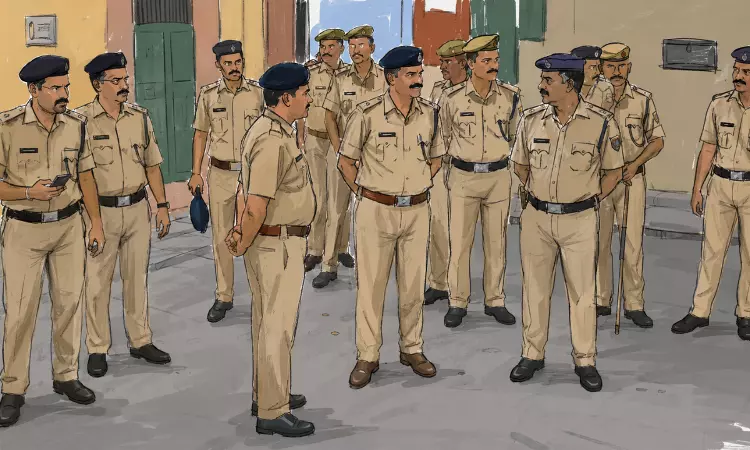
The last few months have rekindled an important debate in the country. What we have witnessed in the national capital and elsewhere ought to make us reconsider whether the paradigms that continue to govern our policing are suited to the constitutional democracy we have become. It is time that we reconsider if the purpose of our policing has to be fundamentally coercive. A closer look explains why the colonial inheritance of Indian policing rationalizes force being so deeply embedded in the institutional response to dissent.
The revolt of 1857 shook the British Raj. The uprising had demonstrated why the existing mechanisms of colonial governance had outlived its use. It had shown that if the British masters wanted to continue ruling over the Indian subcontinent, a major overhaul was warranted. The colonizers realized that they required a more coercive presence in the everyday life of its subjects.
So, amendments were accordingly made. The Government of India Act, 1858 was enacted which transferred control from the East India Company to the Crown. However, they realized that they needed a more permanent instrumentality to ensure that any further discontent in the subjects can be effectively curbed locally before it turns into a mass movement. It was in this pretext that the Indian Police Act of 1861 was enacted.


Conceiving Control
The Indian Police Act, 1861 was a legislation designed to suppress resistance and ensure obedience. The enactment was drafted in such a manner that command flowed downward and accountability flowed upwards. The senior officials, who were usually Europeans, exercised all control without any participation or involvement of the local communities. It was fear that had forged the law, and therefore every attempt was made to ensure that policing was oriented to prevent discontent turning into a movement. The fragmented local administration during the East India Company gave way to centralized provincial hierarchy with a permanent local surveillance network. The British did not merely seek a more efficient crime-fighting institution; they sought a force capable of penetrating Indian society, gathering intelligence, protecting revenue, enforcing executive authority, and suppressing collective resistance and dissent before it matured into rebellion.
From Subjects to Citizens
From the shadow of 1861 to the constitutional present, India has undergone a profound transformation. The character of Indian society has evolved, and so has the manner in which the State engages with the individual. Today, the government derives its legitimacy from collective consent of the people. The individual can no longer be reduced to an object of control but has been elevated to the holder of rights by our Constitution. This constitutional transformation has brought with itself enforceable rights which are guaranteed to every citizen. Articles 14, 19, 21 and 22 of the Indian Constitution inter alia, have transformed all of us into constitutional equalizers to state power and we no longer are mere subjects who ought to be governed.
Another key change that has happened over time is that public manifestation of dissent has acquired constitutional legitimacy and our set notions of 'public order' have evolved. Today, legitimate dissent is a distinguishable feature of our democracy. The state is not merely an enforcer of order and the policing is not just restricted to curbing disturbances. Our notion of 'public order' have transformed from mere 'absence of disturbance' to constitutional management of conflicts and competing interests. The Second Administrative Reforms Committee in its 5th Report on Public Order (2007) recharacterized 'public order' as managing conflict and regulating State power, rather than merely controlling people; emphasizing accountability, rights and consensual equilibrium. The Supreme Court in a 5-judge bench decision (Kameshwar Prasad vs State of Bihar (1962 INSC 67), in 1962, had opined that “demonstration is a visible manifestation of the feelings or sentiments of an individual or a group. It is thus a communication of one's ideas to whom it is intended to be conveyed. It is in effect therefore a form of speech or of expression”[1]. Further, in the same year the Supreme Court in another landmark decision categorically held that “criticism of public measures or comment on Government action, however strongly worded, would be within reasonable limits and would be consistent with the fundamental right of freedom of speech and expression.” (Kedar Nath Singh v. State of Bihar, 1962 INSC 17) [2]. So, dissent and consequent demonstrations today are no longer the antithesis of public order, they are indicators of a functioning democracy and a measure of its vitality.
When Public Order Changes, Policing Must Change
These changes require a fresh examination of the role and performance of the police both as a law enforcing agency and as an institution to protect the rights of the citizens enshrined in the Constitution. When the social and constitutional context in which policing operates have undergone a metamorphosis, it becomes imperative that the role and design of the police in the country is reexamined. These changed times require the police to operate with abilities beyond coercion and suppression. Concepts like communication, de-escalation, right sensitive crowd management need to form the backbone of modern-day policing.
The Government of India in 1977 had appointed a National Police Commission (NPC) to comprehensively review the police system at the national level after independence considering the radical changes in the political, social and economic situation in the country. This Commission produced 8 reports, wherein key recommendations on the notions of professional independence of police, security of tenure, separation of investigation from law and order and etc. were made.[3] However, all these recommendations remained only on paper. In 1996, Prakash Singh and other retired police officers approached the Supreme Court (Prakash Singh vs UOI 2006 INSC 642), seeking implementation of the NPC recommendations.[4] During the pendency of these proceedings the court directed the Government to have the NPC recommendations reexamined. Consequently, Another Committee under Mr. J.F Ribeiro was constituted in 1998. The Ribeiro Committee submitted two reports in 1998 and 1999 wherein it largely endorsed the recommendations of the NPC.
After the Ribeiro Committee, the reform agenda widened. The Padmanabhaiah Committee (2000) examined how policing needed to be modernised, while the Malimath Committee (2000–03) examined police reform within the broader criminal justice system. The Sorabjee Committee (2005–06) then took the final legislative step by drafting a new Police Act. By the time Prakash Singh was decided in 2006, decades of recommendations had produced little implementation; prompting the Court to conclude that there could be “no further wait.”[5] In Prakash Singh vs UOI, the Supreme Court issued seven binding directions to the Union and State Governments to restructure policing, pending the enactment of appropriate legislation and endorsed that a legislative change is warranted to give the recommendations enforceability.
The Reform that Remains Unfinished
Although the Supreme Court passed directions, 'Police' being a state subject, the implementation of those directions depended substantially on the State Governments. While the Union Government did circulate a Model Police Act in 2006, to all states with a request to enact new laws, the implementation was not consistent. Some States did enact a new legislation or amended the existing legislations but a nationwide overhaul of the 1861 Act did not happen. While the Supreme Court is continuously dealing with applications concerning compliance with its directions – but the loss of discretionary control over policing is something that the politics of day is not agreeable to. These reforms hit at the relationship between the police and the political executive that is required to implement it. A political class that still relies on the police force to assert its authority, is reluctant to carry out reforms that will insulate the police from their political control.
As a result of the same, the police force in this constitutional democracy is still operating within the shadows of a colonial framework. We are still far away from a right based policing model that treats peaceful assembly and dissent as constitutionally permissible activities. Appointments, transfers and every other aspect of policing is not insulated from political interference. Investigation and Law and Order management and the diverse needs that both these facets have are still intertwined. This means compromising with investigative integrity and focus to the more pressing demands of maintaining order.
Also, accountability in constitutional policing cannot be just internal. It is high time that independent avenues are created through which citizens can seek answers on arbitrary exercise of power, custodial violence, unlawful restrictions and other abuses. As integral stakeholders – citizens should be made a part of the accountability mechanism to ensure that the exercise is extended beyond departmental discipline. The force manifesting the coercive power of the state cannot be made the sole judge of its own conduct. Having said that adequate measures need to be incorporated to resist political interference. Political Insulation and Public Accountability cannot be understood as competing interests any more. This would also warrant a fresh discussion as to what accountability would mean while responding to dissent. In a constitutional state accountability must not only be restricted to evaluating the outcome of policing, the legality and proportionality of the means adopted to achieve the same also should be examined. One thing that the present times have taught us is that the constitutional right to dissent cannot be subjugated to the discretion of the officer tasked with maintaining public order.
The Colonial model of policing sees public order and individual liberty as competing interests. Hence every dissent is perceived to be a 'disorder' and the police force responds in the only manner it is equipped to. Till the time concepts like negotiations, dialogue and public accountability for actions are not statutorily embedded in the policing framework, the coercive culture is bound to reproduce itself. All of this requires an institutional change which cannot be secured or sustained without a change in the legal framework. The institutional architecture of our policing is designed by the 1861 Act which lies at the heart of every issue. A law whose, foundational premise belongs to a different era cannot be saved by amendments and modifications, it requires an overhaul. An overhaul that begins from the Constitution and a contemporary understanding of policing and public order.
With decades of commissions, recommendations and judicial decisions serving testament, the inference is very clear – the 1861 Act must give way to a modern, evolved and constitutional framework of policing. An institution that is entrusted with the coercive power of the State needs to be brought in alignment with Constitutional values of liberty, accountability and democratic dissent. The problem is institutional; therefore, it should be remedied institutionally. Without changing the legal architecture that sustains the existing model, meaningful transformation will remain elusive.
Kameshwar Prasad v. State of Bihar, 1962 INSC 67 ↑
Kedar Nath Singh v. State of Bihar, 1962 INSC 17 ↑
National Police Commission, First Report (1979); Second Report (1979); Fourth Report (1980); Fifth Report (1980); Sixth Report (1981); Eighth Report (1981), Government of India ↑
Prakash Singh vs Union of India 2006 INSC 642 ↑
Supra 4. ↑
Author is an Advocate-on-Record, Supreme Court of India. Views are personal.