



Constitutional Pathology Of Delayed Adjudication: Reservation Without Preservation
Biswajit Mohapatra
10 Jun 2026 8:50 PM IST
Cessante ratione legis, cessat ipsa lex- when the reason for a law ceases, so does the law. Few maxims have travelled as quietly through the centuries, and fewer have aged with such inconvenient accuracy. It is among the boldest claims the common law has inherited, and for that reason among the most decorated and the least invoked. Treatises preserve it, judgments invoke it with deliberation, and its actual application has remained rare by design. To apply it is to assert that a law, though intact in form, has ceased to live, and the legal order that takes the assertion seriously must be prepared to recognise its own dead matter. It was framed to address laws that outlasted the conditions that authored them, and to give jurisprudence a principle for recognising the difference between legal continuance and legal life.
The maxim was framed for laws, but its logic extends beyond the rule itself: any legal arrangement that draws its life from a purpose must answer to the same principle. Modern adjudication has refined a practice the classical tradition rarely confronted at scale. Where the matter before a court concerns the exercise of executive power that consummates itself in operation, the court's own management of the matter, during the period of its consideration, consumes the conditions under which the eventual judgment could have constituted its question. The interval is constitutive: while it runs, the terrain that gave the challenge its meaning is reshaped by the very conduct the challenge sought to interrogate. The practice is not new, nor confined to a single court, though its recurrence has more often been noticed case by case than named as a single phenomenon. What follows attempts that naming.


Examples from recent decades will serve memory best. The November 2000 Presidential election produced a contested margin in Florida. On 8 December, the Florida Supreme Court ordered a statewide manual recount of uncounted ballots under Florida election law. Counting began. Within twenty-four hours, on 9 December, the United States Supreme Court, in Bush v. Gore[1], issued an emergency stay halting the counters, admitted the matter for expedited review, and set a compressed briefing schedule. Oral argument was heard on 11 December. The decision was delivered late on 12 December, the day on which the federal safe-harbour deadline fell. The safe harbour is the date by which a state's certification of its presidential electors is treated as presumptively conclusive under federal law and shielded from challenge in Congress. Within this three-day window, the Court took up the matter, halted the recount in progress, conducted briefing and argument, and produced an opinion. A 7–2 majority found that the manual recount lacked the uniform statewide standards required by the Equal Protection Clause, the absence of which produced disparate treatment of ballots across counties. A 5–4 majority held that no recount under proper constitutional standards could now be undertaken, because the time within which such a remedy could operate had passed. The defect was named, and the cure was barred by the calendar. The certified result was permitted to stand. Justice Souter, in dissent, exposed the structural contradiction within the majority's reasoning. 'If this Court had allowed the State to follow the course indicated by the opinions of its own Supreme Court', he wrote, 'it is entirely possible that there would ultimately have been no issue requiring our review.' The three days the Court had taken were the very days within which the recount might have completed under the Florida court's direction. By halting the counters and managing the matter through its own procedural architecture, the Court had consumed the time it then declared unavailable. The scarcity of time was not a fact the Court discovered, but a fact the Court produced.
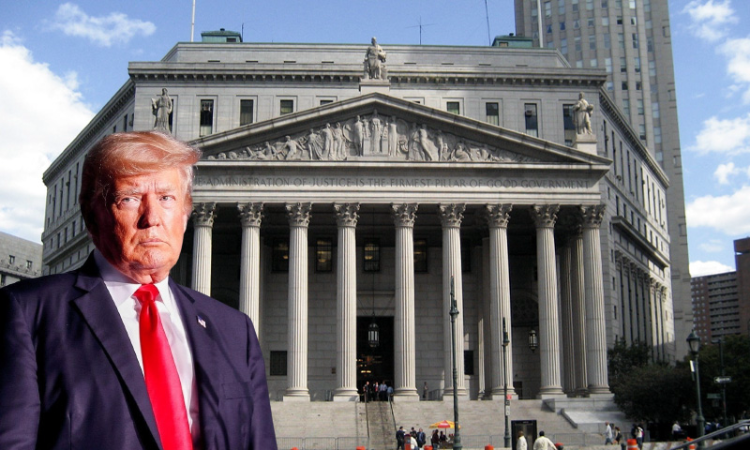
People of the State of New York v Donald J. Trump[2] offers a second instance of the same pathology. On 30 May 2024, a Manhattan jury returned a unanimous verdict of guilty on 34 felony counts of falsifying business records against a former President of the United States. The question the criminal court had been convened to answer had been answered. What remained was the sentence the verdict required. Sentencing was scheduled for 11 July. On 1 July, ten days before that date, the United States Supreme Court delivered its ruling on presidential immunity in Trump v United States[3], dividing conduct in office into immune official acts and non-immune unofficial acts. The trial court was required to reconsider whether evidence admitted at trial fell within the new framework, and sentencing was postponed. A September date was fixed, then vacated and reset for 26 November, to avoid the appearance of judicial interference with the Presidential election then approaching. Yet the election formed no part of the criminal proceeding; nothing in the question of guilt, or in the consequence the law attached to it, turned on who prevailed at the polls. The court did not wait upon an event its proceeding required but suspended a completed criminal question to await one foreign to it. The finding of guilt was what could have influenced the election; sentencing is the criminal law's calibration of consequence. The influence the postponement professed to avoid had already been delivered. What was being withheld was not the proceeding's answer but its execution, and what was being held under the conditions of waiting was the punishability of a convicted defendant whose constitutional position could yet change. The election was held on 5 November. The defendant prevailed. On 3rd January 2025, the trial court ruled that the evidence had been properly admitted because the conduct it documented fell on the unofficial side of the new division. The motion to vacate the verdict was denied. Sentencing was held on 10 January 2025. Justice Juan Merchan imposed an unconditional discharge — a disposition under New York Penal Law that records the conviction while imposing no imprisonment, no probation, and no fine. The reasoning offered was that this was the only legal form by which the jury's verdict could be respected without producing a constitutional conflict with the duties of the office the defendant was about to assume. The seven months between verdict and sentence were the period in which the criminal law's applicability to the convicted defendant was cut down to fit the constitutional position he had since acquired. The verdict survived in form. The punishment the verdict required was foreclosed by the constitutional posture the defendant occupied at the moment of sentencing, a posture the time consumed by the court's deliberation had permitted him to assume. The jury, whose verdict was the operative voice of the public's deliberation on the question of guilt, was given the courtesy of an unconditional discharge — a sentence that records the public's answer while withholding its consequence that the state, in criminal cases, owes to the public.
What both proceedings declined to do is what the maxim's spirit, applied to adjudicative arrangement, demands. Preservation, in each case, lay within the court's reach. In Bush v Gore, the United States Supreme Court could have declined to issue the emergency stay and allowed the recount to proceed under the Florida court's direction. Or, having taken up the matter and found the recount constitutionally defective for want of uniform standards, it could have given that finding its proper consequence: quashed the certified result and directed a recount on uniform standards, allowing the time such a recount genuinely required, or, if no adequate recount could be completed, ordered a fresh election. The safe-harbour date was a statutory convenience; what it was permitted to override was the people's verdict at the ballot, which the constitution exists to register, and no statute may extinguish. In People v Trump, the trial court could have sentenced on the date originally fixed, or on any of the dates available within the window before the election. Or the defendant could have been sentenced after the election, even after the assumption of office, with the verdict given the consequence the law defined for conviction on thirty-four felony counts. Such a sentence would have invited challenge since the Constitution does not permit the prosecution of a sitting President. But the question was a grey one — the crimes had been committed in private capacity, the prosecution had been completed before assumption of office, and the jury's verdict was, in substance, the people's verdict on the question of guilt. A sentence pronounced would have placed the grey question where it belonged, before the federal Supreme Court, for the constitutional law of post-conviction sentencing of a President-elect to be settled in open hearing rather than evaded by unconditional discharge.
The true pathology of these managed delays is not merely that they consume time, but that they manufacture reality. Whether through the three-day window in Bush v Gore, the seven-month interval in People v Trump, or through years in which constitutional and demographic realities are permitted to reorganise themselves through interim measures or judicial reservation itself, the court ceases to stand outside the transformation it was convened to judge. It becomes implicated in the making of the very reality that later confronts adjudication as accomplished fact.
The purpose of a legal proceeding is its legal life , not its continuance on the rolls, but the power of its eventual judgment to constitute the question it was convened to decide. A recount challenge is convened to determine whether an election has been compromised; its purpose is served only if the determined compromise is undone. A criminal trial is convened to determine guilt and to impose the consequence guilt requires; its purpose is served only if the determined guilt is punished. In each case the system performed its forms and discharged none of its functions. The maxim identifies what has died. Guilt without punishment is guilt the law has refused to constitute as such; compromise without remedy is a compromise the law has declined to remove. The proceeding survives. Its purpose does not. This is reservation without preservation: continuance is allowed without preservation of legal life the litigation existed to serve.
A contrary judicial practice demonstrates that courts can master, rather than be mastered by a fluid constitutional timeline. In R (Miller) v The Prime Minister[4], the United Kingdom Supreme Court confronted a constitutional crisis of immediate urgency. On 28 August 2019, Prime Minister Boris Johnson advised Queen Elizabeth II to prorogue Parliament for five weeks, from 9 September to 14 October, during the critical final phase preceding Brexit on 31 October 2019. Because Parliament was actively scrutinising and attempting to constrain the Government's Brexit strategy, the prorogation effectively removed the legislature from the constitutional field at the most consequential moment of the withdrawal process. The prorogation commenced on 9 September, and within days the challenge reached the UK Supreme Court, which responded with remarkable institutional agility by convening a panel of eleven justices, hearing arguments on 17, 18, and 19 September, and delivering a unanimous 11–0 judgment on 24 September. The Court held the Prime Minister's advice unlawful and declared the prorogation null, void, and of no legal effect, following which Parliament resumed sitting the very next day, on 25 September.
The significance of the intervention lay not merely in its substance, but in its timing. Despite operating within an uncodified constitutional structure grounded in Parliamentary Sovereignty, where Parliament remains the supreme legal authority and the Court functions formally as interpreter rather than destroyer of statutes, the judiciary acted decisively to preserve the very sovereignty that the executive action had sought to disable in practice. More importantly, the impugned act was undone within the exact constitutional moment that gave rise to the dispute. The core condition upon which the controversy depended, Parliament's ability to sit and deliberate before the Brexit deadline, remained alive when the judgment was rendered, allowing the judicial answer to directly resolve the live constitutional injury itself. This is adjudicative coevality: the judicial answer occupying the same constitutional moment as the question so that the remedy remains operative rather than symbolic.
Two states, then, lie open to every adjudication of this kind. Where the answer remains coeval with its question, the proceeding lives in both form and purpose, and justice is seen to be done. Where the answer is overtaken, the court retains the power to undo what the delay has wrought, to strike the accomplished fact down entire. It rarely does. What the American courts did was itself a form of surrender: to name the defect with ceremonial candour and leave it standing. Think, then, of what is graver. If the courts had resorted to another course, contorting the law until it sanctified the manufactured reality the managed delay had produced, justice, self-proclaimed to be an integral part of every judicial verdict, would be pronounced only to be claimed as vindication by the party the delay had favoured, thereby establishing Eidocracy[5].
Bush v. Gore, 531 U.S. 98 (2000) ↑
The People of the State of New York v. Donald J. Trump, IND-71543-23 (Supreme Court of the State of New York, County of New York) ↑
Trump v. United States, 603 U.S. 593 (2024) ↑
R (on the application of Miller) v The Prime Minister and Cherry and others v Advocate General for Scotland (commonly referred to as Miller II or Miller/Cherry), [2019] UKSC 41, [2020] AC 373 ↑
Institutional Coalitions and Constitutional Consequences: A Theory of 'Eidocracy'- Published in Live Law on 14th January 2026 ↑
Views are personal.


