



Decoding Section 356 BNSS: Constitutional Perils Of 'Deemed Waiver' And Trial In Absentia
Mukul
20 Sept 2026 3:00 PM IST
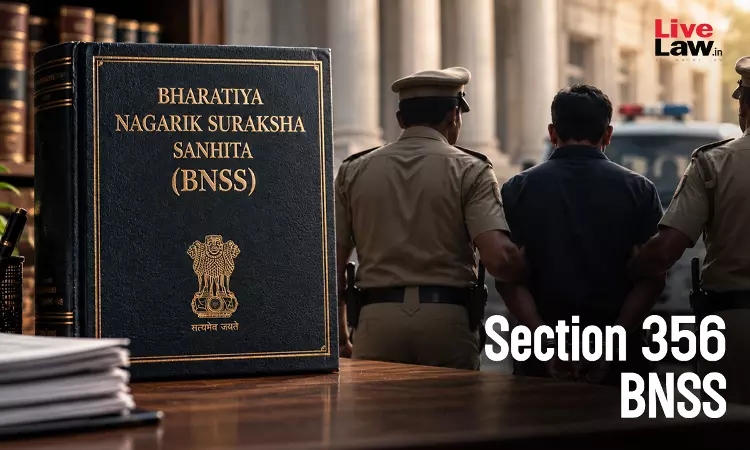
The axiom audi alteram partem (hear the other side) is not a mere procedural courtesy; it is the constitutional conscience of criminal law. For centuries, the physical presence of an accused in court was treated as an indispensable jurisdictional prerequisite. In Indian criminal procedure, this mandate was codified under Section 273 of the Code of Criminal Procedure, 1973 (CrPC). While Section 299 of the CrPC permitted the recording and preservation of prosecution depositions against absconding offenders, the trial itself remained in suspended animation until the accused was physically apprehended.
With the enforcement of the Bharatiya Nagarik Suraksha Sanhita, 2023 (BNSS), this paradigm has shifted. Under Section 356 of the BNSS, Parliament has codified a statutory mechanism enabling courts to inquire into, try, and deliver final judgment in absentia against proclaimed offenders.
While the state's drive to eliminate systemic delays is understandable, Section 356 introduces a profound legal friction: can an individual be presumed to have waived their fundamental right to be tried in person through a statutory fiction, and does this architecture survive scrutiny under Article 21?


The Impetus: Systemic Paralysis and Victim Agony
The legislative genesis of Section 356 was catalyzed by the judiciary's own expressions of anguish over chronic trial delays. Strategically timed abscondence by resourceful defendants routinely paralyzed criminal proceedings. Protracted delays led to the death or intimidation of witnesses, degradation of evidence, and acute secondary victimization of complainants.
In Hussain and Another v. Union of India (2017) 5 SCC 702; 2017 LiveLaw (SC) 196, the Supreme Court took note of the alarming delays caused by absconding accused and observed that Parliament should consider adopting a provision akin to Section 339-B of Bangladesh's CrPC, which permits trial in absentia.
The urgency became acute in Kader Khan v. State of West Bengal (2022/2023 SCC OnLine Cal 1294; 2022 LiveLaw (Cal) 166), arising out of the 2012 Park Street gang rape case. The accused had absconded while the trial of the co-accused proceeded; during his flight, the victim tragically passed away. The Calcutta High Court observed that the archaic framework under Section 299 CrPC resulted in the loss of vital testimony and urged legislative reform to introduce trial in absentia. Section 356 BNSS was enacted directly to address this procedural vacuum.
The Statutory Blueprint of Section 356
Section 356 is calibrated as an exceptional mechanism restricted to specific statutory thresholds:
1. The Jurisdictional Trigger (§ 356(1)): The accused must be formally declared a "proclaimed offender" under Section 84 BNSS (for offenses punishable with imprisonment for ten years or more, life imprisonment, or death). The court must record written satisfaction that the accused has absconded to evade trial and there is no immediate prospect of arrest.
2. The "Deemed Waiver" Fiction: Section 356(1) explicitly mandates that an accused person's abscondence shall operate as an implied waiver of their right to be present and tried in person.
3. Procedural Preconditions (§ 356(2)): Before trial commences, the court must execute a multi-layered notice sequence: (a) issue two consecutive arrest warrants within thirty days; (b) give notice to relatives; (c) publish notices in national/local dailies with a thirty-day appearance window; and (d) affix notices at the residence and local police station. Crucially, a mandatory 90-day cooling-off period must elapse from the date charges are framed.
4. Defense Representation and Verdict (§ 356(3)-(6)): State-funded legal aid counsel must be appointed if the accused is unrepresented. The trial proceeds to a final judgment and sentence, unaffected by the subsequent arrest or appearance of the offender.
Constitutional Friction: The Fallacy of 'Deemed Waiver'
Under the standard articulated in Maneka Gandhi v. Union of India (1978) 1 SCC 248, any procedure depriving an individual of personal liberty under Article 21 must be "just, fair, and reasonable, and not arbitrary, fanciful, or oppressive".
Section 356(1) establishes an irrebuttable statutory presumption: willful flight equals a waiver of the right to personal defense. However, Indian constitutional law has historically viewed the waiver of fundamental rights with skepticism. In Basheshar Nath v. CIT (AIR 1959 SC 149), the Supreme Court held that fundamental rights are public policy protections that cannot be waived by an individual.
Even where procedural rights can be relinquished, the established constitutional standard requires waiver to be "an intentional relinquishment or abandonment of a known right or privilege" (State of Punjab v. Davinder Pal Singh Bhullar, (2011) 14 SCC 770; 2011 LiveLaw (SC) 54; Johnson v. Zerbst, 304 U.S. 458). A valid waiver demands actual knowledge and informed consent.
Equating constructive notice—such as a newspaper advertisement in a language the accused may not read, or a notice pasted on an abandoned house—with conscious, voluntary waiver creates a problematic legal fiction. It disproportionately impacts indigent migrant workers, illiterate individuals, or defendants hospitalized or detained abroad under foreign proceedings without access to local notices.
The Global Benchmark: The Missing Right to a De Novo Retrial
The comparative lens highlights the central constitutional vulnerability of Section 356.
The European Court of Human Rights (ECtHR) in Colozza v. Italy (App. No. 9024/80) and Sejdovic v. Italy (App. No. 56581/00) established that constructive notice is insufficient to establish waiver. The Strasbourg Court ruled that an individual convicted in absentia who did not receive actual notice retains an unconditional right to a de novo retrial on the merits of fact and law upon re-appearance.
Similarly, civil law jurisdictions that permit absentia trials, such as France (procédure de défaut), offer an automatic statutory reset: once the absentee is apprehended, the previous judgment is vacated, and a fresh trial is convened.
Section 356 BNSS adopts the harsh efficiency of absentia adjudication without incorporating this essential corrective safeguard:
Under Section 356(5), an offender who appears during trial is merely permitted to examine evidence recorded in their absence at the trial court's discretion; there is no entitlement to restart the trial.
Under Section 356(7), an appeal against an in absentia judgment is conditional upon the proclaimed offender personally surrendering before the appellate court. Worse, the provision imposes an absolute bar on appeals after three years from the date of judgment.
If a person was genuinely unaware of the trial due to foreign detention, incapacitation, or fraudulent suppression of notice, extinguishing their right to an appeal after three years without offering a retrial mechanism risks violating Article 21.
The Road Ahead: Reading Down Section 356
The intent behind Section 356 is to deter fugitive offenders from holding the Indian justice system hostage. However, administrative dispatch cannot come at the expense of substantive due process.
To protect Section 356 from future constitutional challenge, constitutional courts will likely need to read essential protections into the provision:
1. Actual Knowledge over Constructive Notice: Trial courts must insist on verifiable digital tracing (consular notices, biometrically linked communications) before declaring that the accused has knowingly absconded.
2. Reading In the Right to a Retrial: If a convict surrenders and proves sufficient cause demonstrating that they lacked actual notice, appellate courts must recognize an inherent power to direct a de novo retrial.
3. Condoning the Three-Year Appellate Bar: The rigid three-year limitation under Section 356(7) must be interpreted as subject to judicial condonation of delay where continued absence was involuntary.
Speedy justice and fair procedure are twin pillars of Article 21. The constitutional viability of trial in absentia under the BNSS will depend on the judiciary's ability to ensure that the search for procedural closure does not result in the sacrifice of procedural fairness.
Author is an Assistant Professor of Law at Dr. B R Ambedkar National Law University, Haryana. Views are personal.


