



Ecofeminism And Climate Justice: Why Environmental Law Must Centre Women's Voices
Tasnim Jahan & Shashikant Saurav
24 Jun 2026 3:00 PM IST
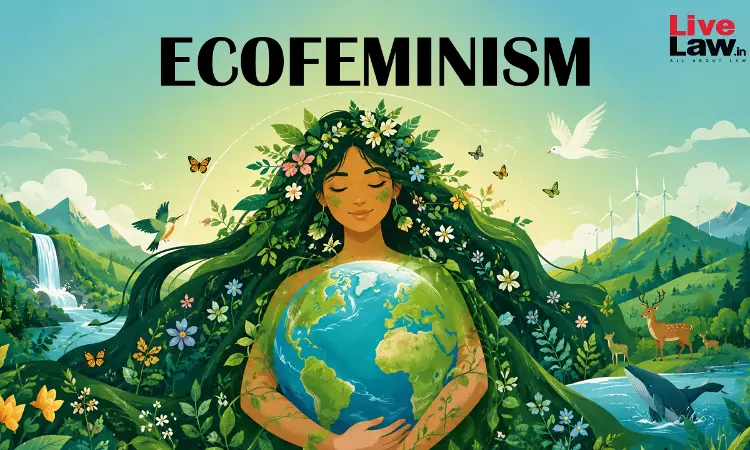
The climate crisis is not gender-neutral. Until environmental law recognises this, the pursuit of climate justice will remain incomplete.
The images are almost always the same. A woman in rural Rajasthan walking kilometres under a scorching sun to fetch water. A female farmer in Odisha watching her crops fail under erratic monsoon patterns. A young girl in Bangladesh displaced by rising flood waters, her education indefinitely interrupted. These are not anecdotal tragedies. They are systemic symptoms of a deeper crisis one that lies at the intersection of ecological destruction and patriarchal inequality. Yet when policymakers sit down to draft environmental legislation or negotiate international climate agreements, these women's voices are rarely in the room.
Ecofeminism, a theoretical framework that draws explicit connections between the domination of women and the exploitation of nature, offers a powerful lens through which to interrogate and reimagine environmental law. As India and the world grapple with the accelerating consequences of climate change, the question is no longer whether gender belongs in environmental discourse it is why it has taken so long to get there.


The Common Root of Two Dominations
Ecofeminism, as developed by thinkers such as Val Plumwood, Vandana Shiva, and Karen Warren, proceeds from a fundamental observation: the same patriarchal logic that historically justified the subordination of women also justified the exploitation of the natural world. Both women and nature have been constructed in Western philosophical and colonial traditions as passive, irrational, and available for extraction. Both have been treated as resources to be managed by a rational, masculine subject rather than as autonomous agents deserving of rights and recognition.
This is not merely an academic argument. In practice, the feminisation of poverty and the feminisation of ecological vulnerability reinforce each other in devastating ways. Globally, women constitute the majority of the world's subsistence farmers, depend most directly on natural resources for food, water, and fuel, and bear the primary burden of care work that intensifies when ecological systems collapse. When a river dries up, it is usually a woman who walks further to find water. When a harvest fails, it is usually a woman who skips meals so her children can eat. When a cyclone destroys a home, it is usually a woman who has the fewest resources to rebuild.
What Environmental Law Gets Wrong
Despite decades of international environmental governance from the Rio Declaration of 1992 to the Paris Agreement of 2015 mainstream environmental law continues to operate through what feminist legal theorists call gender-neutral assumptions. The problem with gender neutrality in law is that it is rarely truly neutral. It typically encodes the experiences, priorities, and epistemologies of those who have historically held power in this case, predominantly male, predominantly Global North actors and presents them as universal.
The Paris Agreement, for instance, includes a single preamble reference to gender equality. The Convention on Biological Diversity has made more meaningful strides with its gender plan of action, but implementation remains inconsistent and underfunded. At the domestic level, India's Environment Protection Act and its various iterations make no substantive reference to gendered vulnerability or the differential impact of environmental degradation on women and marginalised communities.
This legal silence has real consequences. It means that climate adaptation policies may be designed without accounting for the additional burdens placed on women. It means that forest rights frameworks may formally grant land rights while failing to challenge the customary norms that prevent women from exercising them. It means that clean energy transitions may unfold in ways that do not reach the women most dependent on biomass and solid fuels for cooking women who suffer the most from indoor air pollution, one of the world's leading causes of preventable death.
Vandana Shiva and the Chipko Lesson
India has its own rich ecofeminist tradition, most visibly embodied in the Chipko movement of the 1970s, where women in the Garhwal Himalayas wrapped their bodies around trees to prevent commercial logging. The women of Chipko were not acting out of sentimental attachment to trees. They were defending their livelihoods, their water sources, and their communities' survival. They possessed what Vandana Shiva would later describe as a form of ecological knowledge an intimate, embodied understanding of forest ecosystems that the timber contractors and government planners entirely lacked.
This is a critical insight for environmental law: women, particularly indigenous and rural women, are not merely victims of ecological degradation. They are knowledge-holders, environmental stewards, and agents of ecological resilience. Legal frameworks that treat them only as vulnerable populations to be protected, rather than as experts to be consulted and empowered, reproduce the same paternalism that created the problem in the first place.
Intersectionality Cannot Be an Afterthought
Any serious ecofeminist approach to environmental law must grapple with intersectionality the recognition, developed by legal scholar Kimberlé Crenshaw, that gender does not operate in isolation from caste, class, race, disability, and sexuality. A Dalit woman living near an industrial polluter in Tamil Nadu faces a radically different set of vulnerabilities than an upper-caste urban woman in Delhi. Environmental law that speaks generically of "women" without attending to these compounding axes of disadvantage risks reproducing the exclusions it claims to address.
This is particularly urgent in the Indian context, where environmental burdens are distributed along both caste and gender lines. Communities living near coal mines, chemical plants, and waste dumps are disproportionately lower-caste, and within those communities, women bear disproportionate reproductive and caregiving costs. The National Green Tribunal, for all its admirable work in environmental enforcement, has yet to develop a robust jurisprudence of intersectional environmental justice.
Towards a Feminist Environmental Jurisprudence
What would it look like for environmental law to truly centre women's voices? It would mean, first, mandatory gender impact assessments as part of all environmental clearance processes not as a bureaucratic checkbox, but as a substantive evaluation of how proposed projects will affect women's access to natural resources, their health, and their economic security.
It would mean reforming public participation mechanisms to ensure they are genuinely accessible to women, including through local-language consultations, childcare provisions, and protections against intimidation. It would mean building women's representation into the governance structures of forest rights committees, river basin authorities, and climate adaptation bodies at every level.
At the international level, it would mean pushing for binding gender provisions in climate agreements rather than aspirational preamble language provisions with monitoring mechanisms, dedicated financing, and accountability structures. Most fundamentally, it would mean taking seriously the epistemological argument at the heart of ecofeminism: that the knowledge systems of women, particularly those most directly dependent on ecological health, are not supplementary to environmental governance but central to it.
The climate crisis is accelerating. The window for meaningful legal intervention is narrowing. And the evidence is unambiguous: ecological destruction and gender inequality are not parallel problems but deeply entangled ones, sharing common roots and demanding integrated responses. Environmental law that continues to treat gender as peripheral a chapter in the annexe rather than a framework for the whole will produce solutions that are partial at best and actively harmful at worst. Ecofeminism does not offer a soft or sentimental corrective to technocratic climate governance. It offers a rigorous, evidence-based demand that law take seriously the full range of human and non-human lives that ecological collapse destroys. Centering women's voices in environmental law is not an act of charity toward a vulnerable group. It is a jurisprudential necessity for any legal system that takes climate justice seriously.
References-
1. Shiva, V. (1988). Staying Alive: Women, Ecology and Development. Zed Books, London.
2. Plumwood, V. (1993). Feminism and the Mastery of Nature. Routledge, London.
3. Warren, K. J. (2000). Ecofeminist Philosophy: A Western Perspective on What It Is and Why It Matters. Rowman & Littlefield, Lanham.
4. Crenshaw, K. (1989). "Demarginalizing the Intersection of Race and Sex: A Black Feminist Critique of Antidiscrimination Doctrine, Feminist Theory and Antiracist Politics." University of Chicago Legal Forum, Vol. 1989, Issue 1, pp. 139–167.
5. UNFCCC. (2015). Paris Agreement. United Nations Framework Convention on Climate Change, Paris.
6. UN Women & UNEP. (2022). Gender, Climate & Security: Sustaining Inclusive Peace on the Frontlines of Climate Change. United Nations, New York.
7. Agarwal, B. (1992). "The Gender and Environment Debate: Lessons from India." Feminist Studies, Vol. 18, No. 1, pp. 119–158.
Author Tasnim Jahan is an assistant professor at GD Goenka University and Shashikant Saurav is an assistant professor at Vellore Institute of Technology, Chennai.
Views are personal.


