



Harshit Sharma Case ; Paradox Of Colonial Honors In Democratic India
Dr. Arjun Philip George
29 May 2026 10:00 AM IST
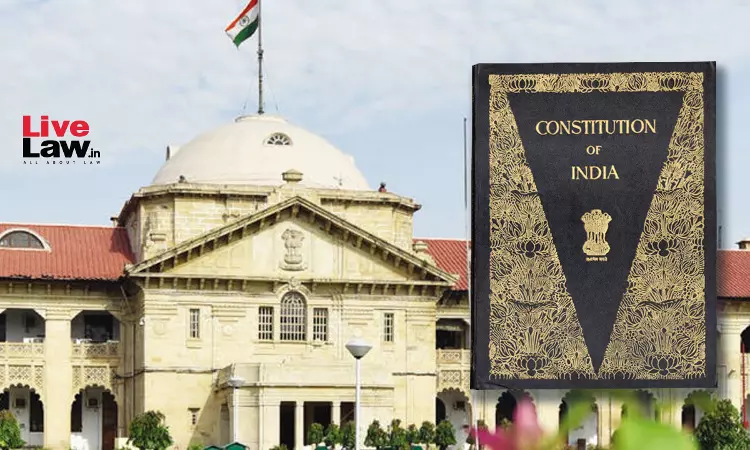
The Allahabad High Court judgment in Harshit Sharma v. State of U.P (Criminal Miscellaneous Writ Petition No. 4982 of 2026) that the honorific 'Hon'ble' is a legal requirement when it comes to referring to constitutional functionaries such as MPs, judges, and ministers in FIRs raises extremely serious constitutional issues as it justifies this requirement on the basis of protecting the dignity of constitutional offices. However, this challenges some of the core commitments of the Constitution of India like equality before the law, an attitude of institutional modesty, and the idea that all citizens stand on a fundamentally non-hierarchical footing.
An FIR is not a ceremonial or formal address, but rather a legal document whose sole purpose is to record information about a cognizable offence in a clear, neutral and precise manner. By forcing the police to insert honorifics into the FIR (even when the complainant has chosen not to do so), the court has brought status and deference into an arena that must be purely factual and objective, which consequently raises difficult constitutional questions such as, can equality before the law tolerate different forms of address for different classes of accused or complainants in the criminal process, can the 'dignity' of an office be translated into a legally enforceable demand for linguistic deference, and should the remnants of colonial etiquette be allowed to taint procedures in an area that is supposed to be governed by constitutional reason and fairness?


Therefore, the judgment seems less like a genuine attempt to protect constitutional dignity, and more like an attempt to re-introduce hierarchy into the routine functioning of the criminal justice system, which makes the judgment not only doctrinally weak, but also institutionally troubling and a strong candidate for careful reconsideration by an appellate court.
The Colonial Legacy
"Hon'ble" - a shortened form of Honourable is not an Indian innovation, but is a product of Victorian British administrative culture, which deployed grandiose titles and honorifics to shore up rigid hierarchies and reinforce British superiority. The fact that such titles continue to be used in independent India is a testament to an incomplete project of decolonization, one that the Supreme Court has tried to remedy over and over again. India's Constitution makers, were keenly aware of this danger. Dr B.R. Ambedkar's famous invocation of "We, the people of India" and the characterization of India as a "sovereign democratic republic" in the Preamble, were deliberate repudiations of colonial ideas of rank and hierarchy, yet nearly 75 years later, our courts continue to use titles that were invented to connote human beings of unequal value. Harshit Sharma's case studiously ignores this history, and instead converts such honorifics into a constitutional requirement, effectively reinforcing the very power structures that the freedom struggle and the Constitution were designed to overthrow.
The Equality Framework
Articles 14 and 18 of the Constitution, provide a clear normative basis for resistance to compulsory honorifics, because Article 14, which guarantees equality before the law and equal protection of the laws to every person, is the obvious place to start, while Article 18, on the other hand, articulates a powerful anti-hierarchy norm by prohibiting the conferment of titles. In Balaji Raghavan v. Union of India (1995:INSC:900) the Supreme Court held that titles and civilian honors must be judged against the equality principle, therefore any practice that formally elevates some persons above others in legal documentation risks running afoul of Article 14's requirement of equal legal status. Article 18 reinforces this conclusion by stipulating that "no citizen of India shall accept any title from any foreign State," and consequently, if citizens cannot accept gratuitous titles, it follows, by parity of reasoning, that the State itself should not manufacture or mandate honorifics that exceed constitutionally ordained offices and designations. That, of course, is the logical consequence of Article 18's anti-hierarchical thrust, but the Harshit Sharma case does the exact opposite, because by mandating the use of "Hon'ble" in FIRs, it converts an honorific into a state-enforced title, which is appended to certain offices as a matter of legal compulsion, thus obliterating the distinction that Article 18 was intended to create, and eroding the constitutional protection against symbolic hierarchies in public life.
In Raghunathrao Ganpatrao Patil v. Union of India (1993:INSC:38), the Supreme Court had left little doubt about its commitment to dismantling the relics of colonialism when it questioned the privileges that accompany historical titles and honors, and the Court found that the Constitution envisages a fundamentally egalitarian state structure, where official documents do not reproduce or sanctify inherited or status-based hierarchies. In light of this, the Harshit Sharma bench's silence on this line of jurisprudence is striking, because the Allahabad High Court seems to be proceeding as though FIRs inhabit some kind of constitutional black hole, exempt from the guarantee of equality that regulates all forms of state action. The Supreme Court reiterated this point in Balaji Raghavan v. Union of India (1995:INSC:900), when it held that protocol and ceremony (important though they may be in diplomatic or in strictly formal contexts) cannot supplant substantive constitutional rights or the guarantee of equality before the law, and the Court made it clear that administrative practices must be tested against constitutional standards, and not the logic of etiquette or protocol handbooks. The judgment inverts this relationship, because by commanding the police (the ordinary state actors, vested with the duty of enforcing the criminal law) to append honorifics that do not exist in the complainant's own language, the judgment permits ceremonial protocol to take precedence over substantive equal treatment, and in doing so, it treats protocol as a constitutional value in its own right, rather than subjecting it to the discipline of Articles 14 and 18.
Apart from the cases noted above, the Supreme Court has enunciated a clear constitutional proposition that has been consistently followed that the legal system must consciously de-colonize itself. The 2006 resolution of the Bar Council of India, which was endorsed by the Supreme Court, dissuaded lawyers from being excessively addressed with honorific titles in court, because a democratic justice system neither should nor needs to replicate the colonial court-room protocol. In like manner, the Court's jurisprudence on court procedure has repeatedly prioritized functional efficiency and substantive justice over ritualistic or ceremonial formalism, and consequently, the Harshit Sharma judgment is strikingly incongruent. Moreover, no recent Supreme Court judgment has made it mandatory to use honorifics in the criminal process; however, the dominant judicial trend has been to question and remove such formalities in a democratic administration.
Practical Implications
Quite apart from these constitutional difficulties, there is a very practical problem with the Allahabad High Court's decision that the court has failed to notice, because India's police forces are already working under enormous handicaps in terms of resource scarcity, understaffing, and vast case backlogs. To ask that, in every case where it is relevant, officers must check whether an accused or complainant holds a constitutional office, and then insert the "correct" honorific into the FIR, is to place a new layer of procedural complexity on a system that can ill afford it, and this will introduce confusion into the record rather than clarity, particularly in cases where an individual's official status is disputed, or has changed recently, or is simply unclear. More fundamentally, this sends an institutional signal that is disturbing, that scarce investigative resources should be diverted toward ensuring ceremonial compliance with a protocol of address, rather than toward the core task of investigating crime, which is deeply counterproductive in a system where investigative capacity is already at a stretch, and where effective investigation has a direct impact on conviction rates and public safety. The ruling also threatens the integrity of the evidentiary record, because an FIR is supposed to be a contemporaneous account of allegations, captured as faithfully as possible in the language of the informant, and it is the foundation of the criminal process, upon which all subsequent investigation and prosecution is predicated.
If the police is mandated to make post-hoc insertions of honorifics, the FIR is no longer a record of what the complainant actually said, but a document crafted to comply with the requirements of etiquette, which will create the possibility of a variance between the original oral or written complaint, and the FIR, and it also raises a very serious question that what if the complainant had deliberately chosen not to use an honorific, as a matter of conviction, or principle, and consequently, under Harshit Sharma, the police would be required to over-ride that choice, and edit the citizen's voice to comply with the court's standard of deference, thereby setting a disturbing precedent for both investigative autonomy, and testimonial authenticity. Furthermore, there are serious access-to-justice concerns, because a large section of India's population, especially from marginalized communities, are unfamiliar with legal formalities and protocol, and while the cost of slowed, complicated, or informally conditioned FIR registration will not be borne by constitutional functionaries, it will be borne by ordinary citizens trying to access the criminal justice system.
Therefore, the very apprehension of an FIR being rejected, delayed, or disapproved of because it does not use "Hon'ble" could also deter a complainant, or give an excuse for hesitation at the police station level, however, this could put in place yet another hurdle between the vulnerable citizen and a system that is already complex and difficult to access, one that privileges a form of ritualistic deference to the constitutional guarantee of equal, effective, and user-friendly access to justice, and thus, the Harshit Sharma mandate risks compromising the integrity of the criminal justice system.
By contrast, in most working democracies, officials try to excise honorifics from official business as far as possible. In American criminal procedure, therefore, while judges and officers are addressed by their office and name, there is no rule that the accused, or his office, if he holds one, must be addressed by any particular title, and the logic is elementary that the criminal law is supposed to treat everyone equally, irrespective of his formal station. From this perspective, the Harshit Sharma judgment is something of an outlier because, in insisting that hierarchical forms of address be used even at the stage of investigation, it places India in conflict with the universal international practice, and makes our criminal process uniquely deferential and status-sensitive.
The Allahabad High Court sought to justify its order by stating that the "dignity" of constitutional offices is at stake, however, the justification does not hold. To begin with, the dignity of a constitutional office is derived from the Constitution itself, and from the powers and duties that are vested in that office, and it has nothing to do with the presence or absence of an honorific in an FIR. A judge's authority, for example, is not derived from the manner in which a police officer drafts a complaint against someone else, but it is derived from the constitutional scheme, and the trust that is reposed in law. Secondly, in our constitutional scheme, dignity and equality are not in conflict with each other, rather, they are complementary values, because the promise of dignity is meaningful because it is universal, and unconditional.
The moment dignity becomes contingent upon the addition of honorifics for a few, it is not inherent dignity at all, but a switchable privilege, whose on/off button is tied to the office that one holds, which is the exact opposite of what the Constitution guarantees. The Court's argument, finally, leads to patently absurd consequences, because if the dignity of office indeed requires honorifics to be used in FIRs as a matter of right, then the same dignity argument could be made by any constitutional functionary, every time an FIR omits to mention a title, and the argument dissolves into absurdity where criminal process would be transformed into a war over missed honorifics, rather than a means for investigating offences.
The Need to Return to the Constitutional Fundamentals
The Harshit Sharma judgment is a case that requires reconsideration by the Supreme Court, and when it reaches there, the Court should use the opportunity to realign criminal procedure with the most basic constitutional values. The Court must re-assert, in express terms, the primacy of Article 14, and make it clear that equality before the law does not allow for any mandatory honorifics in FIRs, or at any stage of the criminal process, regardless of who the accused or the complainant are, because this is essential for upholding the principles of equality and justice. Furthermore, the Court must draw a clear line between the ceremonial and the procedural, while certain high constitutional occasions, such as a presidential address or a parliamentary ceremony, might be justifiably marked by protocol and formal modes of address, such practices have no place in the routine criminal investigation, which must be neutral, functional, and status-blind. Additionally, the Court must make it clear that the purposes of criminal procedure are substantive justice and investigative integrity, and that these must take precedence over considerations of etiquette, therefore, where there is a conflict between efficient and accurate investigation and ceremonial deference, the latter must yield. Consequently, the Supreme Court must confront the colonial legacy of honorifics head-on, by acknowledging how such forms of address, diffused throughout various branches of Indian law and practice, can insidiously reinsert hierarchy into a formally egalitarian order, and by initiating a broader project to excise such usages that are inconsistent with the Constitution's commitment to equality, dignity, and non-hierarchical citizenship.
The use of "Hon'ble" is undemocratic and it is antithetical to the principle of equality before the law. Nobody can be placed above the law, regardless of their rank or position, because by enforcing the usage of "Hon'ble," introduces a hierarchy into the criminal justice system which the law is compelled to adhere to. This is antithetical to the concept of democracy and therefore it highlights the need for change. The Harshit Sharma judgment could have been an opportunity to reform the legal system and move away from its colonial roots, but instead, the Allahabad High Court exacerbates the situation by compelling individuals to exhibit deference to judges, reminiscent of colonial practices.
Author is an Assistant Professor(Sr.) at VIT School of Law, Chennai Campus. Views are personal.


