How IT Act Powers Are Killing Online Dissent
Manu Sebastian
31 March 2026 9:52 AM IST
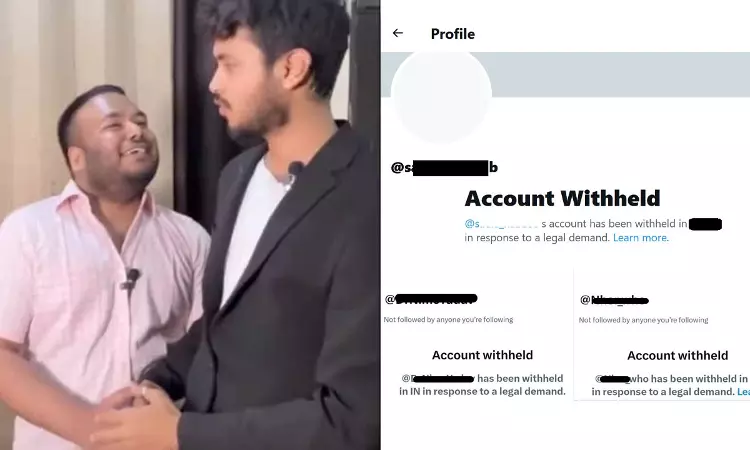
Screengrab from the Instagram video of Pulkit Mani (@hunnywhoisfunny) which was later withheld on Government demand
When the internet is policed without safeguards, democracy risks losing a vital space for dissent and debate.
Recently, an Instagram video posted by a comedian satirising the interactions between Prime Minister Narendra Modi and foreign leaders became hugely viral across several social media platforms. Soon after the video garnered several million views, it was taken down by Meta "in response to a legal demand” from the Government of India.
Around the same time, several accounts on X of political activists and anonymous satirists, who used to post content critical of the Government and the ruling party, were completely blocked without explanation. More recently, posts on X sharing a letter from the Election Commission of India's Kerala office, which allegedly carried the BJP's party symbol, were withheld from public view following a demand by the Kerala Police.
In none of these instances was there an express reason cited as to why the content was blocked; nor was any opportunity of hearing given to the social media user, either before or after the takedown. There was nothing unlawful about these posts, unless one considers the criticism of the Government, or even mocking of those in power, an illegality. One of such accounts was directed to be blocked since the Prime Minister was portrayed in a "bad taste". The Internet Freedom Federation termed these decisions an "alarming escalation of social media censorship" affecting speech that appears political, satirical, or critical.


How IT Act enables the arbitrary take-down of online content?
The Information Technology Act, 2000 and its rules allow the government to direct intermediaries to remove or disable access to content without prior notice to the user and without an opportunity to be heard.
The original blocking mechanism under Section 69A of the IT Act at least recognised the need for procedural safeguards. The grounds for blocking mentioned in Section 69A also flowed from the restrictions mentioned in Article 19(2), such as sovereignty and integrity of India, defence of India, security of the State, friendly relations with foreign States or public order or for preventing incitement to the commission of any cognizable offence. The 2009 Blocking Rules, framed pursuant to Section 69A, required the government to record reasons in writing and provided for a decision-making process through a designated committee. In ordinary circumstances, the originator of the content, if identified, should be given at least 48-hours notice. However,the framework also allowed emergency blocking orders without notice.
The Supreme Court upheld Section 69A in Shreya Singhal largely because some safeguards existed. The fact that this framework broadly mandated the passing of a reasoned order and the hearing of the originator of the content persuaded the Court to uphold it.
However, that minimal procedural safeguard is now being diluted through another route.
Section 79(3)(b) and the Sahyog Portal: A Backdoor Blocking Mechanism
The government has increasingly relied on Section 79(3)(b) of the IT Act, read with Rule 3(1)(d) of the 2021 IT Rules, to compel intermediaries to remove content.
Section 79 was originally designed to determine when social media intermediaries lose their "safe harbour" immunity for the content posted by users. As per Section 79(3)(b), if an intermediary, upon receiving "actual knowledge", or on being notified by the appropriate Government or its agency that any information hosted by the intermediary is being used to commit "the unlawful act", and fails to remove such content, then the intermediary will lose the legal immunity for such content. In Shreya Singhal, the Court read down Section 79(3)(b) to hold that 'actual knowledge' of intermediary means a direction from the Court and that "unlawful acts" should refer to the grounds mentioned in Article 19(2).
It was not conceived as an independent censorship mechanism. Yet in practice, it is now being used as one.
Instead of following the procedure under Section 69A, the government authorities found it convenient to serve notice directly on the intermediaries, claiming that certain content is 'unlawful'. The intermediary, fearing the loss of safe harbour protection, immediately withholds the content notified by the authorities. There is no notice given to the content creator. There is no reasoned order passed. While under Section 69A, only the designated officer - the Joint Secretary of MeITY- could issue the blocking order, the powers under Section 79(3)(b) could be exercised by a wide range of authorities, ranging from State police, railways, and various other ministries.
In 2024, the Central Government created a centralised portal, called the 'Sahyog Portal', bringing all authorities that can exercise S.79(3)(b) powers and the social media intermediaries under one umbrella. Thus, a parallel blocking route, circumventing the procedural disciplines mandated by Section 69A, was formalised and centralised.
Prominent social media platform 'X' (formerly Twitter), refused to onboard 'Sahyog', and challenged the use of Section 79(3)(b) route to block content. Last year, the Karnataka High Court refused X's challenge, firstly on the ground that X could not claim violation of fundamental rights guaranteed by the Constitution as it was an American company. Secondly, the High Court disagreed that the 'Sahyog' portal was a 'censorship portal' and observed that "it stands as a beacon of cooperation between citizen and intermediary, a mechanism through which the State endeavours to combat the growing menace of cybercrime."
However, the hallowed view taken by the High Court does not seem to be translating into ground reality. Experience shows that the Sahyog portal has facilitated a parallel route to block content, circumventing procedural safeguards, and the authorities seem to be acting trigger-happy to use it in an indiscriminate fashion, making it a censorship portal in effect. Emergency S.69A blocking orders without notice is also becoming the norm. Instead of the content which displeased the authorities, the entire account itself gets blocked. Last year, the entire website of Tamil news outlet Ananda Vikatan got blocked after they published a cartoon on PM Modi, and it got reinstated only after an intervention from the Madras High Court.
The regulatory environment has become even more restrictive with recent amendments to the IT Rules that shorten the time available to intermediaries to remove unlawful content. Platforms are now required to act within three hours of receiving certain government directions, compared to the earlier 36-hour window. The executive acts as the judge, jury and executioner here, without any forum for an independent determination of unlawful content.
Harmful, defamatory, or inciteful content must indeed be addressed. Online misinformation, hate speeches, AI-generated fake videos, and child pornography pose a grave menace, and there must be a mechanism to sanitise the internet of such harmful content. At the same time, there must be safeguards to ensure that citizens' critical voices are not suppressed. Since most of the mainstream media have adopted a sycophantic approach towards the executive, dissenting voices survive only in the limited online space. If the IT Act powers are used for an overkill, the bustling online space will soon have the unanimity of a graveyard - something which might please the powers that be, but will ultimately dig the grave for our democracy as well.
The author is the Managing Editor of LiveLaw. He can be reached at manu@livelaw.in