



Hunger Strike: In Perspective Of Section 226 Of BNS
Debashish Kar
1 Aug 2026 10:00 AM IST
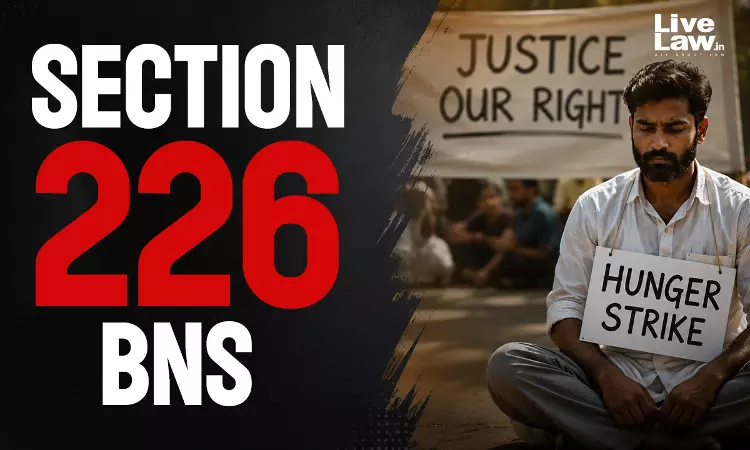
As per Madras High Court held in P. Chandrakumar Vs. State by the Inspector of Police,[1] sitting on 'Hunger Strike' is not an attempt to commit suicide within the meaning of Section 309 of IPC. Similarly Allahabad High Court in Ram Murat Pandey vs State of U.P. & Another[2] held, “Simply by sitting on dharna and going on indefinite hunger strike does not amount to an act towards attempt to commit suicide. The applicant wanted to highlight his grievances and for this purpose only such drama was enacted. If the grievances of a person are not attended to by the authorities, some times, unusual methods may be adopted to draw public attention, but the action of the applicant does not amount to attempt to commit suicide unless some specific act was done which indicated and he was about to commit suicide and had taken some act towards final commission of the offence.”
So, mere sitting on a hunger strike to raise a protest or demand against an authority shall not be considered as an attempt to commit suicide unless and until any act towards commission of suicide has been done by the person sitting on hunger strike. Thus, to bring a protest of hunger strike within the purview of Section 309 of IPC, intention of the protester must be considered. If the intention of the person is to compel an authority to do or not to do any particular act raising protest through hunger strike, same cannot be termed as an attempt to commit suicide within the ambit of Section 309 of IPC. However, if the conduct of the protester is very much clear that his focus is not only on the protest but also on commission of suicide, same shall attract the offence of attempt to commit suicide under Section 309 of IPC.


Hunger strike as a fundamental right:
Article 19(1)(a) of The Constitution of India guarantees the fundamental right of the citizens' namely, right to speech and expression. Likewise, Article 19(1)(b) provides right to assemble peacefully and without arms.
In this context reference of another judgment of Madras High Court in its own words requires attention. In the case between K. Thiagarajan @ Thozhar Thaigu vs The Commissioner Of Police[3] it was observed “The mode adopted by Gandhiji to obtain his goal was fasting. Unlike other forms of agitations, fasting is considered as a non-violent method of protest or expression of dissent. The people of this Country have every right to express their views. In order to achieve the goal, various methods of agitations are now resorted. Very seldom people resort to the non-violent method of protest. When a person approaches the authorities with a request to permit him to go on fasting, the issue should be considered in the light of the freedom of speech and expression guaranteed by our Constitution. Even though reasonable restrictions could be imposed on the exercise of such rights, it is impermissible to prohibit it without any ryme or reason. The orders of this nature should be tested on the touchstone of Article 19 and 21 of the Constitution.”
In the case of K. Thiagarajan, relying on Ramlila Maidan incident and Md. Yusuf Rathar case, Madras High Court brought the protest through peaceful hunger strike within the purview of Article 19 and 21 of the Constitution of India providing the same a status of Fundamental Right subject to reasonable restrictions.
Deletion of Section 309 of IPC from the framework of BNS:
In P. Rathinam vs Union Of India[4] Supreme Court of India declared the provision of Section 309 of IPC as unconstitutional as the person who attempted to commit suicide was obviously not in a good state of mind while tried to commit suicide and imposing punishment for such attempt is nothing but to inflict further sufferings to a person to whom life is already a burden.
Such version of the Apex Court was in the line of 42nd report of Law Commission of India.
However, the observation laid down in P. Rathinam case was overruled by the judgment of Gian Kaur Vs. State of Punjab[5] holding that right to life does not include right to die and upheld the validity of Section 309 of IPC.
But again, in the 210th Law Commission Report of the year 2008 as well as the judgment of the case between Common Cause (a registered society) Vs. Union of India[6] recommendation has been made for humanization and decriminalization of the offence of attempt to commit suicide.
However, after all such efforts the provision of section 309 of IPC i.e. the offence of attempt to commit suicide has been kept aside from the framework of new Penal Law i.e. The Bharatiya Nyaya Sanhita, 2023 subject to the provision of Section 226 of BNS.
Difference between Section 309 of IPC and Section 226 of BNS:
Section 309 of IPC made the act of attempt to commit suicide a punishable offence in general. Legislative intent behind this law was to prevent a person from commission of any act toward the attempt to commit suicide. Main focus of this law was to save the life of a person creating a sense of fear in his mind that in case of failure in committing the suicide he would be punished under law.
But Section 226 of BNS completely stands in separate footing. The provision runs as follows:
Whoever attempts to commit suicide with the intent to compel or restrain any public servant from discharging his official duty shall be punished with simple imprisonment for a term which may extend to one year or with fine or with both or with community service.
So, in this provision the main concern is not to save the life of the offender, but to prevent him from raising his protest against any public servant while discharging his official duty. Section 226 of BNS does not care to prevent any attempt to commit suicide which is not a protest or voice against a public servant.
Section 226 of BNS and “Reasonable Restriction” mentioned in Article 19 of our Constitution:
The fundamental rights guaranteed under Article 19 of The Constitution of India are always subject to reasonable restrictions imposed or to be imposed by the state. Even the right to life and liberty guaranteed under Article 21 is subject to restrictions enabled through the procedure established by law.
As discussed earlier, sitting on peaceful hunger strike is considered as a fundamental right within the scope of Article 19 and Article 21 of the Constitution of India. But legislative intent of Section 226 of BNS can be stretched to the extent that it can be considered as a reasonable restriction created by the state to prevent a person from sitting on hunger strike to compel or restrain a public servant from discharging his public duty. No such rider or proviso inserted in BNS or added with Section 226 of BNS to restrict its applicability to a particular group or category of cases.
During existence of Section 309 of IPC it was settled by judicial pronouncements that hunger strike to raise a protest cannot be considered as an offence to commit suicide as the intention of the protester is to compel or restrain a public servant or an authority from doing an act and not the intention of committing suicide. But Section 226 of BNS is least bothered whether the protester has any actual intention to commit suicide or not. Its main concern is whether there is any threat to commit suicide on the part of the protester to compel or restrain a public servant from discharging his official duty. E.g. Mr. X set on a hunger strike to restrain a public servant from signing a particular office document and continued his fasting for long time. In this case though the intention of the protester may not be to end his life keeping himself on fasting, but Section 226 of BNS may be invoked as the protester kept on fasting (which is a threat to his life) to prevent the public servant from discharging his official duty.
So, till date, it can be said that Section 226 of BNS is a restriction on the right to sit on hunger strike raising a protest against a public servant while discharging his official duty. However, reasonableness of such restriction is a matter of judicial intervention.
Decided on 15.02.2021 in Crl.OP.No.2791 of 2021 and Crl.M.P.No.1546 of 2021. ↑
Decided on 08.04.2011 in Application U/S 482 No. - 4206 of 2001. ↑
Decided on on 1 October, 2013 in W.P.No. 26930 of 2013 & M.P.No.1 of 2013. ↑
1994 SCC (3) 394. ↑
1996 SCC (2) 648. ↑
AIR 2018 SC 1665. ↑
Author is a Special Judge (CBI) at State of Tripura. Views are personal.


