



India's Unfinished Reform: When The Shield Of Impeachment Becomes A Weapon
Rajasekhar V.K
11 Dec 2025 1:23 PM IST
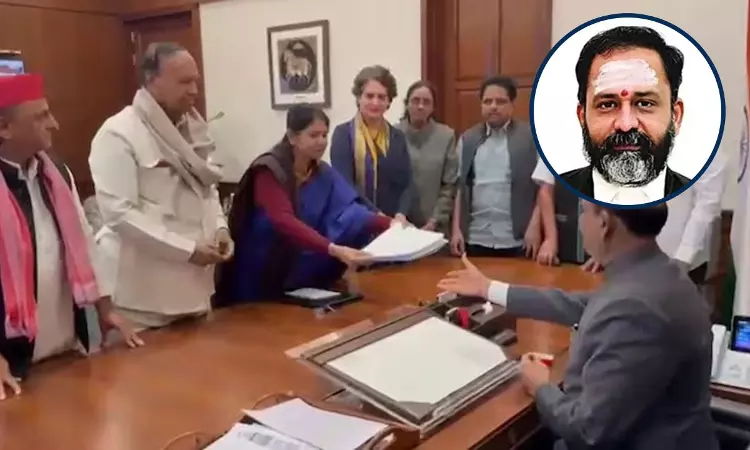
The Swaminathan motion exposes a vacuum: the old shield is brittle, and the new armour was never worn.
The constitutional bargain of 1950
When the framers debated the removal of judges, their anxieties were direct and unsentimental. Members of the Constituent Assembly warned that impeachment could be warped by prevailing passions, allowing a hostile majority to remove a judge for displeasing the government of the day. Others feared the opposite: that a guilty judge might escape removal because political calculations made consensus impossible. What united them was an insistence that the judiciary must be insulated from partisan winds. If a judge was to be removed at all, it would be only for proven misbehaviour or incapacity, through a special majority of both Houses.
This was the constitutional bargain. Independence would be near-absolute. Removal would be onerous by design. And under Article 124(5), Parliament was empowered to create a mechanism to investigate and prove allegations of judicial misconduct.
The first exercise of that power came in 1968. The Judges Inquiry Act, enacted under Article 124(5), created a procedure for investigating allegations against judges. But it was deliberately narrow: a skeletal procedural framework for the extraordinary remedy of removal. It was never intended to act as a routine or comprehensive accountability system. Yet, more than half a century later, this minimalist architecture remains the only statutory mechanism available.


These concerns were not abstract. Over the years, several impeachment motions have been initiated against individual judges, yet none has culminated in removal. The motion against Justice V. Ramaswami in 1993 failed in the Lok Sabha despite the Inquiry Committee's findings. The proceedings concerning Justice P.D. Dinakaran (2009) and Justice Soumitra Sen (2011) were overtaken by resignation. Later notices against Justice S.K. Gangele (2015), Justice J.B. Pardiwala (2015), Justice C.V. Nagarjuna Reddy (2017) and Chief Justice Dipak Misra (2018) did not satisfy the threshold for 'proven misbehaviour.' More recent motions concerning Justice Yashwant Varma and Justice G.R. Swaminathan in 2025 illustrate the same difficulty. These episodes demonstrate that impeachment has operated more as a constitutional alarm bell than as a workable mechanism for addressing concerns of judicial conduct. They underscore the gap that Parliament itself sought to address through the 2012 Bill, but ultimately left unfinished.
The first failure: Parliament's abandoned 2012 reform
If the constitutional shield was hammered into shape in 1950, it has been examined and questioned many times since, well before the present controversy. By the late 1990s, the judiciary itself recognised the need for an explicit ethical compact. This need had already been underscored by the Supreme Court in C. Ravichandran Iyer v. Justice A.M. Bhattacharjee (1995) 5 SCC 457, noting the “yawning gap” between conduct unbecoming of a judge and the narrow constitutional grounds of 'proved misbehaviour.' The Court made it clear that concerns about judicial conduct could not be addressed through public campaigns or coercive pressure, nor could every allegation be funnelled into the impeachment process. The judgment recognised that an intermediate, institutional response was necessary to preserve both judicial independence and public confidence.
It was in the wake of this case that the Supreme Court first formulated the in-house procedure, and in 1997, adopted the Restatement of Values of Judicial Life. In 1999, the Restatement was also adopted at the Conference of Chief Justices of all High Courts. Though non-statutory, it laid down standards on impartiality, aloofness, avoidance of conflicts of interest, dignity, and public conduct. It represented the judiciary's own articulation of the ethical standards expected of the high office.
The judiciary's own in-house procedure, though intended to safeguard dignity and autonomy, remains non-statutory, opaque and without binding consequence, and therefore cannot substitute for a legislated framework.
Parliament, too, came to appreciate the insufficiency of relying solely on the blunt instrument of impeachment, and to enshrine the judicial standards in law. The Judicial Standards and Accountability Bill was introduced in the Lok Sabha in 2010 passed in March 2012. Shortly thereafter, the 15th Lok Sabha's tenure came to an end and the Bill was never discussed in the Rajya Sabha. This Bill was a comprehensive attempt to modernise judicial accountability. Its ambition rested on three pillars.
The first was codification of judicial standards. The Bill took the 1997 Restatement and transformed it into binding norms. For the first time, 'misbehaviour' would have statutory content rather than depend solely on political or parliamentary allegation.
The second was a filtered, graded accountability mechanism. Instead of forcing every serious complaint into the impeachment channel, the Bill created Scrutiny Panels and a National Judicial Oversight Committee. These bodies were empowered to sift grievances, investigate them, and recommend appropriate responses. Crucially, the Bill introduced the concept of “minor measures”: advisories, warnings, or censure for conduct that warranted correction but fell short of impeachable wrongdoing. It provided the scalpel that the 1968 Act never contemplated. The seriousness with which Parliament once approached this reform is evident from the Bill's passage in the Lok Sabha after Standing Committee scrutiny, before it lapsed with the dissolution of the 15th Lok Sabha. It was never reintroduced.
The third was transparency, including mandatory asset declarations. This was a response to judicial and public insistence that the higher judiciary must be both independent and visibly accountable.
This was the system Parliament intended to create. And yet, despite acknowledging in its debates that the 1968 Act was inadequate, Parliament allowed its own reform to lapse. The result is a constitutional irony of the first order: the House that recognised the need for a better accountability system, framed it, debated it, and passed it, ultimately failed to see it through. It is this long inaction that has left the system with only the impeachment mechanism it once sought to refine, and which has now been weaponised inadvertently. As has been observed, the very design of impeachment makes it largely redundant for addressing routine complaints of judicial conduct, underscoring the structural mismatch in relying solely on the 1968 framework.
The second failure: weaponising the nuclear option
The consequences of this legislative inertia are now unfolding. The Judges Inquiry Act, 1968, designed only for the rarest of cases, is being called upon to do work far beyond its intended capacity. Its logic is all-or-nothing. It assumes that misconduct, if proven, is so grave that the only remedy is removal. It vests the Speaker with a constitutional responsibility to admit or reject motions at the threshold. Historically, this responsibility has been exercised with care. Motions were rejected against Justice J.C. Shah in 1970 and against Justice Dipak Misra in 2018, recognising that allegations which failed to meet the strict constitutional standard must not enter the impeachment process at all.
Contrast this with the present motion against Justice G.R. Swaminathan. The allegations, as publicly reported, centre on bias, partiality, favouritism, and ideological predisposition in the context of a specific judicial order relating to a religious practice in Tamil Nadu. These are allegations of professional conduct, not personal corruption or abuse of office. They are precisely the sort of concerns a judicial standards mechanism is designed to investigate: examining the conduct against codified ethical norms, determining whether a breach occurred, and recommending proportionate action if necessary.
Instead, in the absence of such a mechanism, these concerns are forced into the impeachment vocabulary of “misbehaviour”. The motion seeks to try a judge's professional ethics in a political arena. It conflates judicial reasoning, which is properly corrected on appeal, with judicial misconduct, which demands an entirely different process. This is the very distinction the framers feared and sought to protect, and which successive Speakers have guarded against.
The vicious cycle: how inertia fuels politicisation
The deeper tragedy is that none of this is accidental. It is a structural deficiency. The absence of a standing accountability mechanism has created a vacuum. In this vacuum, public trust erodes. Allegations linger without credible institutional resolution. Political actors, seeking to demonstrate accountability, reach for the only constitutional tool available to them. And with each such motion, the judiciary is drawn further into political discourse, magnifying the very distrust that triggered the episode, irrespective of merit.
The cycle feeds on itself. Legislative inertia begets political frustration; political frustration promotes misuse of impeachment. And each such attempt deepens the perception that judges are entangled in political conflict. That perception, in turn, fuels further demands for accountability. A system designed to protect judicial independence is now inadvertently exposing it.
The way forward: completing the unfinished project
What, then, is the constitutional course? In the immediate term, the Speaker must discharge the responsibility conferred by the 1968 Act. Motions that rest not on proven misbehaviour but on disagreement with judicial reasoning must be rejected at the threshold, as precedent and constitutional design require. At this stage, the Speaker must draw a clear line in the sand: judicial outcomes, however contested or unpalatable, cannot be converted into allegations of impeachable conduct.
But the enduring solution lies in completing the reform that Parliament itself began. A modern judicial accountability law must be revived. It should codify judicial standards, establish an independent oversight body with judicial and non-political members, create a graded system of sanctions, and place beyond doubt the distinction between judicial error and judicial misconduct. Such reforms would give genuine grievances a credible forum, provide judges with protection from political retaliation, and remove the temptation to use impeachment as a tool of pressure. Commentators have likewise emphasised that meaningful accountability requires a permanent, statutory oversight body with the authority to impose graded sanctions, thereby reinforcing public confidence while preserving judicial independence. Such a law would, in essence, revive and implement the graduated, judicial-centric architecture of the 2012 Bill, completing the project that Parliament itself had initiated.
The impeachment mechanism was conceived as a constitutional shield. We have allowed it to become the only available tool, asked to perform functions it was never meant to bear. The present controversy is not simply about one motion. It is a reminder that an institution cannot indefinitely postpone the reforms it knows it requires.
Ultimately, the choice before us is stark. We may continue down a path that brings the framers' fear to life: a judiciary vulnerable to the moods and pressures of political contestation. Or we may fulfil their deeper hope: an independent judiciary sustained not by the brittleness of a single, overburdened mechanism, but by a lawful, credible, and depoliticised framework of accountability worthy of the Republic.
Author is Former Member (Judicial), National Company Law Tribunal. He continues to engage with insolvency, judicial process, and institutional reform through writing, research, and advisory work. Views are personal.


