



Impeachment Motion And Judicial Independence
Justice K. Kannan
9 Dec 2025 8:15 PM IST
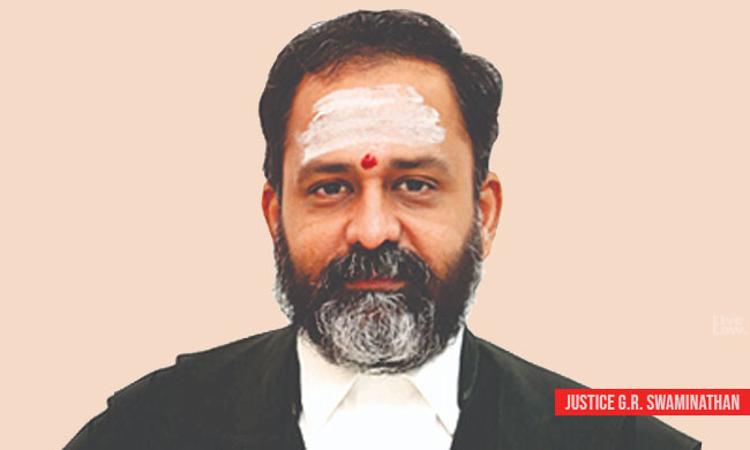
The recent move to present a motion before the Speaker of the Lok Sabha seeking the impeachment of Justice G.R. Swaminathan for his judgment in the Tirupparankundram Deepam case marks a disturbing moment in India's constitutional life. What was once an extraordinary remedy reserved for proven misbehaviour or incapacity is being invoked as a rhetorical and political tool to signal disapproval of a judicial outcome. Such a development raises troubling questions about the future of judicial independence and the health of democratic institutions.
The motion, though presented, does not automatically usher in the process of removal. Under the Judges (Inquiry) Act, 1968, the Speaker is vested with the authority to admit or reject the motion after considering its grounds and supporting material. This discretion is neither procedural ornament nor political convenience; it is a constitutional safeguard against the weaponisation of impeachment in moments of public or partisan dissatisfaction with judicial reasoning.


The Constitutional Design of Judicial Removal
The framers of the Constitution set out a deliberately high bar for removing a judge of the Supreme Court or a High Court. Articles 124(4) and 217 require both proof of misbehaviour or incapacity and the support of a special majority in both Houses of Parliament. The mechanism is intentionally onerous, a reflection of the belief that judges should not be vulnerable to political winds or transient public displeasure.
The Judges (Inquiry) Act creates a structured sequence: notice signed by the requisite number of MPs, admission by the Speaker or Chairman, appointment of an inquiry committee, determination of charges, and finally, debate and vote in Parliament. The crucial threshold is admission: even if the requisite signature requirement is satisfied, the presiding officer “may either admit the motion or refuse to admit the same.” This discretion serves as a filter to prevent the misuse of impeachment for purposes unrelated to integrity or judicial capacity.
Past Precedents of Summary Rejection
Indian parliamentary history offers clarity on how this discretion has been exercised. In 2018, a motion seeking the removal of Chief Justice Dipak Misra was presented in the Rajya Sabha. The Chairman, after examining the allegations, refused to admit it, noting the absence of verifiable material and the risks posed to judicial independence by entertaining such a motion. His order expressly underscored that impeachment cannot be used as a proxy for disagreement with judicial interpretation.
Earlier still, a motion against Justice J.C. Shah was dismissed summarily by the Speaker of the Lok Sabha as frivolous, unsupported by evidence, and wholly unfit to trigger the rigorous procedure prescribed by the Constitution. These instances illustrate a consistent practice: the presiding officers have not treated the impeachment notice as a mere procedural formality but as a substantive constitutional responsibility requiring judgment, restraint, and fidelity to principle.
Judicial Reasoning Is Not Misconduct
The present motion against Justice Swaminathan rests entirely on disagreement with his reasoning in the Tirupparankundram Deepam judgment. The case itself involved contested assertions regarding religious practice, administrative regulation, and constitutional protection. Faced with divergent narratives and precedent that permitted more than one interpretive approach, the judge adopted a view anchored in his understanding of the factual record and constitutional doctrine.
Reasonable minds may differ on whether his conclusions were correct. But they are unquestionably within the permissible bounds of judicial reasoning. Such differences are the everyday lifeblood of appellate jurisprudence. They belong to the realm of appeal, review, or scholarly critique. They do not, and must not, fall within the category of “misbehaviour” that justifies removal.
Impeachment is designed to address corruption, abuse of office, or demonstrated incapacity—not doctrinal disagreement. The only Indian judges who have faced impeachment proceedings that advanced beyond notice—Justice V. Ramaswami, Justice Soumitra Sen, and Justice P.D. Dinakaran—did so because of grave allegations relating to financial irregularities or misconduct, not because someone disagreed with their judgments.
No constitutional democracy has ever treated judicial error—let alone a contested interpretive conclusion—as a ground for removal. To do so would collapse the essential distinction between judicial reasoning and misconduct, making the bench subservient to political passions.
The Speaker's Duty at This Moment
Now that the notice for removal has been formally submitted to the Speaker of the Lok Sabha, the constitutional responsibility shifts squarely to the presiding officer. Past practice, parliamentary convention, and constitutional structure make the duty clear: a motion that is grounded not in allegations of corruption or impropriety but merely in dissatisfaction with judicial reasoning must be rejected at the threshold.
If the admission stage is converted into a mechanical step—triggered automatically whenever political factions amass the requisite signatures—then the impeachment mechanism becomes a political weapon rather than a constitutional safeguard. Such a distortion would undermine both judicial independence and parliamentary dignity.
The Speaker's discretion is not a licence for partisanship; it is an obligation to protect the integrity of the judicial office and the gravity of the impeachment process. The precedents of 2018 and earlier serve as guiding lights: reasoned, principled rejection is the appropriate constitutional response when the motion is bereft of credible allegations of misbehaviour.
A Dangerous Trend of Browbeating Judges
The most worrying aspect of the present episode is not the motion itself but what it represents: a broader cultural shift towards penalising judges for unpopular or misunderstood decisions. Even the threat of impeachment, when deployed in response to the content of a judgment, creates a chilling effect. It signals to judges that their independence is conditional upon their alignment with public sentiment or political approval.
Such a climate corrodes the judiciary from within. Judges cannot discharge their constitutional duties if they must constantly guard themselves against personal attack for every interpretation that provokes controversy. A democracy that intimidates its judges erodes its own foundations.
The Speaker's decision on this motion therefore carries weight far beyond the present controversy. Summary rejection would reaffirm the constitutional norm that judicial reasoning, however debatable, is not misconduct. Anything short of that risks legitimising a trend in which impeachment becomes a tool of pressure rather than a mechanism of accountability.
If India is to preserve a fearless and independent judiciary, it must stand firmly against the creeping normalisation of browbeating judges for the content of their judgments. The Constitution demands nothing less.
Author is Former Judge, Punjab and Haryana High Court.
Views Are Personal.


