



Indian Lawyer Goes To United States Court
Chirayu Jain
2 Aug 2026 10:00 AM IST
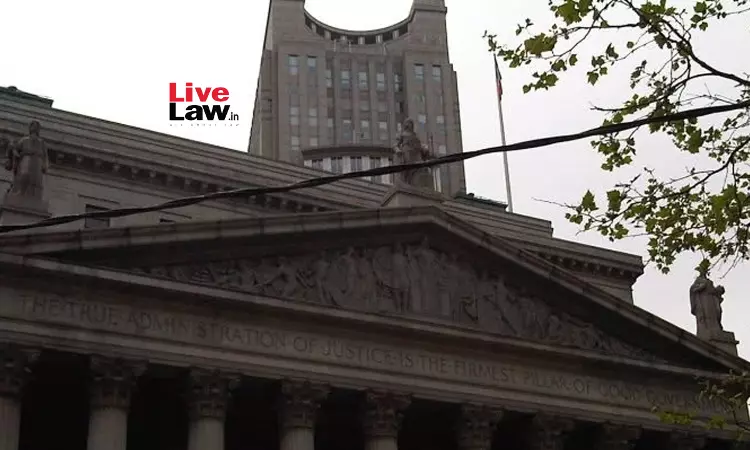
Spending an Indian summer in New York when the World Cup is taking place is a treat. More so was my experience at Courtroom No. 1305, Thurgood Marshall United States Courthouse for Southern District of New York. A world away from snakes and ladders of New Delhi.
Part I
While walking up from Brooklyn Bridge and admiring the tall buildings of Manhattan, we come across a side entry for the 13-floor Thurgood Marshall United States Courthouse. The front of this federal courthouse faces the New York State Supreme Court, whose facade carries the quote that has been a source of continuous inspiration: 'True(due) administration of justice is the firmest pillar of good government'. (read about the famous typo: here). We enter from the side entry to try our luck to see the insides of famous US courtrooms.
First thing that surprises us is the security guards here are full humans. They don't consider themselves as being below in the social hierarchy. There is no meekness or ingrained subordination that is reflected in their body language. They look straight up in the eye, ask us what our business was and let us right in after a some small talk as to why would a couple prefer visiting their courthouse and not their museums on their first day in New York (ofcourse the small talk was accompanied with sympathy smiles for my non-lawyer partner).


The building is emptier than our court-buildings during holidays. Barring a couple of attorneys strolling and carrying their own physical files (No clerks but No iPads either. Imagine), we come across none. We find out to our surprise that here it is usual for most courtrooms to not be in session on any given day. Luckily we find that there is a hearing happening on the 11th floor. We make our way there, just in time to observe the judge giving instructions to the jury regarding the evidence adduced, just before the lawyers made their closing arguments.
I honestly was too distracted to follow their arguments. The grandeur as well as the emptiness of the entire courtroom takes me by a surprise. There is no other case listed today. All the minds in that courtroom are focused on resolving that one particular dispute. Except ours ofcourse and one strange gentleman who also seemed to be an onlooker like us.
Turns out this onlooker, was actually a judge himself. Outside, in the elevator, he introduces himself as Immigration Judge in the next door building. We are taken aback by his candour when he told us that he was just lurking around since he had finished his court-work early that day. Used to our judges being treated as alien overlords, We find ourselves tongue-tied for the rest of the journey to the ground floor. We step outside the elevator and part our ways with the immigration judge. Such carefree attitude. To roam around without an usher around him to carry his bags and protect him from public.
My partner and I step outside the building for the 1.5 hour lunch break. Yes, that long. While enjoying a falafel we notice the immigration judge sharing a bench with who could only be a fellow judge (judging by the age and waistline). The two were enjoying their sandwiches out in the open. As if they were just humans. This experience is enough for me to want to go back after the lunch but it is also enough for my non-lawyer partner to decide she has had enough of courtrooms for the day. She decides to visit a nearby art installation, I decide to go two floors up this time. To the Courtroom 1305.
Part II
I enter the courtroom of Honourable Judge Paul A. Engelmayer. There is a full-fledged trial in a design infringement case taking place. The jury is seated, the judge is seated, the lawyers are seated, there is a witness in the witness box, and the audience there are two law interns sitting, and except for them, the entire courtroom is empty.
I enter with my Indian manners. I bow upon entering. The judge clearly is not used to having onlookers who have no business or people bowing. He acknowledges me and I make my way in, and take a seat next to the two law interns.
The plaintiff's counsel was examining his expert witness. The expert witness was narrating his study's findings of how he found that the counterfeit good could be confused for the original by the general public. The good is some sort of a hookah looking device. The examination-in-chief is long and focused on the merits of the expert's study.
Once the plaintiff's counsel takes a seat, the defendant's counsel is invited by the judge to cross-examine this witness. Instead of attacking any of his findings on merits, the defendant's counsel limits himself to four to five questions regarding the research methodology, about how he selected the randomized groups, and leaves it at that. No 'I put it to yous'. No 'Is it correct that'. Simple questions. No corrections of the typed record required. The jury has heard what it needs to hear.
The testimony is completed, the expert joins us in the backrows. The next witness to be examined by the plaintiff is the defendant himself. The defendant is the owner of a small grocery deli. Hispanic, who can only speak broken English. The judge turns to the defendant's counsel and asks, "Where is the interpreter?"
The defendant's counsel says that the interpreter is on her way and she would be there within the next 10 to 15 minutes. The judge looks at him without any raising his voice and indicates his slight displeasure at the fact that the interpreter not being there in time. The judge decides to adjourn for 15 minutes, allowing the interpreter to reach the courtroom.
The moment the jury gets up, everyone in the courtroom, including the judge get to their feet. The jury walks out of the room and till the time the jury, the last member of the jury has not exited the room, no one moves, even the judge. But later, when the judge gets up to go to his chamber: no one is bothered. Court staff doesn't get up. Lawyers don't bow and they continue sitting. Except me.
In this fifteen minutes break, I try to have a small talk with these foreign lawyers.
I find the defendant's counsel outside. I express my curiosity about what the nature of the device that is being counterfeited, that is being accused of counterfeited. The defendant's counsel, without looking at me, curtly cuts me short, says that he's under strict instructions not to speak to anyone for the time when the trial is in progress. How rude of him!
I think that I have better chances with the plaintiff's counsel. He anyway appeared to be more likable. I repeat my question to him about the nature of the infringing device. My ego is again hurt when the plaintiff's counsel replies with the same short sentence that he is under strict instructions not to talk to anyone about the matter until the trial has ended. But this time I am able to save my face with a "I respect that." The counsel smiles.
I make my way back to the courtroom and find the two law interns of the judge. This third time I'm lucky, and I find out from the law interns the nature of this small device, small hookah-like device, which this Hispanic deli grocer is accused of infringing. During this break, I also notice few circulars and forms kept on a table at the entrance of the courtroom (USD 4.40 per page for certified records. 8.70 if needed urgently. Surprise surprise!).
The judge is back in the courtroom. Again no one gets up except me. He busies himself with some administrative work while waiting for the interpreter.
Part III
Fifteen minutes are over. The interpreter is nowhere to be found. The judge is back in the courtroom. Jury is not. Judge is visibly upset but contained. Judge looks at the defendant counsel. Defendant counsel looks back at the judge.
Judge asks defendant counsel- where is our interpreter?
Defendant counsel is again lost for words.
The Judge laments how this trial had been continuing since last Wednesday. It had been four days, and the defendant counsel was well aware that the interpreter would have to be there in the courtroom today. Yet the interpreter was not there. The counsel mumbles something on the lines of interpreter having gone up in the wrong building by mistake. Judge is very upset by this lack of clear instructions. At the same time, the judge instructs one of his court marshals to go down to the ground floor and fetch the interpreter the moment she enters the building.
While the plaintiff counsel and the judge are discussing about the way forward, whether to strike off this witness or not, thankfully, the young interpreter walks in confidently with a smile. To my great discomfort, even this interpreter doesn't do the 'bow' before the judge. She walks in with the confidence that she has every right to be in that room. No second guessing. No worrying about what the alien overlord may be thinking.
The judge, having already expressed his anger on the defendant counsel's lapse, restrains himself and calls the jury in.
The interpreter takes a seat in the witness box along with our defendant, the Hispanic grocer.
The plaintiff's counsel begins to examine the Hispanic grocer.
He asks about his business history, where all he has worked, what are the businesses that he has, what kind of software that he uses. Unlike in India, where each full stop and comma matters, here, what matters most is what the jury is listening to.
When our Hispanic grocer says that, "I do not use any software, I do all my accounts by hand," the plaintiff counsel decides it's time not to give a customary I-put-it-to-you-... but to actually badger for the real truth.
He asks him about his income tax returns, how he files them, how he hands over the books to an accountant, and tries to get him, tries to dig into the software that he ultimately uses to process and to his goods in his shop.
The other simultaneous line of questioning which this plaintiff counsel is pursuing is asking him about all his other business interests, all the other business entities that are found mentioned in the pleadings thus far, where our Hispanic grocer strictly maintains that he only and only runs his small grocery shop at Broadway, somewhere in Upper Manhattan.
Like in a film when our plaintiff's counsel badgers for asking regarding the income tax returns and filing thereof, and objection is taken by the defendant.
The moment the judge says, "Sustained," the plaintiff counsel very confidently says that, "Do you want me to argue this in front of the jury?"
The confidence to know when it's the counsel's right to argue again takes me by surprise. The counsel is not afraid that the judge would take it to his ego.
The judge calls both the counsels to a sidebar, and there's white noise that is played in the courtroom by some sound systems so that the jury cannot overhear them.
After listening to their arguments for five, ten minutes, the judge decides to sustain his ruling and disallow the questioning regarding income tax returns of the defendant.
While the very interesting cross-examination of our Hispanic grocer was taking place, it was time for me to exit. I get up and do my bow. The judge, by now is already used to my bows. He smiles and acknowledges. And I say goodbye to Courtroom 1305.
Many things stood out for me from this short experience of US judicial system. The majestic buildings and resources which the country has to invest into adjudication of one court dispute, is highly enviable. Not just the infrastructure but also the luxury of time which allowed them to have 20-25 people focusing on one trial matter alone. The jury. The judge. The counsels. The interpreter. The law interns. But this is a known fact.
It was the rudeness and curt behaviour of the two counsels during the fifteen minute break which stood for me the most. Their refusal to divulge even the most basic question was shocking. These small acts which I initially perceived as signs of rudeness, were actually signs of how much pride and integrity these foreigners had towards their profession. While in Delhi, every social appearance or courtroom performance is taught to be seen as a moment to to improve or reaffirm one's professional-social position; these foreigners observed their fidelity to most mundane regulations. Remained fully absorbed in the trial. Focused on their matter at hand. Aware of their rights when they have to step in for their clients. Ready to argue with the judge over what they disagreed without giving a single thought of hurting an alien overlord's ego. These are several values that I have often found lacking in myself over past nine years. And I wonder how to sustain them, without the influence of Delhi's constant games of snakes and ladders.
Author is an Advocate practicing at Delhi High Court. Views are personal.


