



Juridical Debates From Banerji To Nine-Judge Bench On 'Industry' Under Industrial Relations Law
Dr. Sophy K.J
6 April 2026 8:00 PM IST
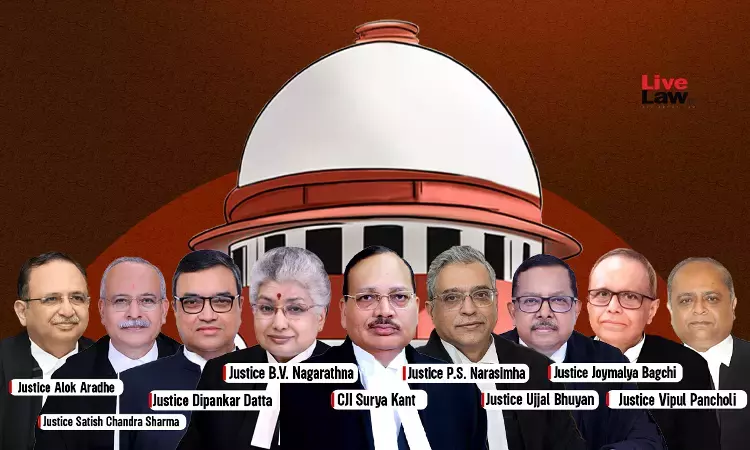
The seven decades old judicial debates on 'industry' under the Industrial Relations Law started with the interpretation of the definition Section 2 (j) of the Industrial Disputes Act, 1947. The first few years of interpretative battle was around the terminology 'undertaking' in the definition. After a 'zigzag' from broader to narrower interpretation, it settled over 'triple test' in Bangalore Water Supply and Sewerage Board v. A. Rajappa, (1978) 2 SCC 213. However, the inconclusive debate post-BWSSB was on 'how to define sovereign function'. This definition determines access to statutory remedies against dismissal/termination, wage disputes or bargaining rights. Any exclusionary reading will affect wide range of workers, in hospitals, municipalities, educational institutions and other government run establishments. This interpretative journey carries such a heavy weight even in 2026 and the workers still look forward to an inclusionary reading to retain or assert their rights.
The stakes: Why a statutory word matters so much
The Industrial Disputes Act, 1947 was conceived in the shadow of India's independence as a welfare-oriented framework. Its core premise was that the relationship between employer and worker is not merely a matter of private contract but a social relationship carrying public significance. The Act created a range of protections against wrongful retrenchment, layoffs, unfair dismissal, and denial of wages. But all of these protections apply only to workers employed in an 'industry' as defined under the Act. The definition is therefore the threshold to all rights under the statute.


Section 2(j) of the ID Act defines 'industry' in two parts. The first part provides that it 'means any business, trade, undertaking, manufacture or calling of employers'. The second part adds that it 'includes any calling, service, employment, handicraft or industrial occupation or avocation of workmen'. The language was deliberately broad, modelled on Section 4 of the Australian Commonwealth Conciliation and Arbitration Act, 1904. That very breadth has spent seven decades generating disagreement, and the disagreement has never been merely semantic.
When courts or legislators draw the boundary of 'industry' more generously, more working people fall within the law's reach. When they draw it narrowly, more are left outside. Each time an institution, a government department, a hospital, a university, a research laboratory, a municipality is carved out of the definition, the workers inside that institution are carved out along with it. They lose, in the same stroke, whatever the Act was designed to give them. Therefore, it contains a constitutional or welfare question whether the law can leave behind workers without any status or access to protection.
The Foundational Phase: Banerji to Hospital Mazdoor Sabha (1953-1960)
The first serious engagement with the question of 'industry' by the Apex Court was in the case of D.N. Banerji v. P.R. Mukherji, AIR 1953 SC 58. The dispute was about whether Municipality can be considered an 'industry', hence the workers can raise an 'industrial dispute' under the Act. The discussion brought in important inclusive jurisprudence about 'non-profit establishments' and held that 'profit motive' is not an essential criteria to become 'industry'. This brought wide range of establishments engaged in charitable, philanthropic or religious activities. Further, it introduced 'analogous to trade or business' test to state that any activity that has a resemblance to organised trade or business is considered as 'industry'.
The Court referred to the test 'whether capital and labour co-operate to satisfy human wants or desires' enunciated in Federated Municipal and Shire Council Employee's Union of Australia vs. Melbourne Corporation, decided by Isaacs and Rich JJ. This became a functional question in later cases and it was held that enterprise qualified to be an 'industry' if capital and labour cooperate for fulfilling human wants or desires, irrespective of there is profit motive intention. The Banerji court, however, expressly left open whether 'purely administrative' or governmental activities fell within the definition.
That unanswered question drove three decades of contradictory decisions. The gap was partially addressed in Corporation of the City of Nagpur v. Its Employees, AIR 1960 SC 675, where the Court drew a distinction between regal functions (defence, law and order, administration of justice, foreign affairs) and municipal functions. Only the former were excluded; the latter were held analogous to trade or business and thus 'industry'. The Court also introduced the 'dominant nature test', where an entity performs both regal and non-regal functions, the predominant character of its activities determines its status.
The most consequential first-phase decision was State of Bombay v. Hospital Mazdoor Sabha, AIR 1960 SC 610, where the Court formalised what became known as the 'triple test'. An activity is an 'undertaking' under Section 2(j) if it satisfies three conditions, (i) it is systematically or habitually undertaken for the production or distribution of goods or rendering of material services, (ii) it involves cooperative effort between employer and employee, and (iii) its object is the satisfaction of material human needs. The Court further established a clear test for identifying sovereign functions, if a private individual or a group of individuals is capable of undertaking a particular activity, that activity does not qualify as a sovereign function (private-individual test) and therefore falls within the ambit of the Act. In short, sovereign functions, those which no private individual could perform, alone were exempt from the purview of 'industry. This brought in all government-run hospitals to the definition. The court also reiterated 'non-profit motive' test evolved in Banerji.
Confusion and Contradiction: The Second Phase (1962-1978)
The functional clarity that first phase brought about was disrupted quickly after two years in University of Delhi v. Ram Nath, AIR 1963 SC 1873. The Supreme Court took a strict position that educational institution could not be considered as 'industry' as the dominant activity of the establishment is imparting education, which cannot be equated to industrial activity. Teaching being a higher avocation, teachers will not be workmen and the dominant activity, teaching, became the exclusionary criteria to deny the educational institution its status as an industry. This departure from functional logic in Hospital Mazdoor Sabha, led to further confusion in the interpretation.
This ambiguity was deepened in Secretary, Madras Gymkhana Club Employees' Union v. Madras Gymkhana Club, AIR 1968 SC 554, where stricter application of organised activity was laid down. Further, Justice Hidayatullah CJ dismissed the private-individual test for lack of analytical clarity in defining sovereign functions. This judgment left the interpretation again unsettled again without any reformulation of the existing tests.
The most consequential rupture, however, came with Safdarjung Hospital v. Kuldeep Singh, (1970) 1 SCC 735. Hidayatullah CJ, now writing as Chief Justice, held that Safdarjung Hospital fell outside the definition of 'industry' largely on the ground that it was operated as a department of government. In doing so, the judgment ran together two distinct ideas, governmental character and sovereign character, treating them as equivalent when they are not.
This was precisely the conflation that Hospital Mazdoor Sabha had gone out of its way to guard against. If every institution run by the government is excluded by virtue of being governmental, then the expansion of the welfare state becomes a mechanism for stripping workers of legal protection. The decision accentuated confusion in the jurisprudence without resolving any of the fundamental questions.
The Landmark: Bangalore Water Supply and Sewerage Board v. A. Rajappa (1978)
By the mid-1970s, the law could not hold. Different benches had applied different tests. The triple test of Hospital Mazdoor Sabha had been partially abandoned. The sovereign function exception had expanded to swallow welfare functions. A priori categorical exclusions had replaced functional analysis. The reference to a seven-judge bench in Bangalore Water Supply and Sewerage Board v. A. Rajappa, (1978) 2 SCC 213 (BWSSB) was the inevitable consequence.
Krishna Iyer J.: The Majority
Justice V.R. Krishna Iyer, writing for himself, Bhagwati J., and Desai J., delivered what remains the leading opinion. His method was not to create new doctrine but to restore and stabilise what had been settled and to overrule what had gone wrong since. The triple test was confirmed and reformulated, wherever there is systematic activity, organised by co-operation between employer and employees, for the production and/or distribution of goods and services calculated to satisfy human wants and wishes, there is prima facie an 'industry'. Absence of profit motive or gainful objective is irrelevant. The decisive test is functional, that is the nature of the activity, with emphasis on the employer-employee relationship.
On sovereign functions, Krishna Iyer J. was emphatic. Only genuinely sovereign functions, the core, non-delegable activities that belong exclusively to the state by their nature, such as defence, foreign affairs, legislation, the administration of justice, and taxation, could claim exemption. Welfare programmes and commercial establishments of the government or its statutory bodies were outside this exception. Safdarjung was expressly overruled. The Delhi University and Gymkhana Club decisions were overruled wherever their reasoning had been used to exclude entities on categorical rather than genuinely functional grounds. Hospital Mazdoor Sabha was restored.
Krishna Iyer J. also introduced the severability principle to the extent that a department which discharges sovereign functions, provided any unit satisfies the triple test can be identified as an industry and does not automatically inherit the sovereign exemption. This opened the analysis of complex governmental organisations.
Critically and this is a point that has been persistently misread, what the majority held was not that all clubs, all hospitals, and all universities are industries. What it held was that none of them could be categorically excluded without applying the triple test on their specific facts. A small hobby club with no real employer-employee structure would not qualify, but a larger one, would. The distinction, as Bhatia has noted, is between categorical exclusion and functional inclusion. The majority opinion made this explicit.
Beg CJ: The Concurrence That Goes Further
The Chief Justice delivered a brief concurring opinion that has been frequently misread as a partial dissent from Krishna Iyer J. A careful reading shows something different. Beg CJ agreed with the conclusion but was inclined to go further. His view was that the question of which state-run industries should be excluded from the Act was 'purely a matter of legislation and not of interpretation'. In essence, Beg CJ appeared to hold that the definition of 'industry', on its terms, admitted no interpretive exclusion at all not even for sovereign functions. It was stated that services that fall within Article 310 and 311 of the Constitution can alone qualify for sovereign functions. Any narrowing of the Act's reach was a matter for Parliament, not for courts.
This is not a conservative departure from the majority. Beg CJ while expressing scepticism about judiciary's interpretative exercise, it spoke about importance of legislative exercise around 'industry' to draw a line on the question of 'sovereign functions' and hence 'industry'. If we read harmoniously with the majority, Beg CJ's central position is to widen the definition of 'industry' by giving a broader reading to 'sovereign function' limiting to constitutional provisions on sovereign offices. It was held that the institutional character cannot be the lone basis for denial of workers' rights.
Chandrachud J. : Structural Ambiguity
Chandrachud J. wrote his part of the judgment on April 7, 1978 after other judges have delivered their opinions and Beg CJ's retirement from office. This indicates lack of discussion among majority judges on his opinion. His analysis tended towards the view that all kinds of organised activities giving rise to employer-employee relationships were covered by the wide definition of 'industry'. While he agreed with 'triple test, he did not agree with wider import of 'sovereign functions.
Taken together, the Krishna Iyer and Chandrachud opinions stop short of drawing any agreed, precise boundary around the sovereign function exemption. This is not, as Jai Bir Singh later suggested, a reason to dismantle the entire framework. It is, at most, a reason to clarify that boundary which is precisely what a nine-judge bench can and should do, rather than using the ambiguity as a pretext for overruling BWSSB's core holding.
Jaswant Singh J. and Tulzapurkar J.: The Minority
The minority view, authored by Jaswant Singh J. for himself and Tulzapurkar J., took a narrower position. Their formulation retained the requirement of 'commercial lines' as a feature of 'industry'. This position expressly at odds with the majority's rejection of the profit motive and commercial character as determinative criteria. This was the minority position. It did not form part of the binding ratio of BWSSB. It is mentioned here because later decisions, particularly the referral order in Jai Bir Singh, sometimes blend minority reasoning into what is characterised as ambiguity in the majority, a manoeuvre that does not survive a close reading of the judgment.
Where ambiguity remained was on the precise scope of the sovereign function exception. But even here, the positions of Krishna Iyer J. and Beg CJ can be read harmoniously. Sovereign functions, understood strictly as those constitutionally non-delegable functions of the state such as the armed forces, the administration of justice, the core machinery of sovereign governance, are excluded. Everything else, however governmental, however statutory, however charitable or non-commercial, falls to be assessed on the triple test and the dominant nature test.
Immediate Parliamentary response to BWSSB
The broader view in BWSSB invited criticism from the policy perspective for keeping sweeping triple test for determining 'industry' and lack of clarity over 'sovereign functions' in the judgment. While the Industrial Disputes (Amendment) Act introduced in 1982 retained triple test with categorical exclusions such as hospitals, dispensaries, educational and research institutions, charitable organisations, agricultural operations (with exceptions), domestic service and activities of the government relatable to sovereign functions.
Though it was enacted, but never notified. In Union of India v. Shree Gajanan Maharaj Sansthan, (2002) 5 SCC 44, when Supreme Court was asked to issue a mandamus to direct the central government to bring amended definition into force, the court declined the move. The Government's position was candid and, inadvertently, legally significant; the categorical exclusions could not be implemented until alternative dispute resolution mechanisms were established for workers who would lose access to the Act. No such mechanisms had been created. They remain uncreated to this day. The Government's own reasoning constituted an acknowledgment that the definition of 'industry' is the threshold to rights, and that removing categories of workers from its scope without substituting alternative protections means abandoning those workers to unregulated employment.
BWSSB: The Contestations that continued
The principles of BWSSB were clear enough. What followed was not. In a series of two-judge bench decisions, the Court repeatedly departed from the larger bench's ratio without acknowledging that it was doing so, creating precisely the kind of 'zigzag jurisprudence' that BWSSB had sought to end.
In Sub-Divisional Inspector of Posts, Vaicam v. Theyyam Joseph, (1996) 8 SCC 489, a two-judge bench held that the postal department performed sovereign functions and was therefore not an 'industry', without even referring to BWSSB. In Bombay Telephone Canteen Employees Association v. Union of India, (1997) 6 SCC 723, another two-judge bench held that the Telecommunications Department was not an 'industry', deviating from the dominant nature test. Both decisions were subsequently overruled by a three-judge bench in General Manager, Telecom v. A. Srinivasa Rao, (1997) 8 SCC 767, which reaffirmed that BWSSB governed the field and that smaller benches were not free to depart from the seven-judge bench.
In Chief Conservator of Forests v. Jaganath Maruti Kondhare, (1996) 2 SCC 293, the Court held that the social forestry department of a state was not a sovereign function and therefore constituted 'industry'. Yet in State of Gujarat v. Pratamsingh Narsingh Parmar, (2001) 9 SCC 713, another bench reached the opposite conclusion on a forest department. The conflict between these two decisions led to a reference to a Constitution Bench.
In Physical Research Laboratory v. K.G. Sharma, (1997) 4 SCC 257, a space research institution funded by the Department of Space was held not to be an 'industry' on the basis that its object was not to render services to others. The reasoning diverged from BWSSB's functional analysis without explicitly acknowledging the departure.
In Coir Board, Ernakulam v. Indira Devi P.S., (1998) 3 SCC 259, a two-judge bench expressed the view that BWSSB 'might have done more damage than good' and requested the Chief Justice to constitute a larger bench to reconsider it. A three-judge bench subsequently clarified that BWSSB required no reconsideration and directed the Coir Board appeal to the appropriate bench for hearing on merits. All the above cases were discussing lack of clarity around 'sovereign function' deriving from BWSSB, but not on the veracity of the 'triple test'.
The Nine-judge bench reference: State of U.P. v. Jai Bir Singh (2005)
The conflicts accumulated and could not be contained. A Constitution Bench in State of U.P. v. Jai Bir Singh (2005) held that a reference to a bench larger than BWSSB's seven judges was required for reconsideration of the definition. The reasons given were notable, Firstly, the judges in BWSSB had delivered opinions at different times, in some cases without seeing each other's opinions. Second, Parliament had responded to the judicial call for reform by amending the definition in 1982, but had not brought the amendment into force for 23 years. Third, the legal position remained uncertain in relation to 'sovereign functions'. The nine-judge bench reference was formally confirmed in 2016. The matter has been pending since.
The IR Code 2020: A New Statutory Move
In 2020, Parliament enacted the IR Code, consolidating the ID Act and two other statutes. The Code retains the triple test's framework in structure and the categorical exclusions from the unenforced 1982 Amendment to the extent that the hospitals, educational institutions, charitable organisations, and government departments are excluded from the definition of 'industry'. When that happens, the institutional exclusions that BWSSB struck down will simply come back through legislation. The government itself admitted in 2002 that not notifying the 1982 Amendment was indefensible. The same reason which is not having any alternative for workers on removal from the Industrial Disputes Act, 1947, is effectively applicable in the case of IR Code today. Since Jai Bir Singh referral case is now being heard after the IR Code, the legislative intention now is clear to keep 'triple test'. However, the limitation that were alleged around 'sovereign functions' BWSSB and non-profit organisations are legislatively excluded under the IR Code. Therefore, the Nine-Judge Bench has to pierce the veil of this insertion and exclusionary intentions needs to be addressed.
Discussion on the same question
While discussing the same interpretational question of 'industry' by the nine-judge bench, the same argument of impact of broader definition on large number of industries came for discussion before the court. However, it is clear from the Jai Bir Singh's judgment and referral order, the question of law that was inconclusive in their opinion was the interpretation of 'sovereign function'.
The IR Code enforced in 2025, upholds 'triple test' with certain exemptions including non-profit organisations and departmental functions as sovereign functions. As the majority in Seven Judge Bench in BWSSB directed for legislative action, IR Code 2020 becomes an important material for the court. As the BWSSB, Amendment Act, 1982 and IR Code 2020, adopts 'triple test' now. The next question is interpretation of 'sovereign function' to finest certainty as this became reason for Jai Bir Singh's referral order. BWSSB has attempted to confine to 'primary and inalienable functions' of the state. This will also clarify that it is not institutional identity that matters for inclusion, but the idea of work and workers that institution carries. The dominant nature test also assists to determine 'what is the work' that the enterprise is engaged in. This test is not on who set it up or whether it receives government funding. The challenge is that any proposition moving away from BWSSB, would remove millions of workers without any alternative forum to approach for their protection.
The word and What rides on it
The Nine-Judge Bench is an opportunity to settle the 'zig-zag' interpretation of 'industry' over seven decades. The Parliament has sat on a notified amendment for over four decades post-1982 Amendment which was notified. It owes workers a clearer answer. The government that acknowledged in 2002 that you cannot exclude workers from the Act without providing them an alternative has a continuing obligation to honour that acknowledgement. The IR Code 2020 through new legislative exercise, has brought in restrictions to BWSSB expanded interpretation. If this is taken as new law, the excluded workers as per the definition do not have alternative infrastructure to approach for their grievances. So the need is to fill in this paradox of lack of an alternative grievance dispute mechanism before the threshold to rights is narrowed.
Author is an Associate Professor & Director, Centre for Labour Law Research and Advocacy at the National Law University Delhi. Views are personal.


