



The Jurisprudence Of Command And The Constitutional Impasse
Rishabh Tyagi
26 March 2026 1:00 PM IST
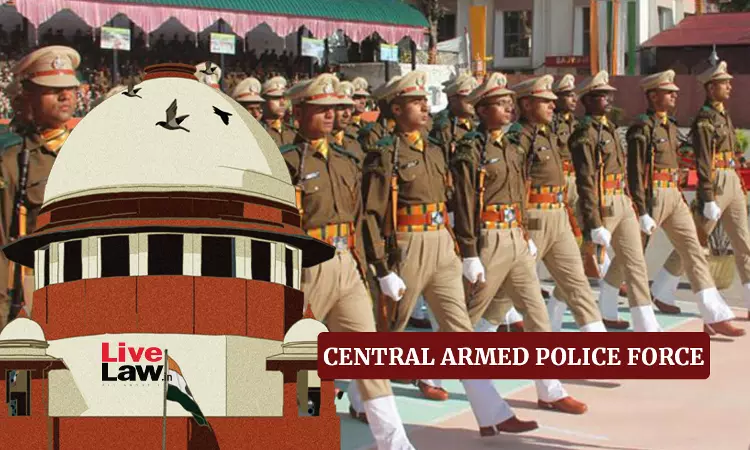
The Indian constitutional project currently faces a defining moment of friction, a precipice where the destiny of thirteen thousand Group-A cadre officers and the institutional integrity of the Supreme Court of India stand in the balance. At the heart of this storm lies the decision in Sanjay Prakash & Ors. v. Union of India & Ors. (2025 INSC 779), a judgment that did not merely settle a service dispute but sought to restore a foundational compact between the State and those who guard its most volatile frontiers. As the Union Cabinet moves to introduce the CAPF (General Administration & Regulation) Bill, 2026, the Republic confronts an urgent constitutional impasse: can the legislature, through ordinary enactment, dismantle a remedial architecture constructed by the Court to protect fundamental rights?
The central legal achievement of 2025 INSC 779 lies in its unequivocal extension of Organised Group-A Service (OGAS) status to the five Central Armed Police Forces—CRPF, BSF, CISF, ITBP, and SSB—for every purpose known to service law. This was an essential judicial intervention, moving beyond the restricted purpose of Non-Functional Financial Upgradation (NFFU) to the very core of promotional architecture. OGAS status under the Department of Personnel and Training's framework is not a mere administrative classification; it is the juridical threshold that triggers a cascade of entitlements: structured cadre review cycles, promotional benchmarking, and the constitutional protection of Articles 14 and 16. Prior to this judgment, successive governments had argued that OGAS recognition could be compartmentalized, effectively creating a class of "Organised" services that were denied the actual organizational benefits of command. The Bench definitively foreclosed that argument, holding that recognition, once granted on constitutional grounds, cannot be bifurcated for executive convenience.


The bench's application of Articles 14 and 16 to the service conditions of CAPF officers constitutes the jurisprudential heart of the matter. Article 16(1) guarantees equality of opportunity in matters of public employment. The Supreme Court has consistently held that promotional channels which create an unreasonable distinction between similarly situated officers violate this guarantee. The distinction between a CAPF cadre officer and a laterally deputed IPS officer is not one of qualification or competence; it is a distinction of service cadre maintained by recruitment rules that had, over decades, congealed into a structural discriminatory apparatus. Invoking the D.S. Nakara v. Union of India principle—that a classification which is arbitrary and creates a penalized class of government servants violates Article 14—the Court held that the existing promotional architecture failed constitutional scrutiny. It further invoked T.R. Kapur v. State of Haryana for the proposition that promotion policy must bear a demonstrable nexus to operational requirements. There is no rational nexus between the operational demands of border management and counter-insurgency and the institutional preference for officers whose formative experience lies in state-level policing.
The Court's engagement with Article 309—which empowers Parliament and the President to regulate the recruitment and conditions of service—is particularly significant. The judgment did not invalidate the IPS Cadre Rules, 1954, or the recruitment rules of individual CAPFs in a vacuum; it employed the technique of constitutional reading-down. The rules subsist, but the administrative practice of treating deputation posts as permanently reserved for external cadres, in a manner that structurally excludes indigenous cadre officers from senior command, has been judicially condemned as ultra vires. Article 309 authority, however broad, must be exercised in conformity with Part III. A service condition structured to systematically disadvantage a class of government servants without rational justification is not saved by the breadth of Article 309 power. An officer who has conducted anti-terror operations for sixteen years should not need the Supreme Court to tell the State that he deserves the right to lead his own force.
The CAPF (General Administration & Regulation) Bill, 2026, approved by the Union Cabinet and listed for introduction in the Budget Session, raises a consequential constitutional question: whether Parliament may legislatively neutralize the operative directions of a binding Supreme Court judgment without crossing the threshold established in L. Chandra Kumar v. Union of India (1997). Sitting in a seven-judge Constitution Bench, the Court held that the power of judicial review is a basic feature of the Constitution that cannot be abrogated even by constitutional amendment, let alone by ordinary legislation. While Parliament may change the law prospectively or alter the statutory norm upon which the court's reasoning rested, it may not—consistent with State of Tamil Nadu v. State of Kerala (2014) and Madan Mohan Pathak v. Union of India (1978)—simply embed a condemned administrative practice into a statutory framework to strip the court's directions of their remedial force.
The timing of the Bill's Cabinet approval is not merely contextually significant; it is jurisdictionally provocative. The Bill was approved during the pendency of contempt proceedings arising from the government's non-compliance with the 2025 judgment. Article 129 of the Constitution vests in the Supreme Court the jurisdiction of a court of record, including the power to punish for contempt. This jurisdiction extends to the conduct of constitutional authorities whose actions tend to obstruct the administration of justice. The question of whether the introduction of legislation, during the pendency of contempt proceedings and with the apparent purpose of foreclosing the court's remedial mandate, constitutes an act tending to obstruct the administration of justice engages Article 129 at its most fundamental level.
The separation of powers, identified in Indira Nehru Gandhi v. Raj Narain (1975) as a constituent element of the Constitution's unamendable basic structure, imposes a further and independent constraint. Judicial power—the power to authoritatively determine the legal rights and obligations of parties and to enforce those determinations—is constitutionally vested in the courts and cannot be negated by the legislature. A statute whose operative effect is to pronounce that what the Supreme Court has directed need not be complied with, because Parliament has now spoken, does not merely violate Article 141; it transgresses the separation of powers. If the 2026 Bill is read as such a statute, it carries within its four corners the seed of its own constitutional invalidity.
Law exists to protect persons. Every citation and doctrinal distinction exists, ultimately, to vindicate the rights of a person. That person is the CAPF cadre officer who joined as an Assistant Commandant and has spent decades in environments where physical risk is a daily reality. This officer is among the nearly thirteen thousand Group-A cadre officers of five forces collectively comprising approximately ten lakh personnel. Prior to the May 2025 judgment, fifty per cent of Inspector General posts in several CAPFs were earmarked for deputation—a structural glass ceiling that ignored operational record. Many DIG posts sanctioned for deputation remained vacant because officers declined postings for reasons of personal preference, yet the government continued to argue for the indispensability of the system.
This is not merely a career grievance; it is a matter of constitutional conscience. The State that sends a man into the Bastar forests or to the Siachen laterals and then tells him that the Constitution cannot guarantee him a promotion has broken a foundational compact. The Supreme Court, to its enduring credit, sought to repair this compact on May 23, 2025. The question the 2026 Bill now poses to Parliament and the Executive is whether that repair will be honored.
A constitutionally wholesome Bill would establish a statutory cadre review mechanism with mandatory timelines, addressing the non-compliance with the Court's direction. It would prescribe a transparent framework for limited inter-service coordination that does not operate as a structural ceiling on cadre progression. And it would provide an ameliorative mechanism for the accumulated promotional deficit of those officers whose careers have been stunted. A Bill that achieves these three goals will be a constitutionally defensible piece of legislation. A Bill that instead seeks to codify the very inequality the Court struck down will not only fail the test of Article 14 but will strike at the institutional integrity of the Supreme Court itself.
The credibility of the law is measured by the faith it can sustain among those for whom it is the final recourse. For CAPF officers, that moment arrived on May 23, 2025. The institutional integrity of the Supreme Court of India is now at stake, as is the fundamental separation of powers that sustains our democracy. The judicial mandate must not be taken back by legislative fiat.
Author is an Advocate practicing at Delhi High Court. Views are personal.


