Kerala To Keralam: Decoding The Constitutional Process Of Renaming A State
Zulfiker Ali
27 Feb 2026 11:05 AM IST
The Constitutional Mechanism For Alteration Of State Names In India
The Republic of India, as articulated in Article 1 of its Constitution, is a "Union of States." The territorial integrity of these constituent states, however, is not immutable. The Constitution of India confers upon the Parliament the power to reorganise the states, including the authority to alter their names. This power is a significant feature of India's quasi-federal structure, often described as an "indestructible union of destructible states." In re: Berubari Union Judgment (1960), the Supreme Court of India has clarified that Article 3 gives Parliament the power to "destruct" the identity of a state. This reinforces the idea that India is an indestructible Union of destructible States.
The procedure for changing the name of a state is primarily governed by Article 3 of the Constitution. This article seeks to provide a comprehensive legal analysis of the constitutional provisions and the procedural framework established for the alteration of a state's name.
The Governing Provision: Article 3 Of The Constitution
Article 3 of the Constitution of India is the cornerstone of the law concerning the formation of new states and the alteration of areas, boundaries, or names of existing states. It empowers the Parliament to enact legislation to achieve these ends. Specifically, Article 3 provides that Parliament may by law (a) form a new State by separation of territory from any State or by uniting two or more States or parts of States or by uniting any territory to a part of any State; (b) increase the area of any State; (c) diminish the area of any State; (d) alter the boundaries of any State; (e) alter the name of any State.


The power vested with the Parliament to change the name of any existing state is plenary and is not subject to any substantive limitations, provided the prescribed procedure is followed.
The Mandatory Constitutional Procedure
The exercise of power under Article 3 is not absolute and is circumscribed by a specific procedure laid out in the proviso to the Article. The process is a carefully calibrated one, involving both the Union Executive and Legislature, as well as the concerned State Legislature. The steps are as follows:
- Prior Recommendation of the President: The first and most critical step is that no Bill for the purpose of altering the name of a state can be introduced in either House of Parliament except on the recommendation of the President of India. This ensures that any such proposal has the imprimatur of the Union Executive before it is considered by the Legislature. Most of the time the process of introducing the Bill begins with a proposal from the concerned state government to the Central Government.
- Reference to the State Legislature: Where the proposal contained in the Bill affects the area, boundaries, or name of any of the States, the Bill must be referred by the President to the Legislature of that State for expressing its views thereon. Even if the Bill was initiated on the recommendation of concerned state, the draft Bill must be referred to the Legislature of that state to ensure compliance with constitutional procedures. The President is required to specify a period within which the State Legislature must express its views. The President may, at his discretion, extend the period so specified.
Once the period for the State Legislature to comment has expired or if the state has sent it views, the Bill can be introduced in either House of the Parliament.
- The Non-Binding Nature of State Views: A pivotal aspect of this procedure is that the views expressed by the State Legislature are not binding on the President or the Parliament. If the State Legislature fails to express its views within the stipulated period, the Bill can still be introduced in Parliament. Furthermore, even if the State Legislature expressly rejects the proposal or suggests modifications, Parliament is under no constitutional obligation to accept them. This underscores the unitary bias within the Indian federal system, where the will of the Union Parliament prevails over the objections of a constituent state in matters of its own name and territory.
- Enactment by a Simple Majority: Once the Bill is introduced in Parliament, it is treated as an ordinary piece of legislation. It must be passed by a simple majority in both the Lok Sabha and the Rajya Sabha. This procedural simplicity is a deliberate constitutional choice to facilitate territorial reorganisation in the national interest.
- Presidential Assent: After being passed by both Houses of Parliament, the Bill is presented to the President for his assent. Upon receiving the President's assent, the Bill becomes an Act, and the name of the state stands formally and legally altered from the date specified in the Act.
Exclusion from the Ambit of Article 368:
Article 4(2) of the Constitution explicitly clarifies that any law made under Article 2 or Article 3 shall not be deemed to be an amendment of the Constitution for the purposes of Article 368. This means that the reorganisation of states, including a change of name, does not require the special majority (two-thirds of members present and voting) and ratification by states, which is mandated for most constitutional amendments. This provision grants Parliament significant flexibility and power in redrawing the internal map of India.
The entire process, particularly the non-binding nature of the state's opinion, firmly establishes the sovereignty of the Union Parliament in matters of state reorganisation. It reflects the Constituent Assembly's intent to create a strong central government capable of making changes to the federation's structure to accommodate linguistic, cultural, or administrative exigencies without being fettered by the intransigence of individual states.
Locus classicus on Article 3 is the Judgment of Supreme Court of India in Babulal Parate vs. State of Bombay (1960). The Supreme Court established two critical principles in this case. (i) The Proviso is Procedural, Not Substantive. The Court held that the requirement to refer the Bill to the State Legislature is only to ensure their views are "on record." (ii) The Parliament is not bound to accept the views of the State Legislature. Even if the State Assembly unanimously rejects the name change or boundary alteration, the Parliament can proceed. It was further held by the Court that even if the Bill is amended in Parliament after the State has given its views, a fresh reference to the State Legislature is not required unless the amendment introduces a completely new "proposal" not contemplated originally.
Supreme Court has consistently noted that Article 3 is a "safety valve" for a diverse nation. Because name changes often stem from linguistic or cultural movements (like the change from Orissa to Odisha in 2011), the Court views the Parliament's "simple majority" power as a way to prevent a single state from blocking national reorganization or cultural alignment.
Article 4(1) provides that any law referred to in Article 3 shall contain such provisions for the amendment of the First Schedule and the Fourth Schedule as may be necessary to give effect to the provisions of the law. The First Schedule lists the names of the States and Union Territories, while the Fourth Schedule allocates seats in the Rajya Sabha. A change in a state's name necessitates a corresponding amendment to the First Schedule, which is accomplished by the same Act passed by a simple majority. No constitutional amendment under Article 368 is required to that effect.
The constitutional framework for changing the name of a state in India is a testament to the unique nature of Indian federalism. It is a process meticulously designed to be initiated by the Union, consultative in its approach towards the state, but ultimately decisive at the central parliamentary level. The power vested in Parliament under Article 3, read with Article 4, is extensive and flexible, allowing the nation to adapt its internal political geography to evolving circumstances. While the role of the State Legislature is purely recommendatory, the practice of consultation upholds the spirit of cooperative federalism. The procedure strikes a balance between the need for national unity and integrity on one hand, and the recognition of distinct regional identities on the other, ensuring that the Union of India remains a dynamic and responsive political entity.
Reflection of Socio-Political Aspirations:
Historically, the renaming of states has been a mechanism to reflect regional identity and shed colonial legacies. The change from "Madras State" to "Tamil Nadu" (1969), "Mysore State" to "Karnataka" (1973), "Orissa" to "Odisha" (2011), and "Uttaranchal" to "Uttarakhand" (2007) are prominent examples. These changes are not merely cosmetic but are deeply connected to the cultural, linguistic, and historical identity of the people of the state, and the constitutional process provides a legitimate channel for these aspirations to be realised.
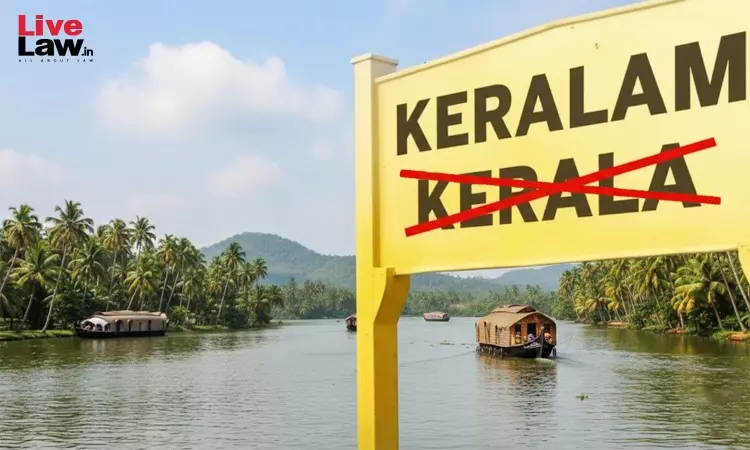
The on-going process for renaming Kerala provides a modern look at the procedure. The Kerala Assembly passed a unanimous resolution requesting to changing its name from Kerala to "Keralam." The resolution emphasized that "Keralam" is the name used in the native Malayalam language and reflects the state's linguistic identity established during the 1956 reorganization. On February 24, 2026, the Union Cabinet formally approved the proposal. The President is now set to refer the Kerala (Alteration of Name) Bill, 2026 to the State Assembly for its views, a formal step despite the fact that the Assembly itself originated the request. Once the State's views are received, the Union Government will obtain the President's recommendation to introduce the Bill in both Houses of Parliament. It will require a simple majority to pass and officially amend the First Schedule of the Constitution.
While Kerala's request was approved and about to reach at positive conclusion, a similar proposal from West Bengal to change its name to "Bangla" (requested in 2018) remains pending. The Central Government had previously cited technical and diplomatic concerns regarding the similarity to "Bangladesh".
Author is an Advocate practicing at Supreme Court of India. Views are personal