Suspension Of Kuldeep Singh Sengar's Sentence In Unnao Rape Case Is Legally Flawed & Problematic
Manu Sebastian
25 Dec 2025 3:20 PM IST
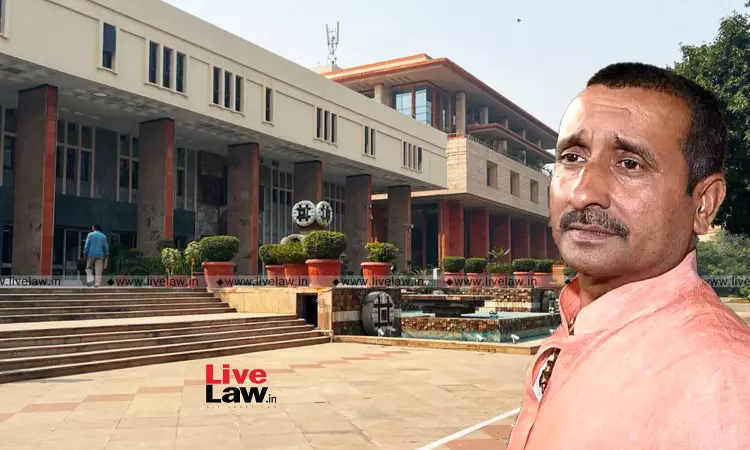
The High Court's order is not based on any prima facie finding regarding innocence but on a hypertechnical view about the misclassification of the offence.
The recent order of the Delhi High Court suspending the sentence of ex-BJP MLA Kuldeep Singh Sengar in the Unnao rape case is problematic for the manner in which it ignored and trivialised the gravity of the offence, while following a textual interpretation of the word 'public servant'.
In essence, the Court noted that a sitting MLA does not qualify as a “public servant” within the meaning of Section 21 of the Indian Penal Code. On this reasoning, it concluded that Section 5(c) of the Protection of Children from Sexual Offences Act, 2012, which treats penetrative sexual assault by a public servant as an aggravated offence, is inapplicable. The Court further held that Section 376(2) IPC, which also treats rape by a public servant as an aggravated form, would not apply. Consequently, it ruled that the sentence of imprisonment for the remainder of life imposed under these provisions could not be sustained.
The Court's interpretation that an MLA is not a "public servant" for the purposes of Section 5(c) of the POCSO Act may appear to be valid on a pure textual and technical reading (POCSO Act adopts the definition given in the IPC). However, even if we ignore the application of Section 5(c), Sengar can still be regarded as guilty of penetrative sexual assault of a minor under Section 4 of the POCSO Act, which is punishable with life imprisonment. Likewise, life imprisonment under Section 376 IPC is also attracted for the offence of rape.


Even accepting the Court's view regarding the application of Section 5(c) of the POCSO Act, the grant of suspension appears difficult to reconcile with well-settled principles governing suspension of sentence in cases involving life imprisonment for grave sexual offences.
Case background and context
The Unnao rape case of 2017 is not an ordinary prosecution. The offence came to be registered only after sustained public protests by the victim, including a drastic act of attempting self-immolation outside the Chief Minister's home. Sengar was arrested in 2018 only after the intervention of the Allahabad High Court which had observed, "The disturbing feature of the case is that the law and order machinery and the government officials were directly in league and under the influence of Kuldeep Singh."
The case had a clear pattern of victim intimidation by abusing official powers and political leverage. Family members of the survivor were targeted after the incident. The victim's father was arrested on questionable grounds, assaulted while in custody, and later died. In March 2020, the trial court sentenced Sengar to 10 years imprisonment under Section 304(Part II) IPC for the culpable homicide of the father of the survivor.
In 2019, following an incident of a truck colliding against a car in which the survivor and her family members were travelling to the trial court - which was then suspected to be a staged accident - the Supreme Court transferred the trial of the cases to Delhi from Uttar Pradesh. A Delhi Court later ruled out foul play in the accident.
In December 2019, the trial court, while convicting and sentencing Sengar, recorded that the survivor was threatened to keep quiet and her family was systematically targeted to silence her.
This background should be central to any judicial assessment of whether a convicted person should be enlarged on bail by suspending a life sentence. Treating the present case as a routine appeal against conviction ignores the very circumstances that made judicial intervention necessary in the first place.
Suspension of sentence in life imprisonment cases
The law on suspension of sentence after conviction is clear. In cases with fixed-term sentences, suspension of sentence is the norm. However, in cases involving life imprisonment, suspension is an exception. The Supreme Court has consistently held that once a person has been convicted and sentenced to life imprisonment, the presumption of innocence no longer operates.
Recently, the Supreme Court severely criticised the Jharkhand High Court for casually suspending the sentence in a murder case. In that judgment(Chhotelal Yadav v State of Jharkhand), referring to various precedents, the Supreme Court observed : “The only consideration that should weigh with the appellate court while considering the plea for suspension of sentence of life imprisonment is that the convict should be in a position to point out something very palpable or a very gross error in the judgment of the Trial Court on the basis of which he is able to make good his case that on this ground alone, his appeal deserves to be allowed and he be acquitted.”
The key point here is whether the inapplicability of Section 5(c) can alone be a ground for setting aside the acquittal. In Sengar's case, even if Section 5(c) is not applicable, there are strong grounds for conviction under Section 4 of the POCSO. The High Court ought to have considered whether the inapplicability of Section 5(c) would lead to his complete acquittal in the case.
Gravity of offence and role of the accused
The major flaw in the High Court's judgment is that it does not consider whether a case is made out for conviction under Section 4 of the POCSO. The High Court says that there is no need to enter into such aspects since Section 5(c) is anyway found to be inapplicable(See para 35 of the judgment).
The Supreme Court has consistently held that the gravity of the offence and the role of the accused are major factors to be considered while suspending sentence. (See recent judgment in Rajesh Upadhyay v State of Bihar, Vijay Kumar v. Narender & Ors., (2002) 9 SCC 366.)
Also, the High Court has to be prima facie satisfied that the convict has a fair chance to succeed in his appeal.
In Omprakash Sahni v. Jai Shankar Chaudhary & Anr(2023), it was held that the endeavour on the part of the Court, while considering sentence suspension, “should be to see as to whether the case presented by the prosecution and accepted by the Trial Court can be said to be a case in which, ultimately the convict stands for fair chances of acquittal”
In Jamanlal v State of Rajasthan and another(2025) it was held that a few lacunae or loopholes here or there in the case of the prosecution cannot be a ground to suspend the sentence, and that the Court has to arrive at a prima facie satisfaction that the conviction may not be sustainable.
In this case, the High Court's relief is only based on the non-applicability of Section 5(c). It does not reach any prima facie finding that the offence of penetrative sexual assault under Section 3/4 POCSO is not attracted. The High Court says that even if Section 4 POCSO is applicable, he can be given relief since he has already suffered the minimum sentence of 7 years prescribed for that offence. The fact that the offence under Section 4 POCSO Act is punishable with life imprisonment is grossly ignored.
Threat to the victim is also a vital factor in decisions on suspension of sentence. In this case, the record itself shows a history of intimidation and violence directed at the survivor's family. The death of the survivor's father, the alleged attempts to silence witnesses, and the extraordinary security measures that were considered necessary during trial are not disputed facts. Without bestowing its serious attention to these circumstances, the High Court appeared to have casually brushed aside such concerns by observing that a convict cannot be kept in jail on the assumption that police would not do their job properly.
The High Court's order reflects a hypertechnical approach that sidelines the seriousness of the offence and its impact on the survivor. By trivialising these considerations, the decision raises troubling questions about the approach to suspension of sentence in cases involving extreme gravity, entrenched abuse of power, and a demonstrable history of intimidation.
The author is the Managing Editor of LiveLaw. He can be reached at manu@livelaw.in