



Legal Proceedings Led To Martyrdom Of Bhagat Singh, Sukhdev And Rajguru
AKASH VAJPAI
18 March 2026 3:07 PM IST
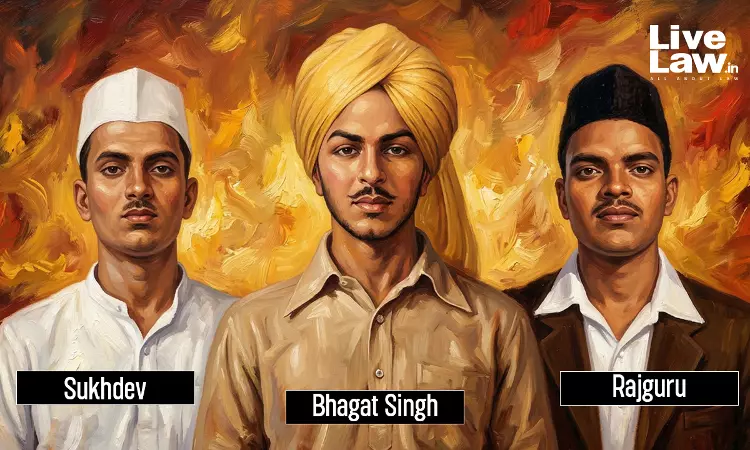
Bhagat Singh faced two significant trials during his lifetime. The first arose from the Central Legislative Assembly Bomb incident in Delhi, while the second was the Lahore Conspiracy Case concerning the killing of Mr. Saunders in retaliation for the death of Lala Lajpat Rai. In the former, Bhagat Singh and Batukeshwar Dutt were sentenced to life imprisonment, whereas in the latter Bhagat Singh, along with Sukhdev and Rajguru, was awarded the death penalty. Following a prolonged legal battle, the three revolutionaries were hanged on 23 March 1931. Nearly ninety-five years later from their martyrdom, everyone should know those historic legal proceedings faced by India's bravest sons and the last-minute efforts made by the legal fraternity to save them from the gallows.
First Trial (Assembly Bomb Case)
Session Trial No. 9 of 1929
Crown Vs. Bhagat Singh and Batu Keshwar Datta
On 8 April 1929, Bhagat Singh and Batukeshwar Dutt threw low-intensity bombs in the Central Legislative Assembly to protest against the Public Safety Bill and the Trade Disputes Bill introduced by the British government. The bombs were intentionally non-lethal, as their objective was to draw public attention to what they regarded as unjust and repressive laws rather than to cause harm to anyone. Although a few individuals, including Sir Bomanji Dalal and Sir George Schuster, sustained minor injuries, neither appeared before the court as witnesses or complainants. After the incident, both revolutionaries voluntarily surrendered, believing their arrest would help publicize their cause. The Sessions Court in Delhi nevertheless convicted them under Section 307 of IPC (attempt to murder) and Section 3 of the Explosive Substances Act. On 12 June 1929, Sessions Judge Leonard Middleton sentenced them to transportation for life. Their appeal before the Lahore High Court (Criminal Appeal No. 748 of 1929) was also subsequently dismissed, and the conviction and sentence were upheld. Batukeshwar Dutt was sent to the Andamans (Kala Pani) to serve his life sentence, while Bhagat Singh was transferred to Lahore to stand trial in the Lahore Conspiracy Case.


Trial 2 (Lahore Conspiracy Case)
Members of the Hindustan Socialist Republican Association (HSRA), including Bhagat Singh, initially planned to assassinate J.A. Scott, Superintendent of Police, Lahore, whom they held responsible for the lathi charge that led to the death of Lala Lajpat Rai. However, due to a mistaken identification by Jai Gopal, who later turned approver, Bhagat Singh and Rajguru shot and killed J.P. Saunders, Assistant Superintendent of Police, on 17 December 1928 as he emerged from the police headquarter. The Lahore Conspiracy Case was initially registered under Sections 121, 121A, 122 and 123 of the Indian Penal Code for conspiracy and waging war against the Crown. Later, when the police connected Bhagat Singh to the murder of Mr. Saunders, Section 302 of the IPC was added. The trial began in the ordinary course, but as proceedings slowed due to the large number of prosecution witnesses around 607, the British Government intervened. Viceroy Lord Irwin promulgated Ordinance III of 1930, constituting a Special Tribunal of three High Court judges to expedite the trial. The ordinance removed the usual right of appeal or revision available under the Criminal Procedure Code and also empowered the tribunal to continue proceedings in the absence of the accused. Consequently, several hearings were conducted ex parte, under Section 9 of the ordinance. By 26 August 1930, the prosecution had examined 457 witnesses and then closed its case, giving up the remaining witnesses. No defence witnesses were produced, nor was any list submitted on behalf of the accused. The prosecution's case largely relied on the testimony of five approvers—Jai Gopal, Phonindra Nath Ghosh, Man Mohan Bannerji, Hans Raj Vohra and Lalit Kumar Mukerji—as there was no direct evidence against Bhagat Singh and the other accused. The prosecution concluded its arguments on 10 September 1930, and the case was reserved for judgment. On 7 October 1930, the Special Tribunal comprising Justice G.C. Hilton (President), Justice Abdul Qadir and Justice J.K. Tapp sentenced Bhagat Singh, Sukhdev and Rajguru to death and fixed 27th October 1930 as the date for their execution.
The Special Leave Petition (SLP) before the Privy Council
Since the ordinance issued by the Viceroy had taken away the right to appeal before the High Court, Bhagat Singh and the other accused had no statutory remedy against the death sentence. Their only legal option was to approach the Judicial Committee of the Privy Council in London, the highest court of the British Empire, by filing a Special Leave Petition. Although Bhagat Singh was initially reluctant to challenge the sentence, he eventually agreed to do so after persuasion from his father. Owing to the pendency of this petition, the execution scheduled for 27 October 1930 was postponed while the Government awaited the decision of the Privy Council. On 11 February 1931, the Privy Council dismissed the petition, and on 27 February 1931 it delivered detailed reasons for its decision. Bhagat Singh and others had challenged the authority of the Governor-General to constitute a Special Tribunal through an ordinance for conducting the trial, arguing that such an ordinance could only be issued in circumstances of genuine emergency and only to restore peace and good governance. These two essential conditions were not met before promulgating the ordinance. However, the Judicial Committee, presided over by Viscount Dunedin along with Lord Thankerton, Lord Russell of Killowen, Sir George Lowndes and Sir Dinshaw Mulla, rejected these arguments and upheld the legality of the ordinance and the tribunal.
Last Minutes legal efforts to save lives of Bhagat Singh, Sukhdev Thapar, and Shivaram Rajguru
After the Privy Council dismissed the Special Leave Petition, the execution of Bhagat Singh, Sukhdev and Rajguru appeared inevitable. Nevertheless, several patriotic lawyers continued to make last-minute efforts to delay the hanging. Among them one was Advocate Sham Lal, who took a notable legal initiative to save their lives. On 16 February 1931, advocate Sham Lal filed an application before the Government seeking postponement of the execution on the ground that in another criminal case, the Second Lahore Conspiracy Case (Crown v. Kundan Lal & Others), Bhagat Singh, Sukhdev and Rajguru were important witnesses for the defence. As the prosecution in that case had nearly 710 witnesses, their presence was essential for the defence to effectively challenge the prosecution's case. Sham Lal argued that if the executions were carried out, the accused in that case would be deprived of the opportunity to present their defence and prove their innocence. However, on 20 February 1931, the Chief Secretary to the Government of Punjab rejected the application, stating that such a request could not be allowed to interfere with the ordinary course of justice in the case of Crown v. Bhagat Singh & Others.
The Habeas Corpus Petition filed before the Lahore High Court
As the newly fixed date of execution, 23rd March, 1931 was fast approaching, it became a race against time to save the lives of the brave revolutionaries. When earlier efforts failed to yield any result, a Habeas Corpus Petition was filed before the Lahore High Court under Section 491 of the Criminal Procedure Code, 1898. It was contented that since the Special Tribunal which had sentenced Bhagat Singh, Sukhdev and Rajguru to death had ceased to exist, there was no authority competent to issue a fresh warrant for the execution of the sentence. Under the law, it was only the court that had passed the death sentence could issue the execution warrant. However, this argument was rejected by Justice Bhide of the Lahore High Court, who dismissed the petition on 24 February 1931, holding that the contention lacked merit. Justice Bhide made the following observations while dismissing the habeas corpus petition:
……..It seems to me unnecessary to express any opinion on this question for the purposes of this petition. As stated already, it is conceded that the original warrant committing the prisoners to custody was issued according to law and it is also conceded that the Local Government had the authority to suspend the execution of the sentence as it did. The question as to what steps can be legally taken to carry out the sentence is one for the Local Government to decide. Even if the Local Government finds that there is any legal difficulty in charring out the sentences as contended on half of the petitioners, it would be still open to the Local Government under section 402 CrPC, 1898 to commute the sentence into one of transportation or imprisonment. It seems to me, therefore, clear that the custody in which the prisoners are kept at present cannot in any case be considered to be illegal or improper.
As the date of execution drew closer, with only a few days remaining, another legal attempt was made to prevent the hanging of Bhagat Singh and his associates. A legal notice under Section 80 of the Civil Procedure Code (CPC) was served upon the British Government, contending that the Special Tribunal which had sentenced them to death had ceased to exist and had not been succeeded by any authority competent to issue fresh warrants for the execution of the sentence, as required under Sections 381, 389 and 400 of the Criminal Procedure Code. It was therefore proposed to institute a civil suit against the British Government and the concerned officials seeking a declaration that the death sentence had become incapable of execution and praying for a perpetual injunction restraining the authorities from carrying it out. The notice further requested the Government to refrain from executing the sentence until the expiry of the statutory two-month period prescribed under Section 80 CPC, which is a condition precedent for instituting a suit against the Government. However, on 28 February 1931, the Government rejected this request, stating that no such injunction could be granted in view of Section 56(d) of the Specific Relief Act, 1877, and that the authorities were under no obligation to delay the execution unless restrained by an interim order from a competent court. Accordingly, the Government directed that preparations for the execution of the three prisoners should proceed.
The Last Effort
As the date of execution i.e. 23 March 1931, approached, public sentiment across Punjab and North India intensified in favour of saving Bhagat Singh, Sukhdev and Rajguru. Several national leaders and sections of the public appealed for clemency. Madan Mohan Malviya wrote to Lord Irwin seeking mercy for the condemned revolutionaries. Public protests also gathered momentum, and Subhas Chandra Bose organized a rally in Delhi in support of them. By this time, even many supporters of non-violence within congress sympathized with the demand for commutation of the sentence. Concerned about the growing public sentiment and possible unrest, the British Government appeared determined to carry out the execution without delay.
As a final legal effort, two more Petitions were filed before the Lahore High Court on 22nd March 1931, just a day before the scheduled execution. One petition argued that a fresh cause of action had arisen after the rejection of a representation made to the local government under Section 401 of the Criminal Procedure Code, 1898 while the other sought leave to appeal to the Privy Council against Justice Bhide's earlier order dismissing the Habeas Corpus Petition. The High Court fixed both petitions for hearing at 10 a.m. on 23rd March 1931. British Government anxiously awaited the outcome, aware that even the issuance of notice in either petition could delay the execution and further inflame public sentiment. However, on the morning of 23rd March, 1931, the Lahore High Court dismissed both petitions without issuing notice. Later that same evening, acting on the orders of the Punjab Government, the jail authorities carried out the execution of Bhagat Singh, Rajguru and Sukhdev, departing from the usual jail practice of conducting executions in the morning, reportedly due to fears that protestors outside the Lahore jail might attempt to storm the prison to rescue them.
The Free Press Journal, in its issue dated 24 March 1931, paid tribute to this supreme sacrifice of the revolutionaries in the following words:
Sardar Bhagat Singh, Rajguru and Sukhdev live no longer. In their death lies their victory. Let there be no mistaking it. The bureaucracy has annihilated the mortal frame. The nation has assimilated the immortal spirit. Thus shall Bhagat Singh, Rajguru and Sukhdev live eternally to the dismay of the bureaucracy. …... To the nation Sardar Bhagat Singh and colleagues will ever remain the symbols of martyrdom in the cause of freedom[1].
The Hanging of Bhagat Singh by Professor Malwinderjit S Waraich ↑
Author is an Advocate practicing before the Supreme Court of India. Views are personal.


