



Mandatory Ship-To GSTIN & Voluntary Closures: A Legal Guide To August 2026 E-Way Bill Update
Vivek Ketan Shah
21 July 2026 3:30 PM IST
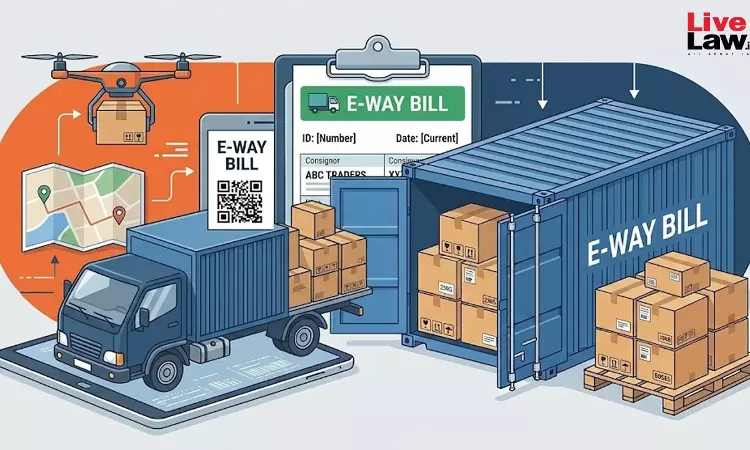
The Goods and Services Tax Network ("GSTN"), through its Advisory dated 17th June, 2026, has notified a set of structural changes to the e-Invoice Application Programming Interface ("API"), the e-Way Bill by Invoice Reference Number ("IRN") API, and the e-Way Bill ("EWB") Closure API. These changes, scheduled for Production implementation with effect from 1st August, 2026, mark a significant tightening of the compliance architecture governing the movement of goods under the Central Goods and Services Tax Act, 2017 and the rules framed thereunder. This article examines the substantive content of the Advisory, situates it within the broader compliance framework of indirect taxation, and evaluates its implications for taxpayers, e-Invoice Registration Portals ("IRPs"), GST Suvidha Providers ("GSPs"), Application Suvidha Providers ("ASPs"), and other system integrators.
Regulatory Background
The present Advisory builds upon an earlier GSTN Advisory dated 20th May, 2026, which had first introduced the requirement for mandatory capture of "Ship-to GSTIN" in Bill-to/Ship-to transactions, with the residual category of unregistered consignees to be denoted by the value "URP" (Unregistered Person). Following representations from trade bodies, ERP vendors, GSPs, ASPs, and private IRPs seeking clarity on the applicability of this requirement to e-Way Bills generated contemporaneously with, or subsequently through, an IRN, GSTN has now issued detailed API-level specifications to operationalise the earlier policy intent. The Advisory therefore performs a dual function: it clarifies ambiguity arising from the May 2026 Advisory, and it introduces an entirely new facility for voluntary closure of e-Way Bills upon completion of delivery.


Mandatory Capture of Ship-to GSTIN
The core amendment lies in Part 3 of the Advisory, whereby the field "ShipDtls.Gstin" in the Generate IRN payload schema has been rendered conditionally mandatory. The condition triggering this mandate is the furnishing of Ship-to Legal Name and Ship-to Address; once these particulars are provided and generation of an e-Way Bill is sought, the corresponding Ship-to GSTIN must also be furnished, failing which the transaction shall attract validation error code 5002. A parallel obligation has been introduced under Part 4 in respect of e-Way Bills generated subsequently through an IRN, where a new field, "Gstin", has been inserted under "ExpShipDtls" and rendered mandatory, non-furnishing of which shall attract error code 5001.
This amendment is not merely procedural. It has the effect of aligning the identity of the consignee across the e-Invoice and e-Way Bill ecosystems, thereby closing a reconciliation gap that has historically permitted divergence between the party named in the tax invoice and the party to whom goods are physically shipped. From a legal standpoint, this strengthens the evidentiary trail available to tax authorities under Section 68 of the CGST Act, 2017, which governs inspection of goods in movement, and correspondingly reduces the scope for disputes concerning the identity of the recipient in transactions involving a distinct "Bill-to" and "Ship-to" party.
Validation Framework: Safeguards Against Misuse
Part 5 of the Advisory introduces a validation architecture of some legal consequence. Most notably, it prescribes that the GSTIN entered in the Ship-to field must be distinct from the GSTIN entered in the Bill-to field, on the premise that in a genuine Bill-to/Ship-to transaction, the billed party and the party receiving physical delivery are necessarily distinct persons. Where the same GSTIN is entered in both fields, the transaction shall not be permitted to proceed. This validation serves a protective function: it is designed to preclude the artificial invocation of the Bill-to/Ship-to mechanism where no genuine tripartite or bifurcated delivery structure exists, a pattern that has, in practice, been associated with attempts to obscure the actual movement of goods for the purposes of availing undue Input Tax Credit or evading e-Way Bill requirements altogether. Additional validations requiring correspondence between the Ship-to State Code and the GSTIN State Code, and between the Ship-to PIN Code and the Ship-to State Code, further reinforce the internal consistency of the declared data.
Treatment in Export, B2B, and SEZ Transactions
The Advisory draws a calibrated distinction between categories of transactions. In the case of Export e-Way Bills, Part 8 permits the Ship details furnished at the stage of IRN generation to be replaced at the stage of e-Way Bill generation, in recognition of the practical reality that export logistics, including the identity of the final consignee or port of shipment, may crystallise only after the invoice has been raised. By contrast, Part 9 stipulates that in Business-to-Business ("B2B") and Special Economic Zone ("SEZ") transactions, Ship details furnished during IRN generation cannot be altered at the e-Way Bill stage, save that a GSTIN omitted at the IRN stage may be supplied thereafter, subject to validation. A transitional provision has also been made for e-Way Bills generated against IRNs where the Bill-to and Ship-to GSTINs were identical prior to this Advisory; such legacy IRNs shall, upon generation of an e-Way Bill, be treated as ordinary or "regular" e-Way Bills, thereby avoiding retrospective disruption to transactions already in the pipeline.
Voluntary Closure of E-Way Bill
Part 10 of the Advisory introduces, for the first time, a facility for voluntary closure of an e-Way Bill upon completion of delivery of goods. This facility may be exercised by the supplier, the recipient, the transporter, or the driver or other authorised person whose mobile number has been registered for this purpose, and may be effected either e-Way Bill-wise or date-wise. Functionally, closure may be undertaken either through the GST portal, which additionally permits closure by a driver or authorised person through mobile number-based identification, or through the EWB Closure API, which requires transmission of the e-Way Bill number, the date of closure, and accompanying remarks. It is significant that the Advisory, at Part 15, clarifies that during the initial stabilisation period, no separate "Closed" status shall be introduced into the existing framework of Active, Cancelled, and Discarded statuses, and that actions such as Update Transporter, Extend Validity, and Vehicle Updation shall continue to remain available even in respect of closed e-Way Bills. This represents a considered, transitional approach by GSTN, calibrated to avoid disruption to trade while the closure mechanism is stabilised.
Constitutional and Policy Dimension
Viewed through the lens of the Preamble to the Constitution of India, the present reform advances the objective of securing "economic justice" to all citizens by seeking to curb the misuse of documentation mechanisms that have historically enabled tax evasion and the consequent erosion of public revenue meant for welfare expenditure. At the same time, by preserving a transitional and non-punitive implementation pathway — evident in the retention of the existing status framework and the continued availability of post-closure modifications — the Advisory reflects a proportionate balance between the State's interest in tax administration and the trade's legitimate interest in an orderly, non-disruptive transition. Such calibrated rule-making is consistent with the principle of reasonable restriction under Article 19(1)(g) of the Constitution, which permits regulation of trade and business only to the extent necessary in the public interest.
Compliance Recommendations
Stakeholders, including taxpayers, ERP vendors, GSPs, ASPs, and private IRPs, are advised to undertake the following, in accordance with Parts 16 to 18 of the Advisory:
First, all system integrators must access the revised API specifications, presently released in the Sandbox environment, and complete requisite testing prior to the Production implementation date of 1st August, 2026. Second, taxpayers engaged in Bill-to/Ship-to transactions must ensure that their internal systems and ERP configurations are updated to capture accurate Ship-to GSTIN details, or the value "URP" where the consignee is unregistered. Third, entities engaged in export transactions should familiarise their logistics and compliance teams with the relaxed provision permitting substitution of Ship details at the e-Way Bill stage. Fourth, businesses intending to utilise the voluntary closure facility should identify the appropriate authorised personnel, including drivers, and ensure that mobile numbers are duly registered on the portal to enable closure.
The Advisory dated 17th June, 2026 represents a measured but consequential evolution in India's indirect tax compliance infrastructure. By mandating the capture of Ship-to GSTIN, introducing robust validation safeguards, and simultaneously creating a voluntary closure mechanism for completed deliveries, GSTN has sought to enhance the integrity of the e-Way Bill system without imposing undue rigidity upon trade. As the Production implementation date of 1st August, 2026 approaches, it is incumbent upon all stakeholders in the supply chain taxpayers, transporters, and
technology intermediaries alike to undertake timely compliance measures, failing which transactions risk rejection at the threshold of movement. The success of this reform will ultimately be measured by its capacity to reduce disputes at the stage of inspection under Section 68 of the CGST Act, 2017, while preserving the ease of doing business that remains central to India's indirect tax reform trajectory.
Views are personal.


