



NALSAR-BCI: An Assault On Constitutional Values
Prof. Madabhushi Sridhar Acharyulu
16 Aug 2026 12:34 PM IST
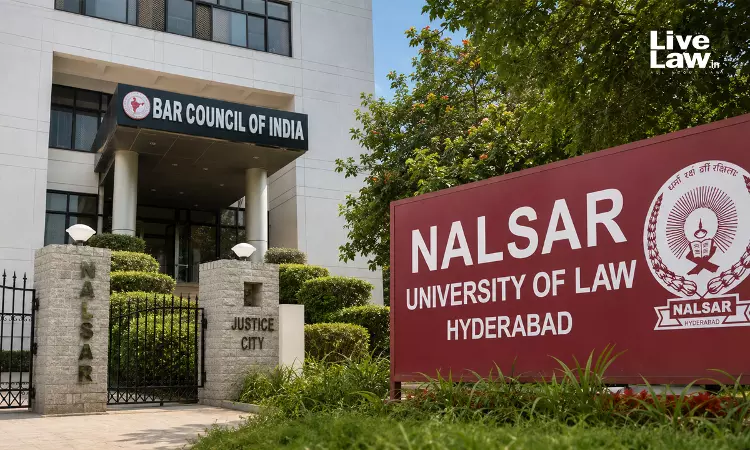
Right to dissent is strongly favoured. The Supreme Court of India, in a strong stance in favour of the right to question, has heavily rebuked the Bar Council of India (BCI) for its efforts to curb the NALSAR University of Law graduates from being enrolled after their peaceful demonstration against the Chief Justice of India (CJI). A bench presided over by CJI Justice Surya Kant, which heard the petition, has expressed its dismay, stating that the BCI acting was “uncalled for”. The Court granted interim protection from any kind of punishment, but at the same time welcomed the NALSAR graduates to practice at the Supreme Court bar and practice legal aid work.
The late Prof. N.R. Madhava Menon was a visionary legal educator who laid the foundation for the present-day legal education in India. Today, 28 National Law Universities (NLUs) have been established, producing thousands of competent lawyers, scholars and public servants. Now is the time when a regulatory body is ready to destroy these very institutions? The freezing of legal futures for 450 young NALSAR graduates trained to be upright citizens and the future custodians of the justice delivery system is a severe setback for the legal profession. Does the honor of the chairman of the Bar Council of India (BCI) give them the authority to abuse it in a manner so contrary to constitutional principles?


This is not merely a transient problem for the graduating class of 2026, nor is it exclusively an NALSAR issue. It is a potentially bad precedent for future generations. Fortunately, there had been better sense prevailed, and the heavy-handed attempt was curtailed before it did irreparable damage. To issue a BCI directive in the early afternoon and then, by evening, to issue a modified version and set it aside, might have removed a tremendous burden from the judiciary and the state, but the experiment is extremely troubling.
The Original BCI Directive
The first order made by the chairman of BCI, Manan Kumar Mishra, directed that all of the 2026 graduating batch of NALSAR would not get enrolled. This six-page letter, sent out far and wide to the university and the media, asked the basic question: How can it be done in the name of justice?
The BCI Chairman had issued instructions to all the State Bar Councils on the morning of August 13, to "not enrol the law graduates passed out in 2026 from NALSAR till further orders". The letter also called for an authentic factual report from the university regarding the primary individuals involved in initiating the campaign, conducting the campaign, coordinating the campaign and/or mobilizing the campaign against inviting the Chief Justice of India, Surya Kant, as the Chief Guest for the convocation of the university. In the wake of news of opposition from a section of students to the CJI's presence, this order was issued.
The BCI directed NALSAR to forward copies of all representations, petitions, memorandum/communications made to the university and the entire list of signatories from the official record. Moreover, it asked for information about the involvement of students, faculty, research scholars, alumni or outside persons. The BCI stated that they will make a final decision on 19th August 2026 after receiving the report from the Vice-Chancellor.
 The Withdrawal and Course Correction
By the late hours of August 13, the Bar Council of India rescinded its morning order, after a change of sentiment. The BCI realised that most of the students were not involved in any wrongdoing in the social media campaigns or letters sent to the Vice-Chancellor.
After much deliberation, the Council modified the Chairman's earlier order and allowed all the 2026 NALSAR graduates to become members of their respective State Bar Councils. The modified communication noted:
"The Council thoroughly discussed and considered the letter issued by the Chairman, Bar Council of India, to the Vice-Chancellor of NALSAR University of Law and the Secretaries of all State Bar Councils. After detailed deliberations, the members unanimously agreed that based on recent reports, the vast majority of NALSAR students (passing out in 2026) are innocent and chose not to partake in any derogatory conduct. Accordingly, the Council modifies the Chairman's order regarding the restriction on enrolment. All students are entitled to register with the State Bar Council of their choice."
Broader Institutional Concerns
It is essential that the public servants who are empowered by the law do not act out of revenge or that the regulatory powers they have are not based on political optics. In a first communication, the BCI had claimed that it had received reports from "reliable sources" that a few faculty members and external actors had instigated innocent students. The Council has said it will take further measures based on the report from the Vice-Chancellor's inquiry, but the fear of what regulators could do is very much there.
How much leverage does a professional regulator have in using enrolment as a tool to discipline student expression? Can it go beyond the boundaries of the Advocates Act and the Constitution?
The BCI's original order and continuing investigation were based on particular statutory responsibilities under the Advocates Act, 1961.
BCI has been given the statutory authority to establish standards of professional conduct and etiquette for advocates under Section 7(1)(b) of the Act. Advocates state that law school is more than learning about the law; it's the path to being an officer of the court. From this perspective, the call to organize against the incumbent CJI takes the stairs from the academic arena to institutional disrespect and moves beyond a reachable courtroom to an unfitness to practice law.
The BCI's proponents argue that this blanket oversight enables the Council to come in when campus culture is at risk of veering into practices that have a negative impact on the justice delivery system. Lastly, under Section 7(1)(l), which grants the BCI the power to conduct all other duties to implement the provisions of the Act, the Council believes it has an inherent and ancillary power to inspect the health in institutions and to determine whether external influences or internal influences from faculty are affecting the professional ethics of students.
Detailed Evaluation: The 10 Core legal Questions
These ten key legal issues that the BCI has raised can be answered with certainty by examining the Advocates Act, 1961, with the university statutory frameworks and the constitutional principles:
As for the power to order student enquiries, the BCI has no such statutory powers. The Advocates Act allows the BCI to audit universities to review legal education standards but does not give the BCI the power to investigate individual students who are not advocates.
Second, the definition of legal education and of recognition of institutions in Section 7(1) (h) and (i) is very narrowly drawn. There is a limit to the extent that curricula, academic standards, and physical infrastructure can be regulated and monitored, or penalized, for political and constitutional expression by students.
Thirdly, the BCI has no statutory authority to impose enrolment bans. Under the Act, State Bar Councils have separate statutory rolls. The BCI does not have powers to give blanket instructions to the State Bar Councils to stop qualified graduates from enrolling in the bar on any specific basis.
Fourth, with regard to the unilateral exercise of executive power, the BCI Chairman is not allowed to wield that power personally. The collective decision-making process of the entire Council must be followed in accordance with the Act and BCI Rules for any regulatory or policy decision and not through a unilateral letter from the Executive.
Fifth, there is no basis for a judicial officer to be disqualified from participating in a peaceful campaign against inviting such a judicial officer under Section 24A. Nor is the grounds of dismissal for peaceful student expression covered by the statutory grounds set out in section 24A comprehensively. Peaceful student expression is not covered by the statutory grounds exhaustively listed in section 24A.
Sixth, the legality of a batch-wide enrolment freeze fails on basic public law principles. Imposing a collective disability on an entire graduating class due to the alleged actions of a few individuals constitutes arbitrary collective punishment, directly violating the principle of equality under Article 14 of the Constitution.
Seventh, the BCI's pre-enrolment jurisdiction is very limited. As per the BCI's disciplinary power under Chapter V (35), only advocates that are enrolled will have the power of the BCI. It is unable to investigate non-advocates for student activism that has nothing to do with statutory professional misconduct.
Eighth, there is a clear distinction between university jurisdiction and BCI jurisdiction. NALSAR Authority is fully responsible for on-campus student behaviour, decorum and discipline as this responsibility is handled by NALSAR's internal machinery, which are the Vice-Chancellor and Proctorial Board constituted under Section 17(2) of the NALSAR Act.
Ninth, under constitutional scrutiny (Articles 14 and 19), the BCI's measures fail the tests of arbitrariness, reasonableness, and proportionality. Threatening students' professional entry for engaging in peaceful expression creates an unconstitutional chilling effect on fundamental speech rights guaranteed under Article 19(1)(a).
Tenth, it would not be possible to make "respect for the highest judicial office" a condition of admission to the bar. The Advocates Act provides for the qualifications and disqualifications in detail in Sections 24 and 24A. It is not the law that allows dynamic constitutional dissent to be submerged in the subjective need for "respect.
Author is an Advisor, Mahindra University and Former Law Professor and Registrar of NALSAR University. Views are personal.


