



- Home
- /
- Top Stories
- /
- One Court, Two Eras : Judicial...
One Court, Two Eras : Judicial Approaches To Ramlila Maidan Incident & Student Protest Crackdown
Manu Sebastian
23 July 2026 9:30 AM IST
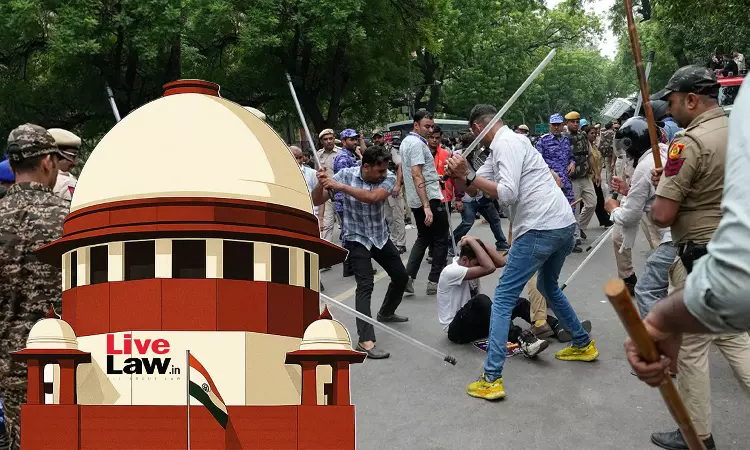
The Courts' approach to the State's suppression of protests over the last half-decade has been quite dismal.
In the wee hours of June 5, 2011, the Delhi police unleashed a violent midnight crackdown on sleeping protesters who had gathered at Delhi's Ramlila Maidan to attend the protest called by Baba Ramdev against black money.The very next day, the Supreme Court took suo motu cognisance of the police crackdown, referring to various press reports. The case “In Re : Ramlila Maidan Incident",...
This is a premium content
Available exclusively to
Our subscribers
Subscribe Premium 
INR 1099+GST
Your support helps us to bring you more content at
an affordable subscription scheme !!!
All payment options available
In the wee hours of June 5, 2011, the Delhi police unleashed a violent midnight crackdown on sleeping protesters who had gathered at Delhi's Ramlila Maidan to attend the protest called by Baba Ramdev against black money.
The very next day, the Supreme Court took suo motu cognisance of the police crackdown, referring to various press reports. The case “In Re : Ramlila Maidan Incident", ultimately led to a landmark judgment the next year, which marks one of the strongest judicial interventions against police violence in independent India.
The Court unequivocally condemned the police action as an “abuse of power” and “invasion of liberties”. Going beyond a mere declaration, it directed departmental and criminal action against police personnel found responsible for acts such as brick-throwing, lathi-charge and excessive use of tear gas. It also ordered interim compensation for those injured in the crackdown, including the family of Rajbala, who later died from the injuries she sustained.
That swiftness and boldness seem to be missing from the judiciary 15 years down the line. The recent protest marches held at Jantar Mantar by students over the issue of exam paper leaks faced a violent crackdown from the forces. Various videos have emerged on social media showing violent lathi charges and stonepelting at the protesters. Certain videos show protesters being slapped. A senior officer was caught on camera slapping a woman. There are also some reports regarding the use of pellet guns and shock batons. All these suggest that the police use of force was excessive and disproportionate. The police, on its part, are claiming their personnel have been injured. It is definitely a matter warranting an independent and impartial investigation, and immediate medical attention for the injured. Though the police action has sent shock waves across the nation, and made an entire generation outraged, no constitutional court has initiated any suo motu proceedings. Let alone suo motu action, when urgent hearing of petitions filed by litigants regarding the issue was sought, the Courts' responses were lukewarm. Perhaps, the contrast in judicial approach signifies how strong the executive's chokehold over it has grown over the last decade.
“Don't drag Courts into this”, was the response of the Delhi High Court on July 21, when a petitioner sought urgent hearing of his petition against police action.
On July 22, when another litigant approached the Supreme Court seeking suo motu cognizance of the police action, the Chief Justice of India expressed, “Don't waste our time.”
When the lawyer said that there are videos showing police brutality, CJI Surya Kant said, “We are not interested in videos, we don't have time to watch.”
Certainly, the Court, which took suo motu cognisance of a school textbook chapter on the ground that students might get a distorted picture about the judiciary, can very well take a solid step to prevent students being ruthlessly thrashed by the police.
While it is within the discretion of the Supreme Court to decline jurisdiction on a matter on the ground that the High Court is hearing the same issue, to use callous and dismissive remarks on a serious issue of civil liberties may not befit an institution which prides itself as the sentinel on the qui vive of constitutional rights.
The Courts' approach towards the State suppression of protests which have taken place in the last half-decade has been quite dismal. In 2019, during the CAA protest, there were allegations that police had entered Jamia Millia University to beat up students. Certain CCTV visuals allegedly showing police entering the university library and beating students who were reading there also emerged. However, the petitions seeking action against police officials who indulged in such excesses, and compensation for victims (one student allegedly lost vision after suffering lathi blows), remain pending in the Delhi High Court for 6 years.
In 2020, ahead of the Delhi riots, videos had emerged of Delhi police beating up certain Muslim youngsters and asking them to sing the national anthem. One of them, Faizan, later died, allegedly due to torture. It took four years for the High Court to order a CBI investigation into the matter.
In the CJP protest, when the police forcefully lifted activist Sonam Wangchuk, who had been on a hunger strike, to a government hospital, the Court did not intervene immediately. The Court's earlier observation that his health should be monitored was used by the State to effectively detain him in a government hospital. His plea for a transfer to the hospital of his choice was initially rejected by the Court, saying that the Government has the duty to protect his health. It was starkly reminiscent of the ignoble observation made by the emergency-era court that persons detained are under the State's motherly treatment.
The Court have rarely stepped in when authorities impose sweeping restrictions such as widespread internet shutdowns or suspension of public transport services such as the metro to curb protests. While the Courts have voiced concerns over the inconvenience caused to the general public due to protests, they have generally not displayed the same level of concern about the impact of restrictions imposed by the State. The Supreme Court has developed the tests of proportionality to measure the validity of State curfews, but they are rarely applied.
The Courts' refusal to act with promptitude in such cases has created an atmosphere of impunity. The Delhi High Court, on July 22, issued notices to the Delhi police on petitions concerning the police action, and granted a long adjournment, posting the matter to September. One hopes that the matter does not go into a limbo, as happened with the Jamia violence case.
As is known to all, every citizen has the right to express dissent through peaceful demonstration. The students are very much within their rights to demand accountability from the system. By violently trampling down upon them, the State is actually attacking the country's future. The questions of the youth are not to be met with lathis and teargas shells. The political actors, who are answerable, are conveniently hiding in silence behind the cover of the police force. The Courts' duty is to stand with the citizens and seek accountability from the State, instead of acting as its extended arm.

Manu Sebastian
Managing Editor

