



Operation Safed Sagar -Untold Courage Behind Kargil's Skies
Justice N. Anand Venkatesh
6 Sept 2026 3:00 PM IST
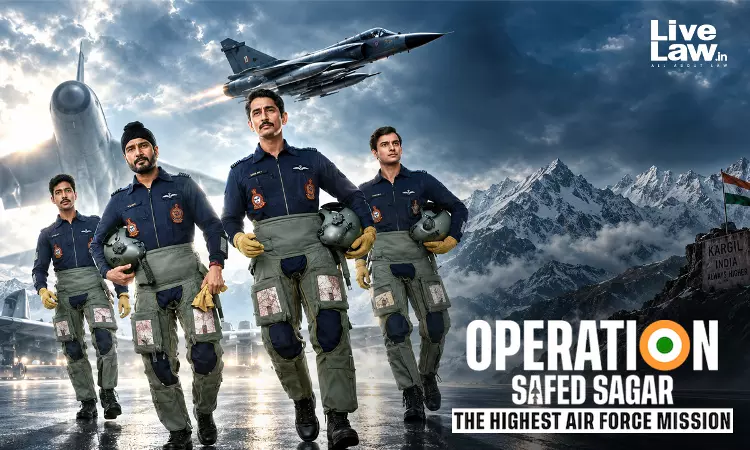
The 1999 Kargil War remains etched in the Indian consciousness as a saga of raw, unyielding grit. For decades, the public memory of that conflict has been dominated by the iconic, harrowing images of Indian Army soldiers scrambling up near vertical Himalaya's exposed mountain faces under a continuous rain of enemy fire. The Indian Air Force's extraordinary contribution from the skies, codenamed Operation Safed Sagar, was a decisive force multiplier that altered the trajectory of the war. Netflix's six- part limited series, Operation Safed Sagar: The Untold Story of the Kargil War, directedby Oni Sen, finally brings this long-underappreciated chapter into the sharp light it deserves. Thanks to technology which ensures the visual effect which otherwise cannot be comprehended in mere words. Led by Siddharth, Jimmy Shergill, and Abhay Verma, the series reconstructs an entire world of duty, discipline, brotherhood, and sacrifice, revealing how the IAF prepared for an unprecedented high-altitude conflict.
To fully grasp the magnitude of Operation Safed Sagar, one must understand the treacherous geopolitical reality of the region. Right on India's border lies a rogue neighbour whose primary objective, obsession, and virtual purpose of existence has long been to continuously trouble and destabilize India. In 1999, this hostility found its architect in a reckless military general driven by a singular agenda: to inflict damage on India at any cost. So deep was this deceit that the general actively lied to his own government and citizens, peddling the cowardly narrative that the mountain ambushes were carried out solely by irregular mujahideen. In truth, it was regular army troops sent into the freezing heights. Adding ultimate insult to injury, when the tides turned, the enemy leadership committed the ultimate betrayal of military honour when they disowned their own soldiers captured by India as prisoners of war, refusing even to claim the bodies of their fallen.


In stark contrast, India has never harboured the slightest intention to trouble its neighbours or forcibly annex even a single inch of foreign land. Rooted in an unshakeable ethos of peace and sovereign dignity, India entered the conflict forced by betrayal, yet fought it with unparalleled nobility. Even under the most adverse and emotionally charged wartime circumstances, India steadfastly adhered to the path of Dharma. The Indian Armed Forces treated captured enemy prisoners of war with absolute dignity in accordance with the Geneva Conventions. Furthermore, when the enemy military cowardly disowned its own fallen combatants, Indian soldiers stepped forward to accord those dead enemy troops a decent, honourable burial complete with full military rites and traditions. It was a profound display of moral superiority that proved Indian military chivalry is non-negotiable, even when facing an opponent devoid of ethics. Operation Safed Sagar captures this moral contrast while immersing the viewer in the high stakes reality of the air campaign. At the center of the series is the Golden Arrows Squadron. Squadron Leader Ajay Ahuja (portrayed by Siddharth) is brought in by Wing Commander B. S. “Tony” Dhanoa (Jimmy Shergill) to train a cadre of young, eager pilots. Dhanoa embodies the heavy burden of command being calm, firm, and acutely aware that a single miscalculation carries national consequences. Ahuja, meanwhile, represents leadership at close quarters: guiding, correcting, encouraging, and shielding his young officers as he prepares them for missions from which some will not return. The younger officers, including characters played by Abhay Verma, inject energy, humour, banter, and raw vulnerability into the narrative, rendering the squadron not as a mere military unit, but as a living family bound by a chain of total trust. The series reaches a crescendo of dramatic tension when depicting the sheer aviation audacity required to strike targets hidden among some of the most forbidding terrain on Earth. Operating at extreme altitudes where aircraft performance drops precipitously, IAF pilots lacked the modern, integrated precision-guided suites taken for granted today. In an extraordinary feat of field-tested ingenuity, handheld commercial GPS units were improvised directly into the cockpits of fighter jets and helicopters which is a pioneering first in Indian military aviation. Technical crews and pilots had to manually calculate coordinates, weapon trajectories, severe crosswinds, and release points with extreme mathematical rigor under wartime pressure, overcoming deliberate external GPS signal degradation and severe coordinate-system discrepancies. Then came the spine-chilling audacity of night sorties. In one of the most perilous operations depicted, six MiG-21s flew fast and exceptionally low through the narrow, pitch-black corridors of the Mushkoh Valley for a low-level night bombing run. Navigating through moonlit peaks where a sudden cloud could instantly plunge a mountain wall into total darkness, the mission demanded legendary formation discipline, steel nerve, and absolute trust in flight instrument calculations.
Yet, the emotional anchor of the series rests grounded on the home front. Behind every pilot flying into a wall of flak and surface-to-air missiles was a family waiting by a silent telephone where the spouses maintaining an exterior of composure for their children, and parents quietly bearing the crushing weight of uncertainty. The series honours these families who surrendered their peace of mind so that those in uniform could fulfil their oaths. Their quiet sacrifice is presented not as passive waiting, but as the steady emotional bedrock of the nation's defense forces.
What sets this series apart is its refusal to rely on cheap Hollywood style superhero tropes. The heroism on display is restrained, professional, and deeply human. These pilots experienced real anxiety, grief, and doubt, yet they strapped into their cockpits day after day because duty demanded it. The patriotism driving the narrative is rooted in quiet responsibility rather than empty rhetoric which are found in tactical briefings, silent moments of reflection, tense radio chatter, and the anxious eyes of ground crews searching the horizon for a returning jet.
The infantry reclaimed the frozen, blood-stained ridges foot by foot, but the Indian Air Force paved their path to victory from the heavens. Operation Safed Sagar sent an unmistakable message across the border and to the global stage: India is a peace-loving nation, but if push comes to shove, we will strike back so hard, so precisely, and with such devastating force that no adversary will ever dare take this country for granted again.
Operation Safed Sagar is a triumph of storytelling a riveting tribute to human ingenuity, unyielding camaraderie, and the soaring spirit of the Indian Air Force.
Author is a Judge at High Court of Madras. Views are personal.


