



Parity In Pay
Ninad P. Shah
19 Aug 2026 8:00 PM IST
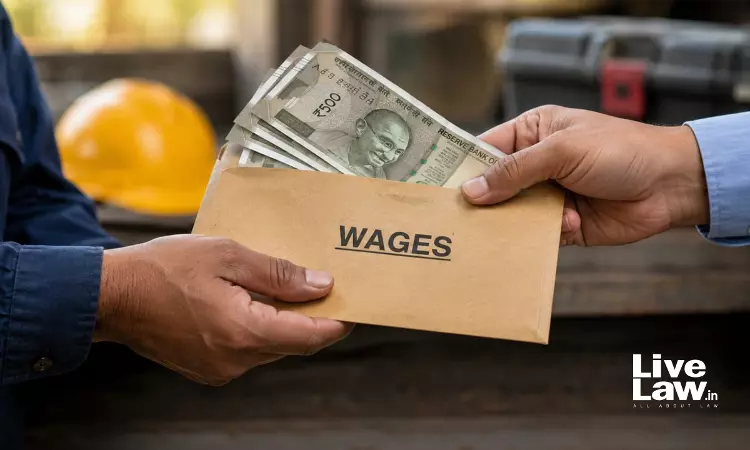
For the purpose of this article, parity in pay can be claimed for basic pay, pay scale, pay band, allowance, all of these, or just wages.
Ordinarily, fixation of pay is in the domain of executive authorities, which can only be brought under the purview of judicial review if the fixation is improper, discriminatory, patently irrational, unjust and prejudicial. The courts generally approach such matters with restraint. Thus, when matters pertaining to parity in pay are entertained, the courts take up the task of evaluating the equivalence between the two sets of employees on the basis of the criteria mentioned hereinbelow.
The primary considerations for fixation of pay for a particular class of employee are:
1. The post (i.e., sanctioned, ad hoc, temporary, deputation, fixed pay, project based, daily wage, piece rate basis, etc.)
2. Method of recruitment
3. Level at which recruitment is done
4. Hierarchy in the service cadre
5. Qualification (educational and/or technical)
6. Promotion avenues, stagnation of post


7. Nature, degree, quality of duties and responsibilities
8. Pay of identical relatives on horizontal or vertical level at state level
9. Public dealing, and
10. Employer's capacity to pay.
The secondary considerations are:
1. Degree of skills
2. Experience
3. Training
4. Strain
5. Fatigue
6. Risk
7. Confidentiality
8. Mental and physical requirements
9. Nature of freedoms vis-à-vis limitations
10. Independence in exercise of powers.
Parity is claimed on the basis of the doctrine of equal pay for equal work, which was propounded as part of the Directive Principles of State Policy. Thereafter, on the basis of the law propounded by the Supreme Court, placing reliance on the mandate of equality and inhibition under Articles 14 and 16 of the Constitution, equal pay for equal work has assumed the status of a fundamental right, becoming enforceable on all.
However, the right to equal pay can be negated when (a) the work is unequal, (b) there is a qualitative difference in the responsibility or reliability of the nature of work, and/or (c) there is reasonable, intelligible criteria having a nexus with the object of such differentiation.
Thus, the right to equal pay is not automatically or mechanically applicable. As the burden is on the employee seeking parity in pay, he or she has to establish (a) discrimination, (b) similarity, and (c) that there is no basis for any differentiation, or that the differentiation is without any rational basis. An employee would have to plead and establish the following:
1. That there is discrimination with their counterparts working on the same post, in the same department, or in another department of the same civil service (central civil service or state civil service). It would be relevant to state that our constitutional courts have laid down four factors for determining the equivalence of posts and have emphasized that all four factors should be fulfilled for equivalence, which are: (a) nature and duties of the post, (b) responsibilities, power, territorial extent and additional charges held by the employee on the said post, (c) qualification, and (d) salary.
2. Same establishment and/or same master/employer.
3. That the basic qualification, i.e., educational qualification, technical proficiency qualification, etc., method, manner and source of recruitment, and, in some cases, grades of promotion, are also the same.
4. That they are performing the same functions, duties and responsibilities, both in quantitative and qualitative terms.
5. Or, wherever applicable, that similar employees have been extended the benefit by way of judicial pronouncement and that there is no material to show any difference between them and the employees who have been extended the said benefit.
6. Or, that the direction issued by the courts is in rem, making them entitled to the said benefit of equality or parity.
Once an employee is able to establish, plead, or show that there has been discrimination, and that they are similarly or identically situated, the court would then have to consider whether the differential treatment or reasonable classification is just and fair, as Article 14 is not violated merely because there is differential treatment. Valid classification has been held to be valid discrimination.
Courts cannot insist on absolute equality; such a question cannot be decided on the basis of a common man's approach, and the court will not sit in appeal over a policy decision passed after consultation with an expert committee. Courts would have to see the object behind such a policy or classification, which should be based on intelligible differentia and a rational nexus to the object sought to be achieved. Once the court is satisfied that the discrimination and classification are rational, courts will not enter into the arena of the experts. Courts will only intervene when the classification smacks of inherent arbitrariness, artificial differences, discrimination, or when the said classification has gone wrong in law or is unreasonable. However, it is assumed that such policy decisions are made in good faith, unless the contrary is shown. Such classification does not need to be scientifically perfect or logically complete.
Another aspect the courts would consider is the financial implications. If the employees are given the benefit of parity, will the employer be able to bear the said financial implication, or will it collapse? Apart from classification, the claim of parity of an employee can be defeated if the employer establishes that:
1. Those employees who are seeking parity of pay with a particular set of employees are a distinguishable class.
2. A set of employees who are doing the same physical work are discharging a higher nature of duties and responsibilities, a different quality of work, or their work is more sensitive, or there is a qualitative difference in the work.
3. There is intelligible differentia, reasonable classification based on merit, experience and seniority, or based on the rules evolved under Articles 14 and 16(1).
4. One set of employees has avenues for promotion, while the other set does not, and thus higher pay is given for stagnation, frustration, or a longer duration of promotional avenues.
5. Employees of the counterpart establishment, on the basis of which parity is sought, are under different management, or, in some cases, under the same management but in different geographical locations.
6. The posts are not equivalent.
7. The higher pay given to a particular set of employees was wrongly or illegally granted.
8. The recruitment process was different, for example, one was through walk-in interviews, the other was a centralized recruitment process based on marks obtained at the UG or PG level, additional qualification, and interviews.
9. Separate recommendations were made by the state as regards pay for the two sets of employees, meaning it cannot be said that there is absolute equality, as separate recommendations denote that there is some difference.
Indian constitutional courts, after evaluating the claims of the employees and the stand of the employer, have held that the following classifications or differentiations made by the employer for justifying the difference in pay are not acceptable/untenable:
1. Employees belonging to different departments of the same government.
2. One set of employees belongs to aided and the other belongs to unaided schools.
3. Differentiation based on the sex (male or female) of the employee.
4. Employees of the same class, subsequently divided on the basis of an artificial distinction arising from re-designation.
5. Similarly situated employees have been granted the benefit on the basis of judicial precedent, and the employer has taken a conscious decision to accept and implement the same; similarly situated employees cannot then be denied.
6. When directions are issued in rem, the state, being the model employer, cannot deny the benefit on the ground of its own inefficiency or negligence.
7. Granting a higher pay scale to a set of employees from a particular date and granting the same benefit to another similar set of employees from a later date is not permissible.
8. When employees are identically situated and the difference is only in department/classification/nomenclature of post, rejection of the claim for parity is not acceptable.
9. Historically, where the posts were similar and/or the employees were treated as equal, classification for different pay is not tenable.
10. A claim of parity of pay by identical employees, discharging the same degree of duty and responsibilities, cannot be rejected on the ground that one institution is getting 100 percent grant and another institution is getting 90 percent grant.
On the other hand, Indian constitutional courts have accepted the following stands of the employer for difference in pay, and have rejected employees' claims for parity of pay, when:
1. Employees working with the state government are seeking parity with central government employees.
2. Employees possess different educational qualifications, degree holders vs. non-degree holders (diploma and license holders), matriculates vs. non-matriculates.
3. The employer is different (if the employer is not the same, the principle of equal pay for equal work would not be applicable).
4. There is a difference in experience, seniority, or onerous nature of the work between the two sets of employees.
5. A daily wage employee cannot claim parity with government employees of autonomous bodies or instrumentalities of the state on the ground of negative equality (negative illegality cannot be claimed; an illegality or wrong cannot be perpetuated further).
6. Contractual employees cannot seek parity with regular employees.
7. The posts are different, or the sanctioning authorities or departments are different, parity cannot be claimed.
8. Employees of a corporation cannot seek parity with similarly situated or identical employees of another corporation, even if under a common employer.
9. Equivalent qualification alone is not sufficient; where the employees are not discharging the actual or dominant duties of the other set, such parity cannot be claimed.
10. Employees appointed by the same authority to the same/identical/similar post, but under different rules, cannot seek parity with each other.
11. Employees cannot seek parity with the pay of a superior post. A superior post can be either promotional or by attachment.
12. Employees working at institutional or sub-level offices cannot seek parity with employees working on the same post at headquarters.
It is noteworthy that, while deciding such cases, our constitutional courts have propounded a new facet of parity in pay and equal pay for equal work, which is granting the minimum of the pay scale. Our courts have held that contractual employees appointed through a recruitment process that mirrors regular recruitment, and who have similar qualifications and discharge duties identical to an ad hoc or regular employee, cannot be granted the benefit of the regular pay scale, but can be placed at, or extended, the minimum of the pay scale of similarly situated ad hoc or regularly appointed employees.
The question that then arises is when a claim for parity can be raised. A claim for parity by an employee or a set of employees should be raised at the earliest possible opportunity. A claim of parity, raised within three years from the date on which the anomaly or disparity crept in, is reasonable. However, for a claim of parity, delay and laches would not come in the way of seeking equitable relief. The cause of action continues from month to month, every month until the anomaly or disparity is resolved, the cause, as such, is continuous. Further, employees cannot be said to be sleeping over their rights if their representation is pending before the concerned authority or is being pursued at the administrative level.
In conclusion, parity in pay is based on the constitutional goal of equal pay for equal work. Such equality can be claimed when there is complete and wholesome identity between the two sets of employees. Employees cannot merely claim parity/equality by self-serving affidavits or averments, as a mere difference in service conditions is not discrimination. Such an exercise of classification and equivalence is left to expert bodies or committees. Our constitutional courts have also accepted this proposition and held that separation of powers is essential, and that they act only in a supervisory jurisdiction in such matters. Our courts intervene in such matters only when the classification or differential treatment is palpable discrimination, unreasonable, arbitrary, or made on extraneous considerations, as non-uniformities would not in all events violate Article 14 of our Constitution.
Judgment referred for this article, (i) Federation of All India Customs and Central Excise Stenographers (Recognized) Versus Union of India, Writ Petition (Civil) no. 5019 of 1982, (ii) state of Haryana Versus Haryana Civil Secretariat Personal Staff Association, Civil Appeal no. 3518 of 1997, (iii) V. Markendeya Versus State of Andhra Pradesh, Civil Appeal no. 764 of 1978, (iv) State of Madhya Pradesh Versus Ramesh Chandra Bajpai, Civil Appeal no. 5058 of 2009, (v) Steel Authority of India Limited versus dibyendra Bhattacharya, Civil Appeal no. 9480 of 2010, (vi) Manishkumar Prahladbhai Patel Versus State of Gujarat, Letters Patent Appeal no. 336 of 2022 (High Court of Gujarat), (vii) Union of India Versus Indian Navy Civilian design Officers Association, Civil Appeal no. 8329 of 2011, (viii) Sanjay Kumar Upadhyay Versus State of Jharkhand, Civil Appeal no. 14046 of 2024, (ix) Shah Samir Bharatbhai Versus State of Gujarat, Civil Appeal no. 11028 of 2025, (x) Suresh Manilal Patel Versus State of Gujarat, Letters Patent Appeal no. 378 of 2025 (High Court of Gujarat), (xi) Muljibhai Naranbhai Bhatti Versus Secretary, Special Civil Application no. 22303 of 2017 (High Court of Gujarat), (xii) Hemant M. Pandya Versus Bhavnagar Mahanagarpalika, Letters Patent Appeal no. 871 of 2020 (High Court of Gujarat), (xiii) Jaisinh Kishorsinh Chauhan Versus Government of Gujarat, Special Civil Application no. 16777 of 2014 (High Court of Gujarat), (xvi) Union of India Versus D.G.O.F. Employees, Civil Appeal no. 1663 of 2016, (xv) B. C. Nagraj & Anr. Versus State of Karnataka, Civil Appeal no. 5529 of 2023, (xvi) D. M. Nimavat Versus State of Gujarat, Special Civil Application no. 7864 of 2008(High Court of Gujarat), (xvii) Gujarat Rajya Pachhat Varqa Chhatralaya Karamchari Maha Versus State of Gujarat, Special Civil Application no. 26938 of 2006 – High Court of Gujarat, (xviii) K. M. Sharma Versus State of Chattisgrah, Civil Appeal no. 3030 of 2022, (xix) State of Uttarakhand Versus Sudhir Budakoti, Civil Appeal no. 2661 of 2015, (xx) Rajesh Pravinchandra Rajyaguru Versus Gujarat Water Supply & Sewage Board, Civil Appeal no. 7578 of 2021, (xxi) Union of India Versus Manoj Kumar, Civil Appeal no. 913 of 2021.
Author is an advocate practicing at High Court of Gujarat. Views are personal.


