Remembering Justice Leila Seth At 96
Liam J. Vas
29 Oct 2026 8:00 PM IST
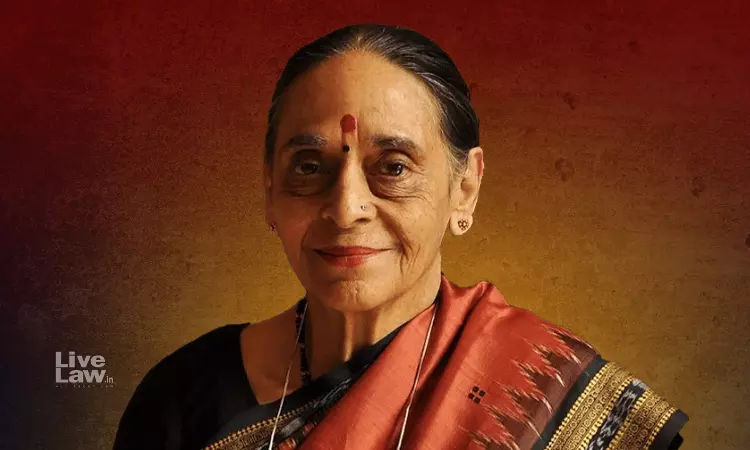
When The (then) Hon'ble Acting Chief Justice of the Hon'ble Delhi High Court, Justice Gita Mittal paid tribute to Late (Retd.) Justice Leila Seth at the Delhi High Court's Full Court Reference in May 2017 following Justice Seth's demise, she remembered a Judge who was courteous yet firm, composed in court and generous towards young advocates, always giving Counsel's a fair opportunity to be heard. Justice Seth is rightly remembered as the first woman to be designated a Senior Advocate by the Supreme Court, the first woman judge of the Delhi High Court and the first woman to become Chief Justice of a State High Court in India, but beyond these historic firsts lie two rather unusual stories; bats in a makeshift toilet at The Hon'ble High Court of Judicature at Patna and a grateful litigant who called her “Leila Babu” together both these occurrences offer a glimpse of the woman behind the milestones and the profession she helped change.
Justice Leila Seth was born in Lucknow on the 20 of October, 1930 and studied at Loreto Convent in Darjeeling before moving to England with her husband, where she pursued law while raising a young family. In 1957, she topped the Bar examinations in England and Wales, becoming the first woman to achieve that distinction. Such an achievement might have been expected to open doors, but the legal profession had its own ideas about a woman's priorities. When Justice Seth approached Senior barrister Sachindra Chaudhuri in Calcutta to train under him, he suggested that she marry. She explained that she was already married. He then suggested that she have a child, only to learn that she already had one; when he recommended another, she informed him that she already had two. Chaudhuri eventually relented, telling her, “You're persistent and you will do well at the Bar.” The exchange is amusing, but its underlying message is less so, despite her qualifications, Justice Seth was made to justify her decision to pursue a career at all.


When she began practising at the Patna High Court in 1959, the profession offered little reassurance that things would be different. There were only two women advocates there, including Justice Seth, and no proper women's toilet. Instead, a dusty storeroom had been pressed into service, with one unwelcome feature: bats. Afraid that one might become entangled in her hair, Justice Seth would cover her head with the end of her sari and hurry out. When she asked her only female colleague how she managed, the response was blunt, how could Justice Seth expect to practise successfully in Bihar if she was afraid of bats? It is a wonderfully human anecdote, but it also exposes a basic institutional failure. Women had entered the profession without even the most elementary provisions being made for their presence. Justice Seth, however, persevered.
In another courtroom encounter, when Justice Seth secured the acquittal of a man sentenced to ten years of rigorous imprisonment in a dacoity case. Grateful for his freedom, he called his advocate “Leila Babu”. The title was presumably intended as a mark of affection and respect, yet its masculine form carries a quiet irony. Justice Seth had earned her place through her own legal ability, even as the language of authority remained distinctly male. She would go on to make that authority her own.
Justice Seth's career at the Bar was marked by the breadth of her practice and the steady accumulation of professional responsibility. Enrolled at the Calcutta High Court on 16 July 1959 and at the Supreme Court on 7 September that year, she practised in the Patna High Court for nearly a decade, handling tax matters alongside civil, company and criminal cases, matrimonial suits and writ petitions. From 1963 to 1968, she served as Junior Standing Counsel for the Income-tax Department in Bihar and was also on the panel of lawyers representing the State of Bihar before the Patna High Court. In 1972, she began practising in the Delhi High Court and the Supreme Court, taking on a wide range of civil, tax, constitutional and other matters. On 10 January 1977, she was designated a Senior Advocate by the Supreme Court, another milestone in a career built through years of demanding legal work.
One of her most memorable cases involved a railway engine driver and a guard prosecuted after people travelling on the roof of their train were killed when it passed beneath a low bridge. The driver faced imprisonment and the possible loss of his livelihood, yet could afford barely a day's legal fees. Justice Seth took up his defence and examined the technical questions at the heart of the case, including whether he could have heard the people on the roof and whether the train could have been stopped in time. She secured his acquittal. The driver later returned with his family and presented her with a tin of homemade ghee. What stayed with her for years was a small gift from a man who had very little to offer, a simple gesture through which he expressed his gratitude to a lawyer who had made a genuine difference to his life. It was not the value of the gift that made it memorable, but what it represented, the trust he had placed in someone whose work had helped protect not just his livelihood, but the future he was trying to build.
On 25 July 1978, Justice Seth was appointed an Additional Judge of the Delhi High Court and became a permanent judge on 18 July 1980. On 5 August 1991, she became Chief Justice of the Himachal Pradesh High Court, the first woman to head a State High Court in India. She retired on 20 October 1992. Her career had taken her from a profession that questioned whether she belonged in it to the highest judicial office she could hold in a State High Court. The significance lay not simply in reaching these positions, but in demonstrating that women could occupy them on the strength of their own ability.
Justice Seth's commitment to justice continued beyond the Bench. As a member of the Fifteenth Law Commission of India from 1997 to 2000, she contributed to efforts to reform women's property rights. The wider reform process culminated in the Hindu Succession (Amendment) Act, 2005, which strengthened daughters' rights in Mitakshara coparcenary property. The change mattered for more than inheritance, property could mean financial security, greater independence and the freedom to make choices on one's own terms. In 2012, Justice Seth also served on the Justice J. S. Verma Committee, constituted after the Delhi gang rape to recommend reforms to the law on sexual violence. Its report informed significant criminal law reforms in 2013, although not all its recommendations were adopted. She also opposed the criminalisation of consensual same-sex relations following the Supreme Court's decision in Suresh Kumar Koushal v. Naz Foundation. Across these causes, she continued to challenge legal and social assumptions that restricted people's rights.
Her writing brought these concerns to readers beyond the legal profession. In her autobiography, On Balance, she reflected on the experiences that shaped her life and career, while her book We, the Children of India introduced young readers to the Constitution and its Preamble. In another of her books, Talking of Justice: People's Rights in Modern India, she explored questions of rights and equality, extending her engagement with the law beyond the courtroom and into public life. Through these books, Justice Leila Seth conveyed a conviction that ran throughout her career, that the law should not remain the preserve of those trained to practise it, but should be understood by the people whose lives it governs.
Justice Leila Seth died on 5 May 2017, aged 86, having lived a life that changed the Indian legal profession in ways both visible and lasting. Her journey from a young advocate navigating a profession that was barely prepared for women to becoming the first woman Chief Justice of a State High Court is remarkable in itself. But it is the smaller stories, too, that make her memorable: the bats that frightened her in Patna and the grateful litigant who called her “Leila Babu”.
Justice Seth never allowed the attitudes of her time to decide how far she could go. She built her career on her own terms and continued to speak and work for equality long after leaving the Bench. She once described the world she wished for as one in which people could “walk hand in hand, not a step in front or a step behind”. That simple thought seems an apt way to remember her, not only for what she achieved, but for the fairness and dignity she believed everyone deserved.
Perhaps that is what makes her story endure. She entered a profession that had not quite made room for her, and left it a little more open for those who came after. The bats and the Babu may be the stories we remember with a smile, but Justice Leila Seth's true legacy is the path she helped clear for others.
Views are personal.