



Remembering Soli Sorabjee: The Peerless Lawyer and Man
V. Sudhish Pai, Senior Advocate
29 April 2026 7:00 PM IST
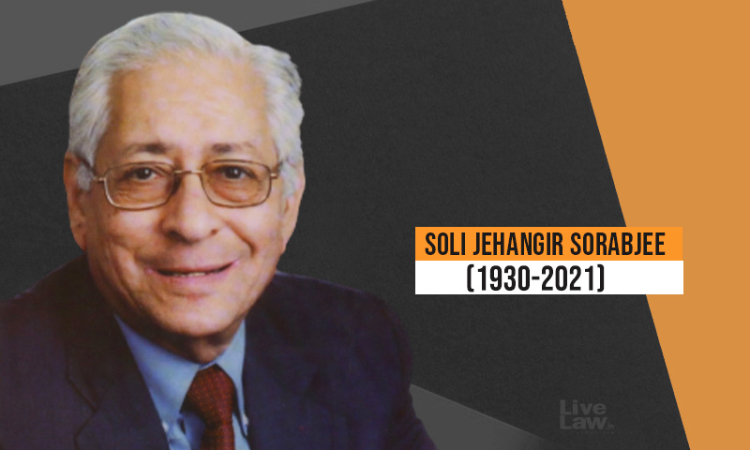
It is given to only a few to be endowed with great qualities of head and heart, don many hats and play many roles with distinction and elan, yet retain the human touch and be considered a legend. Soli Jehangir Sorabjee is certainly one among them whose personality was so warm and vibrant and career so versatile and glittering. He was one of the all-time greats both as a lawyer and a human being. A gentle colossus, his many splendoured life and work is a model. He is among the exceptional few whose very name has aroused attention, summoned up reverence and inspired generations.
“Lawyers in India never retire; they simply drop dead”, remarked Fali Nariman. They are then hardly spoken about or remembered, save in rare cases where while we grieve at their departure, we recall and extol their lives and careers. Soli Sorabjee is certainly among such notable exceptions. To generations who have passed their lives in the law, and even to those outside that field, he was truly an illustrious and venerable person.


It is five years now since his departure from the mortal plane. His work as a lawyer and the principles and values he espoused and practised serve as an inspiration and reminder to us to hold the flag aloft and not swerve from the right path. In an atmosphere where the pursuit of the higher and nobler ideals of the legal profession is becoming increasingly difficult, where ploughing the lonely furrow of scholarship is becoming rare and where half-baked ideas reared by accident have sway, Sorabjee belonged to a refreshingly different genre. It is appropriate that we remember him on his death anniversary on April 30.
The story of his life and work is well and widely known. But that bare story does not reflect his great qualities of head and heart which were never worn on the sleeve. His more than six decades at the Bar is an object lesson of devotion and dedication to the profession and practice of law and its nobler ideals and values. His professional eminence and personal qualities put him on a high pedestal and in a class by himself. Even among the very successful and outstanding lawyers, he stood out like 'a mountain peak dazzling in the last rays of the setting sun'.
When Soli began his career the great Justice M.C. Chagla was the Chief Justice of the Bombay High Court. Soli considered Chagla as the very embodiment of justice and spoke of the congenial atmosphere of his court where justice was dispensed with a smile, not with a frown. When Soli was only three years at the Bar, he appeared and succeeded in a case of preventive detention before Chagla, CJ, being opposed by the then Advocate General, M.P. Amin. For, 'it mattered not if the lawyer who appeared before him (Chagla) was a rank junior, provided he was well prepared and was articulate.' Indeed, Chief Justice Chagla appointed the young Soli in his twenties as amicus curiae in Kamala Nair's case (AIR 1958 Bom 12) and expressed the Court's thanks for his assistance.
Sorabjee had an early start in the profession and early triumphs as well. He started appearing and arguing in the Supreme Court even in the late 1950s particularly cases involving questions of constitutional law. He was right from the beginning interested in and cut out for public law. While many of his contemporaries were building up flourishing practice in commercial law, Sorabjee was rising in the writ court. As he said, cases of commercial law did not move him. He steadily rose in the profession. His commitment to the Constitution and its values was complete and irrefragable and his faith in constitutional rights unflinching. He may truly be said to be a constitutional architect. He fully enjoyed developing the law in that branch. He demonstrated how the two qualities-fidelity and creativity- are not opposed and how with devoted insight they may enhance each other. He was both a witness to and participant in the exciting journey of the evolution of our Constitution and a stellar contributor to it.
A true legal philosopher, his enduring contribution is his remarkable role in endeavouring to inculcate constitutional values in public life and temper the exercise of power with constitutional culture. He was a great leader, teacher and builder. He was a leader of the Bar and led the profession with exemplary equipment and integrity. He was a teacher who taught by precept and practice both law and professional ethics and trained generations of lawyers in that tradition. He was a builder who helped to raise the edifice of our constitutional law and administrative law.
In his long and eventful career, he appeared in and argued a number of landmark cases and assisted the courts in moulding and laying down the law. For over half a century his unmistakable imprint on almost every case of constitutional significance is manifest and telling. Some of the most celebrated opinions of Chief Justice Marshall as in Dartmouth College and Steamboat cases are the arguments of Daniel Webster reiterated. So also, judgments in some of the foremost cases in our public law reverberate Sorabjee's arguments. The story of his life and career is, in a sense, the story of the onward march of public law in India.
It is equally important that Sorabjee cherished and nurtured the great and noble traditions of the Bar. As a young lawyer in the mid-1960s appearing before a Bench presided over by Justice Subba Rao, Sorabjee found the Court fully in his favour. But he knew that there was a judgment which squarely covered the case against him. He expected the opposite side to cite it, but they did not. The matter spilled over to the following day. Sleep eluded Soli, he was in a fix as to what was to be done. The following day also the other side did not cite the case. Sorabjee in all fairness and true to his cloth as an officer of the Court, brought the judgment to the Court's notice and tried to distinguish it but did not succeed. The case was decided against his client but he earned a good night's sleep and, what is more, a high reputation for fairness and the goodwill of the Bench. There can be no better role model, no higher tradition of professionalism.
Years later as Attorney General speaking at the obituary reference to Chief Justice Sabyasachi Mukharji in October, 1990, he said quoting Carlyle that tradition is an enormous magnifier, but traditions are not like instant coffee, each generation would have to imbibe and cherish them. Teachers and seniors should lead and teach by example. Soli lived this and his chamber was a nursery for training a large number of distinguished men of law who rose at the Bar and some on the Bench.
His mentor Palkhivala greeting him on his appointment endorsed what Sorabjee had said about his role- the guardian of public interest and the protector of human rights. Palkhivala wrote, “I meant to write to you to congratulate you on your appointment as the Attorney General. But after reading your public statement, I would like to congratulate India on having you as the highest law officer of the Government….. The greatest glory of the Attorney General is not to win cases for the government but to ensure that justice is done to the people.” Soli substantially lived this maxim. He could be critical of the government whose principal law officer he was, much like his eminent predecessor Motilal Setalvad.
Every advocate has a two-fold duty- one to the client and the other to the court and in case of conflict the second duty must prevail. This is all the more so in the case of the Attorney General, an office which is by long tradition one of great respect and distinction. Government is not like every other ordinary litigant. As Justice Brandeis said, Government is a potent, omnipresent teacher. And as is inscribed on the portal of the US Supreme Court: The Government of the United States wins every case in which justice is done to the citizen. The AG is thus an amicus curiae-friend of the court in every sense in every case. Even when he appears and argues for the Government, he is to assist the court in the administration of justice- holding the scales even between the citizen and the State. In discharging all these functions, the AG indeed represents public interest and must act with independence and fairness. Sorabjee could take a principled stand on any question or case. When a coalition partner of the NDA was keen to have a State government dismissed invoking Art 356, Soli as AG told Prime Minister Vajpayee that such action would be unsupportable and that he would take the responsibility of explaining the legal nuances. He told the PM that his shoulders were broad enough to take the onslaught of any politician.
As the former Attorney General, K.K. Venugopal said very few can match Soli's stature and independence and impartiality as AG. In some case which the Government and Air India had won with the Supreme Court reversing the Bombay High Court which had held in favour of the female cabin crew, the losing party- Air Hostesses' Association met Attorney General Sorabjee and explained to him the injustice done. Sorabjee immediately wrote straight to the Prime Minister stating that a court verdict in favour of the Government did not come in the way or preclude Government from seeing the justice of the case and acting accordingly. He saw to it that the Court order was not implemented and justice was done to the private litigant. Where in a matter in which he had succeeded and it was brought to his notice that some part of a statutory provision had been inadvertently overlooked, he went back to the Court and in all fairness mentioned about the omission to notice the statute and also acknowledged the efforts of counsel who brought it to his notice and the Court reversed the order. That was in the highest traditions of the profession. Justice was done. Wherever he found it just, he would convey to the Government the views of the Court and ensure that the matter was sorted out accordingly. It was not unoften that the Court would ask the Attorney General to prevail upon the Government in many complicated situations and let everyone know how much the Court relied on Soli.
In a glorious career that spanned more than six decades, Sorabjee appeared with equal ease and success both for the citizen and as a law officer for the State. He never wavered in his passion and commitment. Even so, while he was a great lover and champion of liberty, he believed in, and always struck, a studied balance. He was aware that no right or freedom is absolute. Balancing of rights is a constitutional necessity. Absolute freedom can degenerate into licence and destroy the freedom itself. He always emphasized that all rights have corresponding duties; while enforcing our rights, we need to pay heed to our duties and responsibilities.
He was fully conscious of the import of Justice Robert Jackson's observation regarding judging: “The task of this Court to maintain a balance between liberty and authority is never done, because new conditions today upset the equilibriums of yesterday. The seesaw between freedom and power makes up most of the history of governments, which, as Bryce points out, on a long view consists of repeating a painful cycle from anarchy to tyranny and back again. The Court's day-to-day task is to reject as false, claims in the name of civil liberty which, if granted, would paralyze or impair authority to defend existence of our society, and to reject as false, claims in the name of security which would undermine our freedoms and open the way to oppression. These are the competing considerations involved in judging any measures which government may take to suppress or disadvantage its opponents and critics”, and that this is equally applicable to advocacy.
Soli's reading was wide and extensive, it was 'unselfish'- in the sense not necessarily for a case, but for its own sake which really makes one grow and be well equipped. His learning was deep and profound and his advocacy was superb. But more importantly, he was deeply rooted in legal theory: theory is the most important part of the dogma of the law, as Holmes pointed out. He was charming and persuasive. He never irritated the judges and never showed any disrespect. Though firm, he was known never to have lost his temper in Court. He was choosy in his words and had the rare gift of knowing exactly when to stop an argument. Gentle in manners and faultlessly polite and courteous, he was grace personified. Unfailingly deferential to the Court, none was more conscious of its dignity and 'when he appeared the dignity of the Court was, as much as, if not more, in his keeping than in the Judge presiding over the Court.' Law was to him not a mistress but a ministering angel that nurses the vestal flame of truth and justice. He was true to the great and severe traditions of the Bar and conventions of the profession. He was true to his clients, to his opponents and above all to the cause of administration of justice. It may be said that with Soli at the Bar, justice was really a pilgrimage for truth and a joint venture of the Bench and the Bar. He would never stoop to conquer nor climb by unworthy means and had malice towards none. He was an assiduous fighter, but he bore the arms of a warrior, not an assassin. Hero of many a legal battle and cause célèbre, he was a noble warrior who bore his scars and honours with philosophical indifference.
Professionally he gave his best, but there was no identification with the client. While he took his instructions from the client and the briefing counsel, what and how to present to the Court was always his call. Sorabjee possessed that beautiful virtue compassion and saw the justice of a case and he would spare no effort to see that justice was done, as far as possible. As he once said, 'all clients are necessary evils, don't forget that you are an officer of the Court; so don't worry about clients, worry about your reputation.' It may be said that he brought to bear a moral eminence on a highly commercialized and at times unprincipled legal profession. He was indeed a great humanist.
As his lifelong friend and rival, Fali Nariman said of him, Soli was an outstanding lawyer, very astute, with a command over the case law; he was adroit and knew when to shift his focus a bit. But the sound lawyer that he was, Sorabjee rested his arguments on first principles. Both in conferences and in Court, the discussion and the argument was first the principles, case law to buttress a position came later. He was brief and precise in his formulation. He was verily a court room genius. He had a broad, eclectic vision of the Constitution, its values and principles. He was conscious that a constitutional court, that too the final court, should have a broader vision, not merely bookish logic and legalism and it should have a 'proper representative character as a complementary organ of the social will.'
He was clear and unequivocal that a lawyer has to be absolutely correct on facts, be fair and never mislead the Court. One may try his best and present one's arguments but never mislead the Court. That was his piece of advice to every lawyer, especially the new ones starting on their professional journey.
Wit has the ability to enlighten as also lighten the tense atmosphere. Wit and humour were an inseparable part of Soli's personality. He could also enjoy a joke at his expense and laugh at himself. His social interactions and also his conferences were interspersed with wry humour. His life and work demonstrated that humour is not inconsistent with serious endeavour.
Sorabjee was conscious that the profession of law was a great calling. He always reminded us that Dean Roscoe Pound touched the essence of the matter when he said: Historically these are three ideas involved in a profession: organization, learning and a spirit of public service. These are essential. The remaining idea, that of gaining a livelihood is incidental. He lived it himself. He was never after money: that was never the driving force. He charged his normal fees, but was always ready to do, and did, many matters pro bono. Soli believed with Disraeli that money is not the measure of a man, but it is often the means of finding out how small he is. He was in a sense somewhat contemptuous of it. He even told some of his friends and colleagues that there should be no vulgar display of wealth. He had also suggested levy of a tax on lavish expenditure and show of ostentation. He was never ostentatious though coming from a wealthy background.
The man was as great as the lawyer- an extremely gracious person. He fully answered Cardinal Newman's definition of a gentleman, a writing that he was very fond of. His claim to eminence rests as much on his great humanity and urbanity. He could make anyone from any walk of life feel at ease. He could make conversation with people from different fields and of different ages and make them feel important and at home. He was genuinely friendly and proved that intellectual rigour and friendliness can coexist. A steadfast friend, he was always quite supportive- one on whom you could lean.
Sorabjee was quick to recognize and acknowledge the good in and the efforts and contribution of others. Simple in his tastes and habits and without pretence, he was free from rancour, bitterness and resentment. Great liberality of thought and catholicity of outlook combined with sturdy independence were his hallmarks. So also were his total fairness, objectivity and impartiality. The great legal conceptions became a way of life for him; fairness and natural justice were part of his system. Secularism was ingrained in him. When Soli had his own independent chamber, a Parsi solicitor appears to have told him that he should promote Parsi juniors. He categorically told that solicitor that only merit counted; and true to his credentials, Soli's chamber had lawyers of all faiths, each of whom made it great. Jealousy, or rather envy, the besetting sin, which cannot countenance the fame and success of others, never consumed him. The attitude of 'holier than thou' was alien to his being. Denigration of others and backbiting were equally unknown to him. Even if he said something against someone or disagreed with any point of view, he would do so politely. He articulated the view that success and failure are two sides of a coin and that we must accept things that life throws at us and move on.
He was a 'cultivated man' to use the felicitous expression of Frankfurter. “A lawyer without history or literature is a mechanic, a mere working mason, if he possesses some knowledge of these, he may venture to call himself an architect.” Sorabjee possessed these aplenty and he was an architect par excellence. He was fully aware that law is the principal institution through which a society can assert its values. He was of the view that to preserve basic values, everyone-whether he be a public functionary or a private citizen- should display a degree of vigilance and willingness to sacrifice. He was himself an exemplar. It is noteworthy that Soli was not only an outstanding counsel. He metamorphosed into a great citizen of the nation, much like his mentor Nani and in a way became the impersonal voice of the Constitution. He was pubic spirited and had the courage of conviction and would speak out frankly what he believed to be right. He was a builder of public opinion.
He has not left behind any memoirs or autobiography just as his mentor Nani Palkhivala with whom Soli also believed that autobiographies may hurt the feelings of some and hence they are best avoided. As Daphtary remarked, 'the unwritten autobiographies are the best.'
The principles and values that Soli Sorabjee cherished and lived for can never die. With those ideas and ideals, he will continue to live in our hearts to inspire and guide. His was an enriching and inspiring personality. The greatest tribute you can pay a man is to emulate him. It is for those who are left behind to carry forward the legacy and be true inheritors of a great heritage. The love and respect with which we light his memory is a measure of his magnificent contribution to human rights and constitutionalism, his commitment to professionalism and values.
Author is a Senior Advocate, Supreme Court of India. Views are personal


