



Sand Scandals: Directive On Disusage
Anirudh Rathi
13 Sept 2026 3:00 PM IST
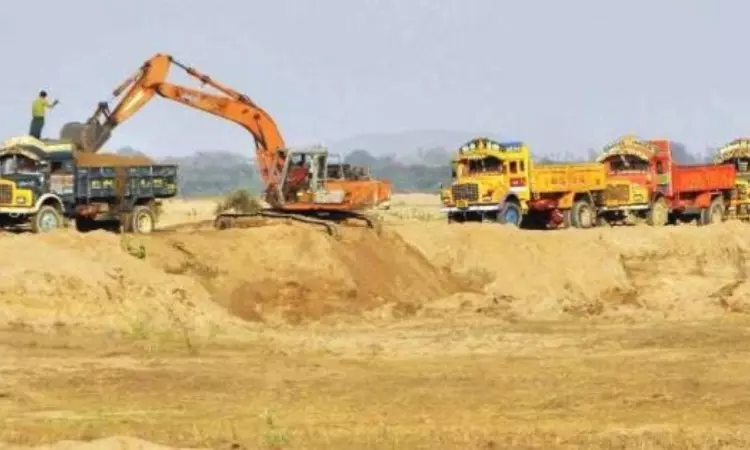
Despite a call for sustainable practices and the efforts to establish a surveillance system, coupled with the National Green Tribunal's targeted crackdown on the illicit sand mining activities, rampant illegal sand mining continues to plague the country in response to the excessive demand of sand, to match the massive construction drive of the nation. Demands tripling by the time we form these thoughts, sand holds the infamous title, for collectively being the second-most exploited natural resource on the planet.
At the foremost, we thereof divert our attention towards some representative news pieces, all of which are connected through a commonality of vice. For instance, in the foretimes of the April of 2023, a key rail-bridge connecting different locations in Maharashtra had come under scrutiny for its deteriorating infrastructure. In the following months of the same year, a revenue officer in Shahdol, Madhya Pradesh had been crushed to death in his quest to fight against illicit sand mining activities. In continuance, the yesteryear festive fervour of the October of 2025, witnessed a tragedy of twelve men ultimately drowning into a 25-feet deep death trap of the Utangan river, situated in the Khairagarh district of Uttar Pradesh.


These are merely reported instances, of the common vices of illegal sand mining that pervade through such mishaps. The tendrils of illegal sand mining have repercussions that are multitudinous in nature, tapping into different disciplines. Biologically, illegal sand mining is a relentless attack on rivers, which leads to a widespread destruction of aquatic life habitat and their breeding grounds, consequently resulting into a pernicious collapse of food chains.
Ecologically, relentless sand mining can lead to a severe depletion in groundwater. Removal of sand, not only destructs the natural purifier (sand) that helps in decontamination of ground water, but it also leads to a destruction of groundwater-holding-aquifers that have the capacity hold water, which can be accessed through wells dug deep into the ground. Due to the deep pits created by sand mining, groundwater rushes to fill the new cavities created by mining activities, lowering the overall depth at which groundwater could be found, which ultimately results in the drying up of wells. Needless to say, sand mining is also a causal link to increased water contamination. Unchecked mining of sand leads to resuspension of sedimentary particles in the water, which in turn invites repercussions like murky water, hindrance to aquatic flora photosynthesis and the choking of aquatic species over sediment-ridden water.
Ultimately, in the essence of human rights, illegal sand mining is a silent catastrophe that requires an urgent redressal. The mass of indigent labourers engaged in this work, often perform their work with hardly any equipment asides an iron bucket. Negligence at the site, can often lead to death of the workers by getting buried under sand mounds or, drowning in the water. Sand mining has also become the pathway towards the deep creation of pits inside the rivers, which can lead to unsuspecting deaths of the common public accessing the rivers. Moreover, sand-mining activities encompass a massive illicit business ring that has been subjected to mafia-like controls that fights against anyone wishing to curb its burgeoning.
Metamorphosis:
Thereof, the solutions to illegal sand mining must speak towards a gradual but complete shift in the practice of the usage of sand, in construction. The proposition thereby, would be to completely halt the usage of sand in construction, by a gradual timeline that should not exceed five years. In that accord, a separate fund must be created in the Union budget on an urgency basis that caters towards environment research and technology. The means of this funding, may be derived from corporate social responsibility or a cess created for environment research/development. During the timeline of the said five years, the ruling government would be required to push for a circular economy, which for an active working must be accompanied by incentives. These are recommendations in supplementation of the Environment (Construction and Demolition) Waste Management Rules of 2025, that will impose recycling responsibilities upon waste generators who occupy/own or will occupy/own building complexes of an area of 20,000 sq. metres or above.
Disuse:
In the advent of a circular economy, we would be required to work towards finding long-term sustainable alternatives to sand. First, we may consider the cyclic usage of glass. Glass is, but sand losing its crystalline nature by succumbing to high temperatures. India produces an annual estimate of 3.2 million tons of glass, the entire waste output of which mandatorily needs to be recollected and reduced to a cullet-form (crushed or powdered form) in recycling or glass manufacturing factories. As glass is, but a treated version of sand, its reduced cullet-form would possess cementitious properties which can be utilised as a replacement to cement. This would entail a deficit in the continuous demand of sand, for cement requires sand as a component in its making. However, all of the discarded and treated glass waste, cannot be solely attributed to replacing sand in construction. The glass cullet would need to be distributed between the construction industries and the glass objects manufacturing industries, depending on the sustainability requirements of either of these sectors.
We thereof, look for other simultaneous solutions, that would help in the gradual disusage of sand. Accordingly, India produces about an annual mass of 100 million tonnes of coal ash, which comprises either of fly ash (a finer residual byproduct of burning coal) or bottom ash (a coarser residual byproduct of burning coal), both of which have in some capacity when mixed with other agents displayed a durability in concrete mixtures. When fly ash is mixed with quarry dust, another neglected but excessively produced byproduct during the processing of rocks in quarries, it can achieve a form that has the capacity to replace sand, at a complete 100 percent rate. Similarly, when bottom ash is mixed with quicklime (calcium oxide) it displays a great compressive strength (the ability to sufficiently withstand pressure/load without succumbing) at ambient temperatures, akin to sand. While bottom ash without the presence of quicklime, has been observed to deliver great compressive strength at higher temperatures. Depending on the need of the construction, bottom ash has also been deemed suitable for usage in concrete manufacturing.
It would be lackadaisical here, to not mention the uncharted waste production that is a result of the construction and demolition of infrastructure throughout the country. The capital city (Delhi), alone accounts for an estimated production of about 1.5 million tonnes of annual construction and demolition waste. While the said waste, may not possess the strength of the original concrete mixture, its uses could surely be inculcated for non-structural purposes like flooring.
Asides from evaluating alternatives, concomitantly the five-year timeline must also be devoted to using the budget for researching and developing technology, that may cater to increasing the durability of pre-existing alternatives or creating lab curated alternatives to sand. At this juncture, our challenge would become the willingness of the Indian business sector to actively participate in the alleviation of the sand crisis. Despite of the necessitated legal compliance and monitoring for these ideas to work, contributing towards the circular economy must be awarded with provisional tax incentives. In any case, India though nascent, will become a behemoth in the carbon trading market due to the increasing conscience around environment and the fast-paced development drive of the nation. Accordingly, in tandem with the Energy Conservation Amendment Act of 2022, which introduced the idea of Indian Carbon Markets, there would be an imminent necessity for mandated carbon credits in industries dealing with the increased usage of sand. This would boom the business of creating sustainable alternatives to sand, as sustainable industries acting in carbon abatement, would essentially mint carbon credits. Trading these credits with the industries that require carbon credits, would bring in additional capital to the sustainable industries. Which, may push industries towards working more competitively or may nudge them to increase the affordability of their sustainable alternative products to sand, owing to supplemental income arising out of carbon trading.
Perhaps, the complete replacement of sand maybe idealistic in nature, but the ideas must be treated with urgency and importance rather than being subjected to cold storage until danger is right at the door, which is usually how environmental issues gain their cognizance. These development of alternatives to sand and a growth in the carbon market, will require labour and create numerous jobs, that are here to persevere and would not be subjected to the whims of mafia-like control and illegalisation.
Author is an Advocate practicing at District and Sessions Court of Harda, Madhya Pradesh. Views are personal.


