



Supreme Court Clarifies: Section 480(3) BNSS Bail Condition Not Applicable To Offences Punishable Up To Seven Years
Shreya Garg
5 May 2026 10:38 AM IST
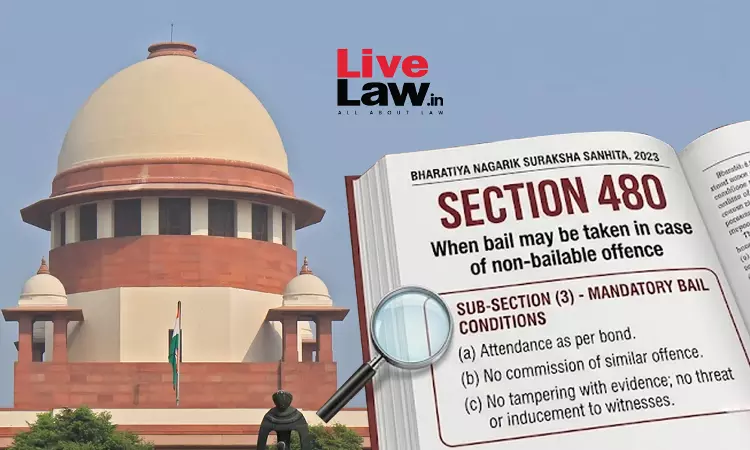
In a significant order passed on 22nd April 2026, the Supreme Court settled an important question of bail jurisprudence that trial court across country had been getting wrong since Bharatiya Nagarik Suraksha Sanhita, 2023 (BNSS) came into force. In Narayan v. State of Madhya Pradesh, SLP (Crl.) No. 7011 of 2026, a division bench comprising Justice J.K. Maheshwari and Atul S. Chandurkar held that the mandatory conditions prescribed under Section 480 (3) BNSS do not apply to non-bailable offences punishable with imprisonment upto seven years. The Court set aside the Madhya Pradesh High Court's order cancelling the appellant's bail, observing that the Section 480 (3) BNSS conditions could not be imposed since the subsequent offence carried a maximum punishment of less than five years. This ruling highlights a widespread misinterpretation of the provision by the trial court since the BNSS came into force and seeks to prevent routine imposition of onerous bail conditions.
UNDERSTANDING SECTION 480(3) BNSS
Section 480(3) of the Bharatiya Nagarik Suraksha Sanhita, 2023 (BNSS), corresponds to Section 437(3) of the Code of Criminal Procedure, 1973 (CrPC), provides that the courts impose certain conditions when granting bail to an accused for offences "punishable with imprisonment which may extend to seven years or more" or for offences under Chapters VI, VII, or XVII of the Bharatiya Nyaya Sanhita, 2023 (BNS). These conditions are: that the accused appear before the court when asked to do so as per the bond, not to commit any offence of a similar nature, not to tamper with or conceal evidence or induce witnesses.


The operative phase of the section is "which may extend to seven years or more." The Supreme Court's ruling makes this clear that these conditions are not triggered where the maximum punishment for the offence is seven years or less. This means that for mid-level offences, punishable upto seven years, the courts are not required to impose the harsh conditions mentioned in Section 480 (3) BNSS. The mandatory character of Section 480 (3) is contingent on the nature of the offence and it does not apply universally.
THE PRACTICAL PROBLEM
Despite the clear statutory text, courts across India have been consistently imposing standard conditions, including surrender of passport, weekly or daily reporting at the police station, stay within the district or state, and stringent surety conditions in all cases, including where Section 480 (3) is not applicable. The consequences of these conditions are real. For example, a person charged under Section 318 BNS (cheating) that has a maximum punishment of seven years, may be required to report at the police station every day as a condition of bail. If the person is works in another city, this condition may effectively force them to give up their employment. For a professional such as an IT professional, importer or doctor, surrendering the passport means losing contracts, missing surgeries, or forfeiting international work entirely. Therefore, even before the trial begins, onerous bail conditions may have a negative impact on a person's life and career.
Such conditions can have a significant impact on the lives of undertrial. India has one of the largest undertrial populations globally, and overly restrictive bail conditions often prolong the hardship faced by accused persons who are yet to be proven guilty. It is important that bail conditions remain proportionate and do not effectively amount to pre-trial punishment, keeping in mind the presumption of innocence.
CONSTITUTIONAL AND STATUTORY FOUNDATION
This ruling is consistent with the longstanding rule that “bail is the rule and jail is the exception,” as reiterated by the Supreme Court in Satender Kumar Antil v. Central Bureau of Investigation, 2022 INSC 690. This principle flows from the basic observations of Justice V.R. Krishna Iyer in Gudikanti Narasimhulu v. Public Prosecutor, 1978 INSC 232, that personal liberty is precious, and its curtailment must be justified rather than routine. More recently, in Kapil Wadhawan v. Central Bureau of Investigation, 2025 INSC 1440, the Court held that an undertrial should not remain in custody indefinitely unless there is a real risk of flight, witness tampering, or danger to the public. Similarly, bail conditions that are equivalent to jail in disguise should not be applied automatically.
According to the proportionality doctrine, now firmly embedded in Indian constitutional law, requires that any restriction on liberty must be lawful, pursue a legitimate aim, and impose the least possible burden necessary to achieve that aim. A condition imposed as a matter of routine, without reference to the fact of the case, fails this test at the outset.
WHY THE HABIT'S PERSISTS
If the constitutional idea is established and the statutory text is clear, then why trial courts impose these restrictions so often?
There appear to be three main reason. The first is risk aversion. A trial court judge who imposes conditions and an accused person who violates them are not institutionally condemned. When a judge grants bail without conditions and the accused person flees, the judge is criticized. The incentive scheme promotes extreme caution rather than rewarding proportionality.
Second factor is the absence of adversarial challenge. At the trial court stage, lawyers often consider the grant of bail as a victory and don't challenge the conditions. The conditions go uncontested, and the next order mirrors the old one.
Third, there has been inadequate sensitization to the new law. The CrPC was replaced by the BNSS in July 2024, but magistrates who routinely imposed conditions under Section 437(3) of the CrPC continue to do so under Section 480 (3) BNSS, without checking the veracity of the argument that the language of the new provision is the same as of old code.
WHAT MUST CHANGE
A Doctrine without implementation remains inert. For the ruling in Narayan to mean anything beyond its own facts, several things must follow.
Bail Conditions must be reasoned. If a court imposes conditions requiring that passports be surrendered or reporting be made, it must explain why they are needed in the particular case. Is there a flight risk? Has the accused breached bail before? In the absence of reasons, any condition should be, and can be, challenged.
Defence advocacy must engage actively. It is not sufficient to wait until an accused breaches a condition and then contest the cancellation of the condition. The challenge must come at the initial bail stage, with specific arguments as to whether Section 480(3) is triggered at all, and whether the facts justify the condition sought.
High Court must exercise their supervisory role. Several High Courts have already initiated Suo motu reviews of bail conditions imposed in trial courts in relation to undertrial detention. Similar oversight of the quality and proportionality of bail conditions imposed in trial courts under Section 480 BNSS would be a natural extension of that jurisdiction.
Judicial Training must be updated. The National Judicial Academy and State Judicial Academies should incorporate the ruling in Narayan case into training curricula for Magistrates and Judicial Magistrates First Class, before whom the majority of bail applications are first heard.
The Supreme Court's April 2026 ruling is, ultimately, a restatement of a proportionality principle that Indian courts have long articulated and only sometimes applied that liberty is the rule and curtailing liberty—either in person or in bail conditions—is the exception or must be justified on a case-by-case basis. The BNSS was designed to reform Indian criminal procedure. If it is to serve the accused, who appear before trial courts every day, courts must read it as it is written, and stop imposing conditions that are not required by law.
Author is a practicing Lawyer at Patna High Court. Views are personal.


