



Sinking A Warship, Testing A Charter: Lessons From The Iris Dena Incident
Syed Shiraz Fazal & Twinkle Hussain
10 March 2026 10:00 AM IST
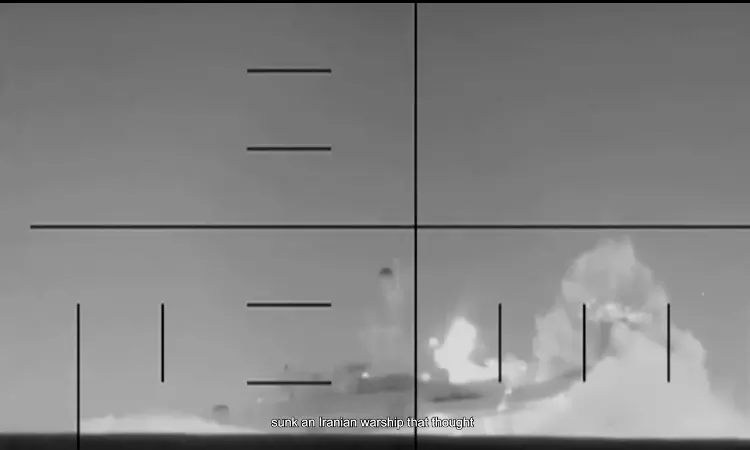
Screenshot of visuals of US Submarine attacking Iranian naval ship (from video shared on X by The White House)
The sinking of the Iranian warship Iris Dena by an American submarine in the Indian Ocean is not merely a dramatic naval episode, rather it represents a classic case of contemporary use of force. A sovereign immune warship of Iran, returning from a multilateral naval exercise hosted by India, was destroyed in international waters off the coast of Sri Lanka by forces of the United States. That combination of facts — interstate violence outside a declared theatre of war, directed against a naval vessel rather than a land target — places the incident squarely within the ambit of jus ad bellum, the law governing when states may resort to force at all.
Yet the legal analysis cannot stop there. If the strike is defended as part of an existing armed confrontation between the United States and Iran or Iranian proxies, then a second body of law becomes relevant: the law of naval warfare, a branch of international humanitarian law regulating how hostilities may be conducted at sea. The incident therefore raises two distinct questions — whether the United States was entitled to use force at all and whether the manner in which force was used complied with the rules governing naval hostilities.


A warship is not an ordinary military asset operating in run-of-the-mill circumstances. Under long-settled law of the sea, reflected today in Article 95 of the United Nations Convention on the Law of the Sea, a warship enjoys complete sovereign immunity. It is treated as a floating extension of the flag state's territory. This is not merely a symbolic legal measure. In the Corfu Channel Case, the International Court of Justice treated interference with British warships as an affront to the United Kingdom's sovereign rights. The ARA Libertad Arbitration reaffirmed the same principle decades later, holding that even temporary detention of a warship violates sovereign immunity. Destroying one is therefore the clearest possible form of force against the state itself, falling within the prohibition in Article 2(4) of the United Nations Charter unless justified by self-defence.
Self-defence, however, is a narrow exception rather than a strategic licence. Since the Caroline Incident, the doctrine has rested on necessity and proportionality. Modern case law adds a further requirement: the existence of an armed attack attributable to the state targeted. In Nicaragua v United States, the Court rejected the argument that general hostility could justify force. In Armed Activities on the Territory of the Congo, Uganda's claim of self-defence failed because it could not demonstrate that the Democratic Republic of the Congo had launched or controlled the attacks relied upon. In the Legal Consequences of the Construction of a Wall in the Occupied Palestinian Territory, the Court reiterated that Article 51 presupposes an armed attack by a state.
Applied to Iris Dena, the difficulty is evident. The vessel does not appear to have been intercepted while firing missiles, laying mines, escorting an attack or participating in hostilities. It was reportedly returning from a naval visit. Without evidence of an ongoing or imminent armed attack, the strike begins to resemble a preventive or punitive action against a state asset. That logic was rejected by the Court in Oil Platforms (Iran v United States), where the United States argued that Iranian oil installations were legitimate targets because Iran was generally hostile in the Gulf. The Court insisted that a specific nexus must exist between the target attacked and the armed attack relied upon as justification.
Suppose, however, that one accepts the premise that a broader armed conflict exists between the United States and Iran or Iranian-backed forces. The legal inquiry would then move from jus ad bellum to the law governing naval hostilities. Even there, the permissibility of the strike is far from obvious.
Modern naval warfare law is most clearly articulated in the San Remo Manual on International Law Applicable to Armed Conflicts at Sea, which reflects customary principles derived from humanitarian law and state practice. The Manual recognises that enemy warships may generally be attacked during armed conflict because they constitute military objectives. Yet this rule is embedded within broader principles of distinction, proportionality and due regard for neutral rights.
Naval warfare unfolds in a shared environment where belligerents and neutrals occupy the same maritime space. The M/V Saiga (No. 2) judgment emphasised that coercive action at sea must be exercised with particular restraint because of the risks to neutral shipping and the international community. The Indian Ocean, one of the world's busiest maritime corridors, is not a closed theatre of war. Torpedoing a warship in such waters is therefore not merely an engagement between belligerents; it carries risks for every vessel navigating those routes. An attack on a warship in such waters does not remain a bilateral matter, it internationalises the conflict by exposing third states to danger. That is why incidents like the 1988 destruction of Iran Air Flight 655 or the tanker war of the 1980s continue to haunt legal debates about escalation at sea.
The doctrine of naval exclusion zones highlights the point. During conflicts such as the Falklands War, belligerents declared maritime areas in which hostile vessels could be attacked on sight. Even these zones were controversial and were justified only with advance warning to neutral shipping. Outside such zones, the presumption is that belligerents must exercise caution and maintain respect for neutral navigation. No comparable exclusion zone appears to have existed in the region where Iris Dena was sunk.
Equally relevant are the traditional doctrines of visit and search and interception at sea. Naval warfare law historically required belligerent warships to intercept, identify and if necessary capture enemy vessels before destroying them, particularly where neutral shipping might be present. Although submarines complicated these practices during the world wars, the underlying principle remains that attacks should be conducted with precautions that minimise risk to civilians and neutrals. A sudden torpedo strike against a transiting warship in crowded sea lanes sits uneasily with that tradition.
The law of blockade also provides context. Under classical naval warfare rules, belligerents wishing to interdict enemy shipping typically declare a blockade, notify neutral states and enforce it within defined geographic limits. These rules exist precisely to prevent arbitrary violence against vessels outside recognised zones of hostilities. The absence of any declared blockade or maritime interdiction regime in the region further weakens the claim that the sinking formed part of a legally structured naval campaign.
Historical practice underscores the sensitivity of such actions. When the United States engaged Iranian naval forces during Operation Praying Mantis, the confrontation occurred in the immediate context of ongoing hostilities in the Persian Gulf and involved vessels actively participating in combat operations. Even then, the legality of those strikes was litigated before the International Court of Justice.
State practice reinforces this restrictive approach, even where states push its boundaries. The US justification for the killing of Anwar al-Awlaki relied heavily on claims of imminence. Israel's historic invocation of pre-emption in 1967 was defended on the basis of immediate existential threat. Whatever one thinks of those arguments, they at least acknowledged the need to frame action within necessity and imminence. There is no settled state practice supporting the proposition that a warship may be sunk simply because it belongs to an adversary engaged in hostilities elsewhere. Naval warfare since 1945 has, if anything, been marked by caution about striking sovereign vessels outside active combat zones, precisely because of the escalatory consequences.
Another legal obstacle concerns the attribution of proxy activity. Iran's support for non-state actors attacking shipping is frequently cited as justification for targeting Iranian assets. But international law draws a sharp distinction between influence and operational control. In the Bosnian Genocide Case, the Court held that responsibility for the conduct of non-state actors requires proof of effective control. Transposed to the use-of-force context, this means that even extensive support for proxy groups does not automatically transform every Iranian naval vessel into a lawful target.
Absent such a nexus, the strike risks being characterised as a reprisal — a retaliatory response to past attacks rather than a defensive act necessary to halt an ongoing one. Armed reprisals are widely considered unlawful under modern international law, a position reflected in UN General Assembly Resolution 2625 and repeatedly acknowledged in the jurisprudence of the International Court of Justice.
For India, the episode carries an additional layer of significance. An Iranian vessel that had just participated in an Indian-hosted naval exercise was destroyed days later in waters not far from India's maritime neighbourhood. That does not render India legally responsible. But it illustrates how easily distant conflicts can spill into regions that regard themselves as neutral maritime spaces. The broader danger lies in the precedent. If warships may be attacked wherever they are encountered, without the constraints traditionally imposed by the U.N. Charter framework and the law of naval warfare, then sovereign immunity at sea becomes conditional and the carefully constructed restraints on naval conflict begin to erode.
Public international law does not prohibit the targeting of enemy warships during genuine armed conflict. But it does require that such attacks occur within a legally recognisable framework of hostilities and comply with the principles governing naval warfare. On the publicly available facts, the sinking of Iris Dena appears to fall outside that framework. The distinction between defence and deterrence, between necessity and convenience, has always been fragile. If incidents like this are normalised, the threshold for lawful force will sink as surely as the ship itself. International law does not demand passivity in the face of attack. But it does demand proof, imminence and restraint. Without those, torpedoes become arguments — and arguments are no substitute for law.
The Author Syed Shiraz Fazal is an Assistant Professor at Lloyd Law College and Twinkle Hussain is an Assistant Professor at Asian Law College. Views are personal.


