



Police Force Meant To Disperse Crowd, Not To Punish Protesters
Gyanvi Khanna
1 Aug 2026 4:45 PM IST
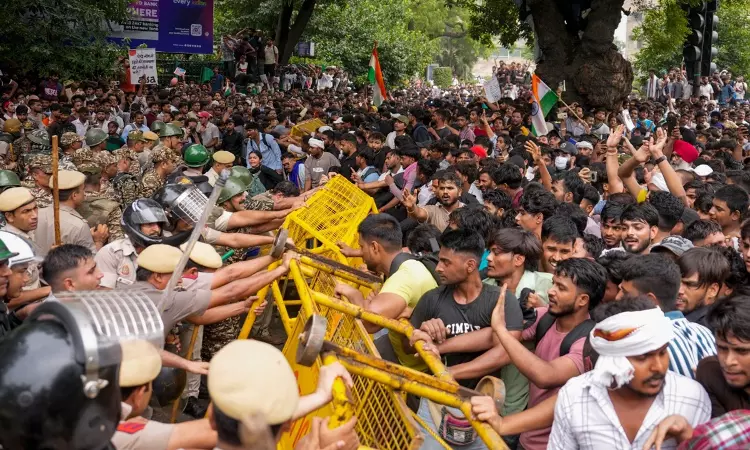
On July 20th, 2026, videos and clips of the student 'Chalo Sansad' march appeared across several online platforms. While an executive order under Section 163 of the Bharatiya Nagarik Suraksha Sanhita (BNSS), directing persons to abstain from certain acts to preserve public order, was in force in New Delhi, the brutal police action against students forces us to ask whether the same was justifiable. Even if students were said to have violated the order, whether the use of tear gas, lathis, pellets and other colonial measures was constitutional, let alone proportionate, is something every citizen of this country must ponder.
It is important to understand the text of Section 163 of the BNSS, which is a near re-enactment of its predecessor, Section 144 of the Code of Criminal Procedure (Cr.P.C.). It enables an executive magistrate to issue a written order "where immediate prevention or speedy remedy is desirable", directing "any person to abstain from a certain act" if "such direction is likely to prevent, or tends to prevent, obstruction, annoyance or injury to any person lawfully employed, or danger to human life, health or safety or a disturbance of the public tranquillity, or a riot, or an affray."


The right to peacefully protest is a fundamental right conferred by our sacred Constitution. Under Article 13, even executive orders that are inconsistent with our fundamental rights can be declared void. However, as we must know, these fundamental rights are not unlimited and are subject to reasonable restrictions in the public interest. Thus, even if for the sake of argument, there was a breach of the executive order, one must ask whether such an order can stand constitutionally where there was no foreseeable threat and most of the protestors were young students, and whether the way this order was enforced satisfied the test of legality, necessity and proportionality.
Lessons from Ramlila Maidan
In Re: Ramlila Maidan Incident v. Home Secretary, Union of India & Ors., Suo Motu Writ Petition (Crl.) No. 122 of 2011, the anchor case for this article, concerned a similar police crackdown on crowd protesting against black money had taken place. In the wee hours of June 5th, 2011, police assaulted and evacuated a sleeping crowd of protestors under the garb of Section 144 Cr.P.C. The Supreme Court took suo motu cognizance of the incident.
The bench of Justices Swatanter Kumar and B.S. Chauhan held that the said assembly did not per-se reflect any apprehension of imminent threat or danger to public peace and tranquillity. While deprecating the police action, the Court also doubted the sufficiency of the reasons for promulgating such an executive order, going so far as to observe that that the executive order was a colourable exercise of power and was uncalled for.
The bench also highlighted Delhi Police Standing Order 309, which requires a police officer to appeal to demonstrators to remain peaceful. Only if such appeal is unheeded can the assembly be declared as unlawful. Drawing on this, the Court pointed out that at no point was the assembly declared unlawful.
It emphasised that a threat to public peace must be real and not a mere possibility. The Court further held that dispersal of an unlawful assembly should be by use of "permissible force". Importantly, on the use of teargas, the Court said it should be fired away from the crowd rather than into the crowd.
"The Police Force and, at least, some members of the Police Force, have failed to execute the orders in accordance with the standing orders and have failed to take various steps that were required to be taken including use of minimum force, videography of the event, display of banner, announcement into the PA system etc. Similarly, some members of the Force when incited by provocation or injury, used excessive force, including use of teargas."
Accordingly, the Court directed disciplinary action against all erring officers, making them individually accountable for resorting to lathi charge and excessive use of tear gas. The Court, without mincing its words, said that such action shall be taken against the officer "irrespective of what ranks they hold in the hierarchy of police". Not only this, but the Court also ordered compensation for the injured and deceased, making clear that, prima facie, it was the negligence and limited abuse of power that resulted in the injuries and the death of a protestor.
The Court, with respect to disproportionate action, noted that a restriction must be enforced with least invasion. The Court also highlighted that the onus to justify this force lay on the State and police, which they have failed to discharge. While observing that people of a democratic nation have a right to engage in peaceful agitations and express their resentment over government actions, the Court observed that the government has to respect and encourage exercise of such rights.
The Court categorically held that it the State's duty to protect the right to freedom of speech and not throttle such right under the garb of reasonable restrictions.
Minimum Force, Limits on Police Action
Following this, in Anita Thakur v. State of J&K, Writ Petition (Criminal) No. 118 Of 2007, the Supreme Court again reiterated that the force used by police during protests should be minimal and proportional to the situation, and that where an assembly is peaceful, the use of force is unwarranted.
"However, it becomes a more serious problem when taking recourse to such an action, police indulges in excesses and crosses the limit by using excessive force thereby becoming barbaric or by not halting even after controlling the situation and continuing its tirade. This results in violation of human rights and human dignity. That is the reason that human rights activists feel that police frequently abuses its power to use force and that becomes a serious threat to the rule of law."
Was the assembly declared unlawful?
Section 148 of the BNSS allows dispersal of an unlawful assembly using civil force. Therefore, it permits only minimum force and not indiscriminate beating. One of the landmark precedents in this context is of Karam Singh v. Hardayal Singh, 1979 Crl.L.J. 1211. Herein, the Punjab and Haryana High Court noted that force may be used where an unlawful assembly- an assembly of five or more persons likely to cause disturbance to public peace-does not disperse even after a dispersal order. Even in Ramlila Maidan case, the Supreme Court observed that, even if the teargas shells were filed in retaliation to the brick-batting by the crowd, proper announcements should have been made beforehand.
Thus, it can be safely said that, time and again, the courts have distinguished between dispersing an assembly and punishing it. Moreover, it would not be remiss to mention here that Section 163 of the BNSS is a preventive measure, not a punitive one. This is important to highlight because it shows that a breach of a prohibitory order does not authorise punitive police action. The precedents above make it crystal clear that an order under Section 163 is not a license to deploy disproportionate force and cannot subvert our constitutional rights.
What the Court must examine now?
Even if such an order was in place on July 20, the brutal use of force and assault by police calls for careful judicial scrutiny. Now that the Supreme Court is hearing petitions against use of force by police, it must look into whether sufficient warning was given to the crowd before lathi charge and use of other coercive measures; whether the use of force was necessary at all, and whether it was proportionate to threat posed by the young crowd.
In Ramlila Maidan, media coverage played a significant role and led the Supreme Court to take suo motu cognizance shortly after the incident. It was not the first case where media reports prompted suo motu cognizance. However, on July 22, 2026, when an advocate approached the Top Court seeking suo motu intervention against police brutality, the Chief Justice of India, Surya Kant, reportedly declined the request and asked the advocate not to waste the Court's time.
Even as independent journalists worked hard to bring ground reports from the day of protest, showing the excessive use of force through lathis and teargas against a young crowd, the CJI responded- "We are not interested in videos; we do not have time to watch it". However, subsequently petitions were filed on use of excess force by police and are listed now before the Supreme Court. Imperatively, on the first day of hearing, the Union of India and State of Delhi both have firmly denied use of the excess force by the police.
The Court must now ensure that all the erring officers are held liable, victims are compensated, and, on an immediate basis, protestors who are targeted by police through retaliatory FIRs and detention are given protection. It goes without saying that constitutional rights cannot be defeated by the arbitrary exercise of power on the streets of Delhi.
Views Are Personal


