



Venezuela And The Limits Of International Law's Hollow Core
Ivan & Vivek Mathur
23 Jan 2026 10:00 AM IST
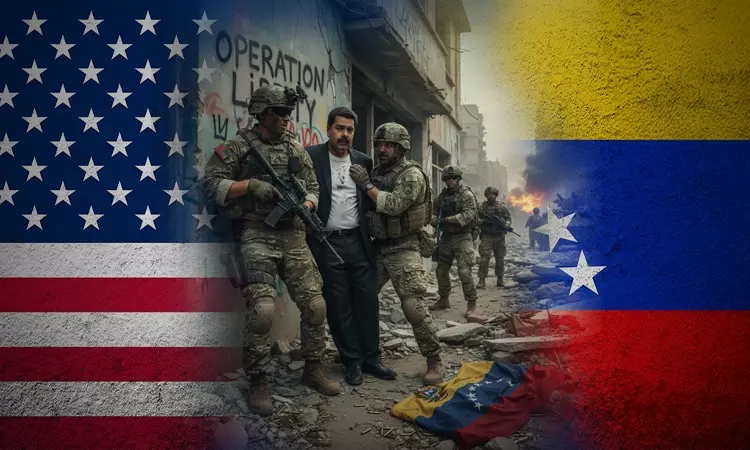
The recent interventionist posture adopted by the United States in Venezuela has laid bare a truth long articulated by critics of international law but seldom confronted with such clarity: when confronted with hegemonic will, international law ceases to function as a constraint and survives only as rhetoric. What is unfolding in Venezuela is not merely a regional crisis or a contested foreign policy decision; it is a case study in the structural futility of international law when power decides to dispense with restraint.
International law presents itself as a rules-based order founded on sovereign equality, non-intervention, and collective security. These principles are said to bind all states equally, irrespective of their material capabilities. Yet history repeatedly demonstrates that this equality is formal rather than real. The Venezuelan episode underscores how legal norms operate selectively— invoked when convenient, discarded when obstructive, and reinterpreted when necessary to align with strategic interests.


The intervention has not been authorised by the United Nations Security Council, nor can it be plausibly justified under the narrow exceptions to the prohibition on the use of force recognised by the United Nations Charter 2 Venezuela, as perhaps unlike the Islamic Republic of Iran back in June 2025, posed no imminent armed threat to the United States. No claim of collective self-defence has been substantiated. And yet, military action, coercive economic measures, and political interference have been undertaken with remarkable confidence. This confidence does not arise from legality; it arises from power.
Attempts to clothe the intervention in legal justification reveal the malleability of international law in the hands of dominant states. Law-enforcement rationales, counter-narcotics objectives, and humanitarian concerns have been marshalled as substitutes for legal authorisation. What emerges is not a coherent legal doctrine, but an amalgam of arguments designed to normalise conduct that international law explicitly prohibits. Domestic legal reasoning is projected outward and repackaged as international legitimacy, collapsing the distinction between municipal authority and international restraint.
Equally revealing is the institutional response. Multilateral mechanisms designed to uphold collective security have proven incapable of meaningful intervention. The Security Council remains paralysed, constrained by veto politics and geopolitical alignments. General Assembly condemnations, where they exist, remain symbolic and unenforceable. International law speaks, but it does not act. Its enforcement mechanisms falter precisely where they are most needed—against the powerful.
This pattern is neither novel nor accidental. Realist critiques of international law have long argued that legal norms reflect underlying power relations rather than constrain them. International law functions effectively when it aligns with the interests of dominant states; when it does not, it is sidelined. Venezuela is not an exception to this rule—it is its confirmation. The language of democracy, human rights, and humanitarian concern serves as a legitimising vocabulary, not a binding obligation.
For states in the Global South, the implications are stark. Sovereignty, once assumed to offer legal protection against external interference, now appears conditional. The norms that prohibit intervention are shown to be negotiable, subject to reinterpretation by those with the capacity to enforce their will. This asymmetry erodes trust in the international legal system and reinforces the perception that international law is an instrument of governance over the weak rather than a system of restraint on the strong.
Defenders of the intervention argue that legality must yield to justice, that extraordinary circumstances justify extraordinary measures. Yet this argument itself exposes the fragility of the legal order. If legality is contingent upon moral or political approval by powerful states, then it ceases to be law in any meaningful sense. It becomes discretion dressed as normativity.
The Venezuelan intervention also sets a dangerous precedent. When a dominant power demonstrates that regime change, military action, and coercive economic measures can be undertaken without legal consequence, it invites emulation. Other powers will draw their own lessons, invoking their own versions of necessity and legitimacy. The erosion of legal restraint is cumulative, not isolated.
International law, as it currently exists, is not an autonomous system capable of regulating great-power conduct. It articulates ideals, codifies aspirations, and disciplines marginal actors, but it falters at the point where power asserts itself most forcefully. Venezuela exposes this hollow core with unsettling clarity.
If international law is to remain more than a vocabulary of convenience, its advocates must confront this reality honestly. Until then, episodes like Venezuela will continue to remind us that in the hierarchy of global order, legality follows power—not the other way around.
1. Articles 2(4) and 51 of the Charter of the United Nations govern the prohibition on the use of force and the limited exception of self-defence
The Authors Are Advocates-on-Record At Supreme Court Of India
Views Are Personal


