



- Home
- /
- Book Reviews
- /
- Memoir Of Constitutional Lawyering...
Memoir Of Constitutional Lawyering & Feminist Resistance : On Indira Jaising's 'Constitution Is My Home'
Gursimran Kaur Bakshi
27 Jun 2026 9:46 AM IST
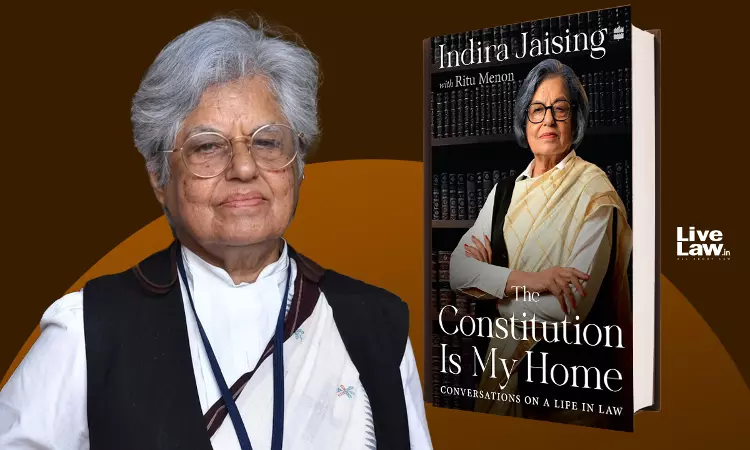
American poet Sylvia Plath once wrote how she saw her life branching out like a green fig tree, each fig a different path and the anxiety of choosing one. This analogy may fit every woman well, unless you are Indira Jaising. She could have chosen an ordinary home and an ordinary life. Instead, she chose to call the Constitution her home. But to call something a home requires defending...
This is a premium content
Available exclusively to
Our subscribers
Subscribe Premium 
INR 1099+GST
Your support helps us to bring you more content at
an affordable subscription scheme !!!
All payment options available
American poet Sylvia Plath once wrote how she saw her life branching out like a green fig tree, each fig a different path and the anxiety of choosing one. This analogy may fit every woman well, unless you are Indira Jaising. She could have chosen an ordinary home and an ordinary life. Instead, she chose to call the Constitution her home. But to call something a home requires defending it, sometimes for a lifetime. Her recently released memoir, 'The Constitution Is My Home: Conversation On A Life In Law', is a record of exactly that. The book is divided into nine chapters and is structured as a series of candid conversations with writer Ritu Menon.
The memoir begins with a brief glimpse into her personal life. Her commitment to protecting the Constitution may have begun unconsciously when she decided not to marry for convenience but establish a career, a choice many women thought they never had at the time. Yet, in her career, she successfully defended a woman judge who was forced to resign for choosing her child over her career, and petitioned the Supreme Court for a creche facility; both reflecting her feminist perspective of acknowledging different choices women can make.
Born to a Sindhi family, Jaising carried the partition memories through the eyes of her family. She began her career mostly leaning towards trade union matters and concerns of working women, the latter she says she instinctively identified with.
She speaks about how she began to see the scope of constitutional litigation concerning socio-economic rights in the backdrop of the post-Emergency period and the Supreme Court's expansion of PIL jurisdiction, beginning with the 1985 Bombay hawkers union case. In this, the Bombay Municipal Corporation had issued 14,000 hawking licenses, leaving unlicensed vendors to the mercy of paying regular bribes to the police. The corporation exercised discretion to deny or renew a hawking license and to seize goods without opportunity to be heard.
Jaising, representing the union, argued that the Constitution protected the right to livelihood and that they had a fundamental right to carry out trade under Article 19(1)(g). This case shaped the Street Vendors (Protection of Livelihood and Regulation of Street Vending) Act, 2014. She applied similar approaches in defending the right to livelihood of pavement dwellers in Bombay, who were facing eviction, known as the 1985 Olga Tellis case or protecting the right to work of women vegetable vendors in Ahmedabad. These judgments were fundamental in shaping Article 19(1) as it is today.
Jaising says while these cases shaped her career, she grappled with the paradox of dealing with cases involving religion and personal laws violating equality and anti-discrimination guarantees. In her chapters on democratic and secular lawyering, she discusses two practices, the Triple Talaq practice and the Sabarimala temple entry ban, both centering around personal laws and religion, respectively, that she challenged before the Supreme Court.
In discussing these cases, Jaising tells Menon rather assertively that the Supreme Court has always avoided solving this paradox. She says it has some unfinished business, especially around the ghost of the 1951 Narasu Appa Mali judgment, which continues to hang around the neck like an albatross.
Her agony is that one can't simply argue that these practices are discriminatory and violate the Constitution because they are premised on uncodified invisible laws sheltering patriarchy, and their interpretation is mostly controlled by religious authorities.
Jaising also speaks on the intersectionality of personal law and family law based on the common thread of religion, which can be seen from the writer Githa Hariharan's case challenging the RBI's policy, which only considered the father as a natural guardian of children or Mary Roy's challenge to the Travancore Christian Succession Act that denied daughters equal share in the estate's property.
She remarks: “If I were to name one core insight from my years in law, it would be this: We will not build a society free from sex-based discrimination unless the law is disentangled from religion. That applies to all religions. Much of my legal work has focused on stripping personal laws of religious residue. The fight has been long, and the resistance has been constant.”
Her deeper questions on substantive equality, connecting to power imbalance, can be seen from her bitter experience of dealing with cases involving sexual harassment. In one of the cases involving allegations of sexual harassment of IAS Officer Rupan Deol by DGP Punjab, K.P.S. Gill, Jaising shares her ordeal that during the court proceedings, Gill's lawyer made unnecessary remarks in open court, saying: “What's a pat on the back, Ms Jaising? Right now, in court, if I tap you on the back, would you object?”
In this case, the Supreme Court held that outraging the modesty of a woman included outraging her dignity. His conviction under Sections 354(outraging the modesty of a woman) and Sections 509(words, gesture or act intended to insult a lady) was upheld.
Jaising questions if such remarks would have been made to a male colleague. She writes: “There have been times when male judges and lawyers have made sexist remarks against me in open court. I have pointed this out immediately and demanded that they stop. The culture of sycophancy has not prevented me from calling out judges or lawyers as they speak, rather than filing cases against them in future. When a senior colleague refers to you as someone's wife, it is time to stop them in their tracks. When a judge, yielding to the influence of senior male colleagues appearing against you, says, 'We have had the pleasure of hearing you, Dismissed', it is time to tell them in open court that we go there for work, not for their pleasure.”
While the early chapters of the memoir set the tone, the latter chapters focus on how she contributed to institutional well-being and raise questions on judicial accountability. Jaising discusses her petition for streamlining the senior advocate designation, which led to the 2017 guidelines laying down objective criteria. But unknown to many has been her role in co-authoring an article titled 'Judicial Corruption' which had disclosed an internal audit report containing the details of Justice Ramaswami's unaccounted expense when he was the CJ of the Punjab and Haryana High Court. This publication led to the first formal impeachment motion against a sitting judge.
The memoir allows the reader to visit the judiciary as an institution through the lens of someone who refused to back down. Some of these conversations might feel rhetorical and rather academic, but it sets the tone for some of the larger issues Jaising intends to raise. Most importantly, this book tells you why and how she decided to take a specific case or refused the brief, signalling deliberate choices which continue to shape and reshape her home: her Constitution of India.
Tags
Gursimran Kaur Bakshi
Gursimran is the Principal Correspondent with LiveLaw for the Supreme Court. She can be reached out at: simrankaurbakshi@livelaw.in

