Corporate
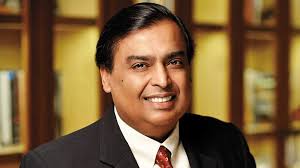
'Publicity Driven Exercise': Orissa High Court Quashes Case Against Mukesh Ambani Over Supply Of 'Defective Mobile' To Lawyer In 2003
The Orissa High Court has quashed a criminal complaint and summoning order issued by a Magisterial Court against the Reliance Industries Limited (RIL) and its Chairman Mukesh Ambani over supply of a defective mobile handset to a lawyer in the year 2003.While setting aside the impending criminal prosecution, the Bench of Dr. Justice Sanjeeb Kumar Panigrahi termed the entire exercise as...
Civil Courts Can't Decide Premature Loan Repayment Disputes, Only NCLT Has Jurisdiction: Allahabad High Court
The Allahabad High Court has held that civil courts cannot decide disputes regarding premature repayment of a loan. Only the National Company Law Tribunal (NCLT) has such jurisdiction under Section 45QA of the Reserve Bank of India Act, 1934, read with Section 430 of the Companies Act, 2013.Section 45QA of the Reserve Bank of India Act, 1934, empowers the Company Law Board, constituted...
Supreme Court Refuses To Stay Adani's Resolution Plan For Jaiprakash Associates; Urges NCLAT To Hear Vedanta's Appeal On Priority
The Supreme Court on Monday refused to interfere with the order of the National Company Law Appellate Tribunal (NCLAT) which refused to accept the plea of Vedanta Ltd to stay the implementation of Adani Enterprises' resolution plan for Jaiprakash Associates Ltd.The Court declined interference noting that the NCLAT has posted Vedanta's appeal for hearing on April 10. The Court however...

Empowering SEBI: Case For Statutory Framework To Compensate Victims Of Corporate Fraud
The Securities and Exchange Board of India (SEBI) is the market regulator focused on protecting investor interests. However, its role in settling disputes between investors and companies is still debated. While SEBI regulates and enforces rules, it does not have a solid system for providing remedies that focus on investors.Since the Securities and Exchange Board of India Act was introduced in 1992, SEBI has slowly expanded its power over intermediaries and listed companies. However, it has not...
Company Cannot Give Loan To Director Without Special Resolution In General Meeting : Supreme Court
The loan advanced to the director from company's funds must relate to the principal business of the company.
Order 23 Rule 1 CPC Applies To S.11 Arbitration Act; Fresh Arbitration Barred After Abandoning Earlier Claim : Supreme Court
The Supreme Court has observed that a party who abandons an earlier arbitration proceeding would be barred from initiating a subsequent arbitration proceeding on the same cause of action. The Court underscored that such conduct amounts to an abuse of the judicial process and is barred on grounds of public policy. “A litigant cannot be permitted to abuse the process of Court to file a...
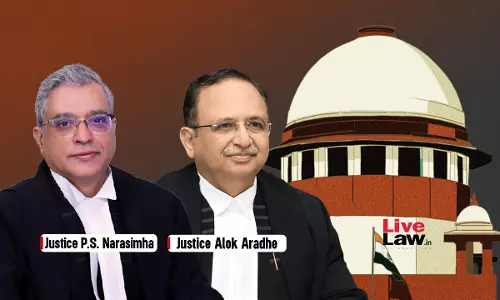
Govt Can Withdraw Tax Concession Given To Industry In Public Interest : Supreme Court
The recipient of concession has no vested right to claim that the concession must continue indefinitely, the Court clarified.
When Data Is The Market: India's Competition Law Blind Spots
Artificial Intelligence tools such as ChatGPT and Gemini are now part of everyday life. A student may use ChatGPT to draft notes, while business owners may rely on Gemini to create marketing content or respond to customers. These tools appear as simple applications but behind them lies a complex ecosystem involving cloud computing, datasets and AI models controlled by a handful of large technology companies. This raises a question that is if a few firms control both the infrastructure and the...

From Pandemic Protectionism To Strategic Liberalisation: Rethinking India's FDI Security Regime After 2026 Amendment To Press Note 3
Among the most important and impactful regulatory decisions in the recent times in terms of the impact on the Indian foreign investment regime is the Press Note 3 (2020 Series) FDI Policy issued by the Government of India in 2020. The policy was issued during the COVID-19 pandemic with the objective of protecting Indian companies from opportunistic acquisitions by investors from countries that share a land border with India.The policy significantly modified the Indian regulatory framework of...
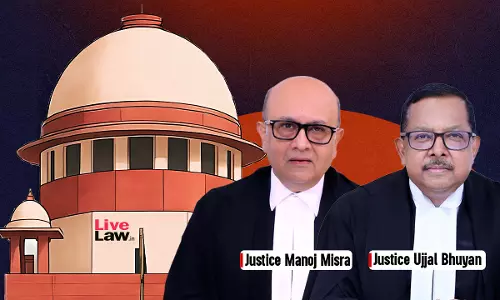
Excise Duty Exemption Notifications Based On “Intended Use” Must Be Liberally Construed In Favour Of Assessee : Supreme Court
Incidental or ancillary use of goods does not defeat exemption claim, the Court observed.
IBC | After Moratorium, Creditor Cannot Appropriate Pre-CIRP Dues From Earlier Security Deposit Made By Corporate Debtor : Supreme Court
The Supreme Court has observed that once a moratorium is imposed, a corporate debtor's pre-CIRP dues cannot be set off against a deposit held by the creditor. The Court held that until such deposit is lawfully adjusted, it continues to remain the property of the corporate debtor, and any appropriation after the moratorium would be impermissible in law. “The deposit made even if treated as...