




Corporate
Party Estopped From Challenging Award On The Ground Of Mandate Expiry After Accepting Extension Of Arbitrator's Mandate: Supreme Court
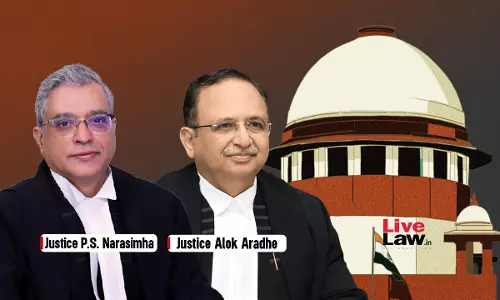
The Supreme Court on Tuesday (May 26) has held that a party who continues to participate in arbitration proceedings without objecting to the extension of the arbitrator's mandate cannot later challenge the award on the ground that the mandate had expired. A bench of Justice Pamidighantam Sri Narasimha and Justice Alok Aradhe heard the dispute that arose out of arbitration proceedings between...
Supreme Court Surprised Over Vacancies In ITAT Administrative Staff, Seeks Attorney General's Intervention
The Supreme Court on Tuesday expressed surprise over the large number of vacancies in the administrative staff of the Income Tax Appellate Tribunals (ITAT) and sought the intervention of the Attorney General for India to ensure that the posts are filled at the earliest.A bench comprising Chief Justice of India Surya Kant and Justice Joymalya Bagchi was hearing a writ petition filed by...
Supreme Court Questions Centre's Delay In Notifying Commercial Court Rules 2021, Says HCs May Consider Setting Up District Execution Cells
The Supreme Court on Monday (May 25) took serious note of the Union Government's failure to notify the draft Commercial Courts Rules, 2021, observing that the country is facing a “huge challenge” in the effective and expeditious disposal of execution petitions. A bench of Justice JB Pardiwala and Justice Pankaj Mithal took suo motu notice of the fact that the draft Commercial Courts...
Interim Profits In CIRP: EBITDA Allocation Dilemma
The major headline from the Supreme Court's decision to restore JSW Steel's resolution plan for Bhushan Power and Steel Limited (BPSL) on 26 September 2025, was the rescue of a ₹19,350 crore acquisition that the same court had set aside five months earlier.Another issue that came to the forefront but gained little traction was the consequential question: Who is entitled to the EBITDA...

Illusion Of Digital Convenience
Navigating the Regulatory Void in the Indian e-Commerce LandscapeThe statutory architecture governing e-commerce in India presents a formidable facade of consumer protection that crumbles upon practical execution. We operate under the ambit of the Consumer Protection Act, 2019 and the Consumer Protection Electronic Commerce Rules, 2020, yet the digital consumer remains vulnerable to corporate negligence. The legislative intent of passing this legislation and framing these rules was progressive,...
When Can Re-Assessment Be Opened U/s 147, 148 of Income Tax Act? Supreme Court Explains
While dealing with a tax case related to development of a housing project, the Supreme Court recently elucidated the position of law pertaining to reopening of assessments under Section 147 of the Income Tax Act, 1961. A bench of Justices JB Pardiwala and KV Viswanathan referred to Section 147 (pre-2012) and Section 148 (pre-2006) of the IT Act and observed that power to reopen assessment is...
Reliance's Supply Of Gas From KG Basin To UP Is Inter-State Sale; VAT Not Applicable : Supreme Court
The Court held that the transaction came within the Central Sales Tax Act.
Arbitration Clause Gets Incorporated In Later Contract When Earlier Agreement Is Imported “Body and Soul” : Supreme Court
The Supreme Court observed that when a subsequent contract incorporates, in its entirety, the terms and conditions of an earlier agreement containing an arbitration clause, such incorporation is sufficient to invoke arbitration, and the later agreement need not separately express a clear intention to refer disputes to arbitration or specifically mention the arbitration clause in the...
IBC | Appeals Must Be Filed With Certified Copy Of Impugned Order, Mere E-Filing Not Enough: Supreme Court
The Supreme Court on Tuesday (May 12) observed that an e-filing of an appeal before the National Company Law Appellate Tribunal (NCLAT) without a certified copy of the impugned order is not a mere defective filing but a “wholly incompetent appeal” that cannot subsequently be cured. A bench of Justice Sanjay Kumar and Justice K. Vinod Chandran set aside the National Company Law...
Consumers Cannot Be Made To Bear Power Plant Depreciation Costs For Period During Which No Electricity Was Supplied: Supreme Court
In a significant relief to the electricity consumers, the Supreme Court on Thursday (May 7) has observed that electricity consumers cannot be burdened with paying depreciation costs for a power plant that no longer supplies electricity to them, even if the asset continues to have remaining technical life. “…admittedly, electricity has not been supplied to the consumers beyond March-2018....
Companies Act 1956 | Entry In Register Of 'Members' Not Necessary To Maintain Plea Against Oppression/Mismanagement: Supreme Court
The Supreme Court recently upheld a stakeholder's locus to maintain a petition before the Company Law Board alleging oppression and mismanagement, holding that entry in the register of "members" is not the only mode of acquiring membership.The Court observed that even in the absence of a formal entry in the appellant-company's register of members, respondent No.1 was entitled to be treated as...
Corporate Veil Can Be Lifted To Include Assets Of Group Companies In CIRP Of Holding Company : Supreme Court
The Supreme Court on Tuesday (May 5) observed that for protecting the rights of the homebuyers and paving a way for completion of the stalled real estate projects, the corporate veil may be lifted during the Corporate Insolvency Resolution Process initiated against the holding company, by allowing the inclusion of the assets of the subsidiary companies. Setting aside the NCLAT's decision,...