



'UN Has Potential To Rebuild Public Trust': Dr Eun-Ju Kim On Her Latest Book
Gursimran Kaur Bakshi
26 Sept 2026 9:59 AM IST
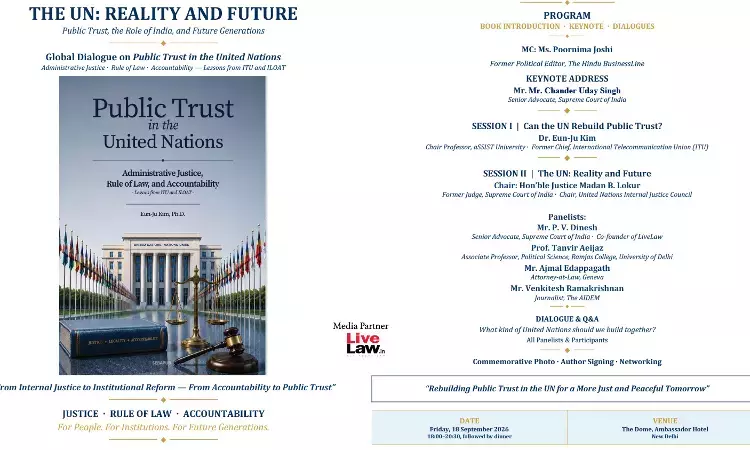
Recently, Dr. Eun-Ju Kim released her book 'The UN: Reality and Future Global Dialogue on Public Trust in the United Nations' in New Delhi in the presence of senior advocates of the Supreme Court, UN members, and diplomats. The launch was followed by a keynote address by Senior Advocate Chander Uday Singh of the Supreme Court of India.Kim has served in and with ITU, first as a national...
This is a premium content
Available exclusively to
Our subscribers
Subscribe Premium 
INR 1099+GST
Your support helps us to bring you more content at
an affordable subscription scheme !!!
All payment options available
Recently, Dr. Eun-Ju Kim released her book 'The UN: Reality and Future Global Dialogue on Public Trust in the United Nations' in New Delhi in the presence of senior advocates of the Supreme Court, UN members, and diplomats. The launch was followed by a keynote address by Senior Advocate Chander Uday Singh of the Supreme Court of India.
Kim has served in and with ITU, first as a national delegate from the Republic of Korea, then as a representative of the UK Sector Member, and later as a staff member in Asia and the Pacific and in Geneva.
Her book examines the question of 'public trust' in the UN through ITU as a case study. She has examined the internal governance of the UN through her institutional journey and through five judgments of the Administrative Tribunal of the International Labour Organisation(ILOAT), which provide independent judicial records against which the story needs to be examined.
This was followed by Session I on the topic 'Can the UN Rebuild Public Trust ', in which Kim made her keynote address. She stated that she chose India to launch her book because the country remains very special to her, particularly as she has served India, among other countries, as a Regional Director for Asia and the Pacific for the International Telecommunication Union(a specialised agency of the United Nations).
She said: "India is a centre of intellectual and legal courage, with a strong tradition of engaging with issues concerning not only the UN, but also accountability, justice and the rule of law."
On whether the UN can rebuilt public trust, Kim said she believes that the trust can be rebuilt but it must be earned through "visible institutional behaviour", particularly through leadership. She stated that international organisations must be more transparent in implementing their judgments and repeated adverse judgments should actually trigger an institutional review, rather than merely another payment from organisational funds.
"A judgment should not be treated merely as the closing of a case file. It should serve as evidence for institutional learning: what failed, why it failed, what was corrected, and how recurrence will be prevented. Only then can legal correction lead to governance reform, and governance reform strengthen public trust."
Subsequently, in Session II on 'The UN: Reality and Future,' Senior Advocate PV Dinesh, Professor Tanvir Aeijaz, Associate Professor at the Ramjas College, University of Delhi; Ajmal Edappagath, Attorney-at-Law, Geneva; and Venkitesh Ramakrishnan, Journalist at The AIDEM, spoke as panellists.
ILOAT is not a national court, but it performs an essential judicial function for international civil servants. As per Kim, ILOAT is especially significant because it is the last judicial resort for international civil servants.
By examining ITU-related proceedings and the jurisprudence of the ILOAT, the book seeks to draw broader lessons for governance reforms, institutional integrity, public trust, and the transformation of international organisations for future generations.
The five judgments that this book covers are ILOAT Judgment No. 4832, 5117, 5118, 5213, and 5214. These largely concern due process, the direct consequences of unlawful demotion, compensation for the loss of a proper investigation, and proof of abuse of authority or discrimination.
For instance, Judgment No. 5118 illustrates the accountability gap of ILOATs. The Tribunal held that ITU had unlawfully failed to conduct the formal investigation required by the rule then in force and knowingly rejected it with the attempt to apply a later rule retroactively to the earlier complaint.
In consequence, the Tribunal did not determine whether the underlying allegations of abuse of authority and harassment were substantiated. Instead, it compensated the complainant for losing the right to a proper and thorough investigation.
Kim says the legal wrong was identified: "By contrast, the complainant was repeatedly investigated and subjected to procedures later found unlawful by ILOAT, in repeated efforts to establish individual fault. Yet the allegations concerning the elected official were never subjected to the mandatory investigation required by the Organization's own rule. That is the accountability gap on which I hope the panellists, lawyers and esteemed participants can offer their perspectives. "
Thus, even after multiple favorable judgments, annulled decisions and compensation, the fundamental questions may remain: What actually happened? Who was responsible? Why were the mandatory investigations repeatedly rejected? And what institutional lessons should follow?
"Without sufficient independence, transparency, and safeguards, even a formally valid structure may create conditions in which power can be exercised without adequate challenge, especially when allegations concern officials connected to geopolitically influential Member States. That does not mean that every incorrect decision proves abuse of authority. Nor does every procedural failure prove bad faith. But where serious errors recur even after the governing rule has been clarified, where the same rules are applied differently, or where mandatory investigations are not conducted or lack structural independence, the possibility of abuse, misuse, or unaccountable exercise of authority can no longer be ignored. That is where governance becomes a matter of public trust."
Gursimran Kaur Bakshi
Gursimran is the Principal Correspondent with LiveLaw for the Supreme Court. She can be reached out at: simrankaurbakshi@livelaw.in

