



- Home
- /
- High Courts
- /
- Allahabad High Court
- /
- S. 138 NI Act | Joint Account...
S. 138 NI Act | Joint Account Holder Who Hasn't Signed Bounced Cheque Can't Be Prosecuted: Allahabad High Court
Sparsh Upadhyay
11 May 2026 9:25 PM IST
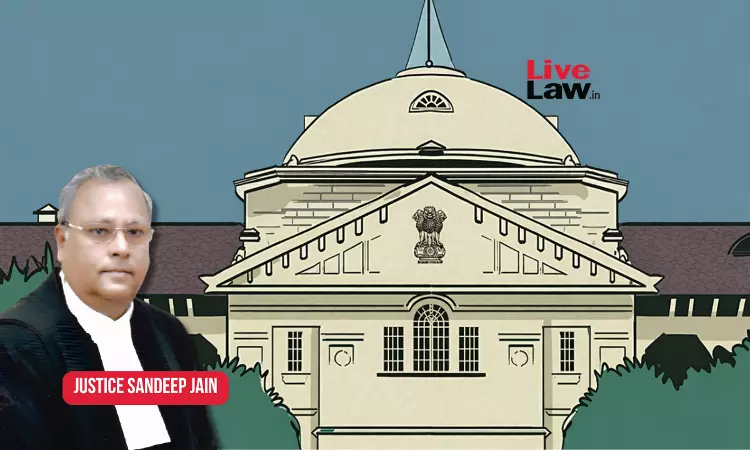
In a case pertaining to dishonour of a cheque, the Allahabad High Court recently reiterated that a joint account holder who is not a signatory to the disputed cheque can't be prosecuted under Section 138 of the Negotiable Instruments Act, 1881. A bench of Justice Sandeep Jain also clarified that Section 141 of the NI Act, which deals with vicarious liability, is applicable only to...
This is a premium content
Available exclusively to
Our subscribers
Subscribe Premium 
INR 1099+GST
Your support helps us to bring you more content at
an affordable subscription scheme !!!
All payment options available
In a case pertaining to dishonour of a cheque, the Allahabad High Court recently reiterated that a joint account holder who is not a signatory to the disputed cheque can't be prosecuted under Section 138 of the Negotiable Instruments Act, 1881.
A bench of Justice Sandeep Jain also clarified that Section 141 of the NI Act, which deals with vicarious liability, is applicable only to companies and partnership firms and not to individuals.
The single judge thus quashed the criminal proceedings against the applicant (Madhu Singh), who was summoned by the Special CBI Court in Ghaziabad in connection with a complaint case concerning two bounced cheques.
Briefly put, the complainant/respondent no. 2 (Hari Om Pathak), filed a criminal complaint against the applicant (Singh) and co-accused Rahul Thind under Section 138 NI Act as well as under Section 420 IPC.
It was his case that he advanced a loan of Rs. 8 Lakh to the co-accused (Thind) for business purposes. To repay the debt, Thind issued 2 cheques from a joint account he maintained with Madhu Singh.
However, when the cheques were presented to the bank, they were dishonoured and returned with the remark that the drawer's account had been closed.
The complainant alleged that both account holders had deliberately issued cheques which were dishonoured and even closed the bank account to evade liability. It was contended that both of them were jointly and severally liable to repay the loan
Applicant's counsel strongly contended that since the applicant (Singh) is not a signatory to the cheques, no offence under Section 138 of the NI Act was made out against her.
It was further contended that the present case does not involve vicarious liability under Section 141 of the N.I. Act, which applies only to companies and not to individuals.
The High Court relied upon various judgments of the Supreme Court, including in Alka Khandu Avhad vs. Amar Syamprasad Mishra LL 2021 SC 146 and Aparna A. Shah vs. Sheth Developers Pvt. Ltd. & Another (2013), to conclude that in the case of a joint bank account, only the person who has signed the cheque can be prosecuted for its dishonour.
Furthermore, the Court relied on the Top Court judgment in Bijoy Kumar Moni vs Paresh Manna and Another 2024 to conclude that Section 141 of the NI Act, which deals with vicarious liability, applies only to companies and partnership firms, and not to individuals.
The Bench further observed that the allegations are primarily directed against the co-accused and no specific role had been attributed to the applicant, the bench found that no prima facie case was made out against her.
Thus, noting that the applicant was not a signatory to the cheques and therefore could not be held liable for the offence under Section 138 of the NI Act, the bench allowed her plea.
Case title - Madhu Singh vs State of U.P. and Others 2026 LiveLaw (AB) 270
Case Citation: 2026 LiveLaw (AB) 270
Tags

Sparsh Upadhyay
Sparsh Upadhyay is an Associate Editor with LiveLaw.

