



- Home
- /
- High Courts
- /
- Allahabad High Court
- /
- Advocate, Family Received ₹23L+...
Advocate, Family Received ₹23L+ Across Cases; Allahabad High Court Orders UP-Wide Inquiry Into 'Misuse' Of SC/ST Act Benefits
Sparsh Upadhyay
7 Sept 2026 3:56 PM IST
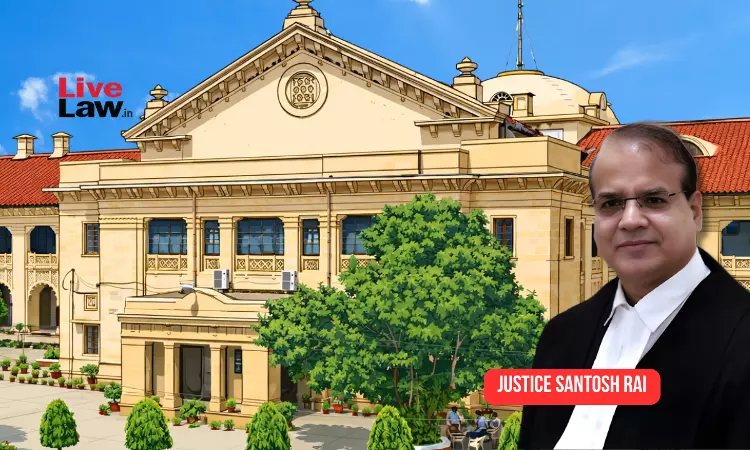
The Allahabad High Court has directed the Uttar Pradesh Government to undertake an inquiry into the manner in which benefits under the Scheduled Castes and the Scheduled Tribes (Prevention of Atrocities) Act, 1989, and the Rules framed thereunder are claimed and disbursed, particularly in cases involving repeated claims by the same persons or their family members. The direction was passed...
This is a premium content
Available exclusively to
Our subscribers
Subscribe Premium 
INR 1099+GST
Your support helps us to bring you more content at
an affordable subscription scheme !!!
All payment options available
The Allahabad High Court has directed the Uttar Pradesh Government to undertake an inquiry into the manner in which benefits under the Scheduled Castes and the Scheduled Tribes (Prevention of Atrocities) Act, 1989, and the Rules framed thereunder are claimed and disbursed, particularly in cases involving repeated claims by the same persons or their family members.
The direction was passed after a bench of Justice Santosh Rai noted that one Santosh Kumar Dohrey, an advocate by profession, and his family members had received an aggregate ₹23,36,250 in relief/financial assistance across various criminal cases.
In addition to this, the bench noted that approximately 10 to 12 further cases involving claims for relief were currently pending before the concerned District Level Committee.
While ordering an inquiry, the Court, however, clarified that repeated claims do not by themselves establish misuse. "Recurrent registration of criminal cases followed by claims for relief, without more, does not by itself establish misuse", the bench remarked.
Case in brief
The bench was dealing with two criminal appeals challenging orders of the Special Judge, S.C./S.T. Act, Jhansi, rejecting applications seeking release of balance financial relief under the SC-ST Rules, 1995.
In the leading appeal, the investigating officer had proposed relief of ₹2 lakh to each victim under Item No.41 of the Schedule to Rule 12(4).
Under the Rules, 25% was payable at the FIR stage, 50% when the charge-sheet was sent to court and the remaining 25% upon conviction. Thus, ₹1.50 lakh per victim became payable at the charge-sheet stage.
The appellants claimed that only ₹75,000 each had been released and sought payment of the balance ₹75,000.
The Special Judge rejected the applications noting that it would not be proper for the Court to determine the nature of the offence or fix or enhance the quantum of financial assistance.
High Court's observations
The High Court found that the Special Judge had proceeded on an "erroneous premise". Justice Rai held that Rule 12(7) specifically empowers the Special Court or Exclusive Special Court to examine whether relief has been paid within the prescribed time, whether the relief or compensation is adequate, or whether only part of it has been paid.
If satisfied, the Court may direct payment of the relief or other assistance, wholly or partly, the bench said. The provision, the Court added, contemplates “active judicial scrutiny” of the adequacy and timeliness of relief.
The High Court further described this Rule 12(7) as a "judicial check against under-payment, delayed payment or arbitrary curtailment of statutory relief by the administrative authorities".
Now, while considering these appeals, the Court took note of the State's disclosure that the advocate and his family had received ₹23,36,250 under the 1995 Rules and connected schemes across various criminal cases.
The State also informed the Court that around 10 to 12 further criminal cases involving the advocate and/or his family members were pending before the District Level Committee for further relief.
Taking note of the state government's submissions, the Court stressed that the SC/ST Act relief scheme is a "benevolent and protective measure intended for genuine victims of caste-based atrocities", whose integrity must be “zealously safeguarded”.
At the same time, the bench added that the number of cases and relief claims did not, by itself, prove wrongdoing.
However, the bench opined that the "scale and frequency" disclosed were such that they could not be left unexamined, lest the beneficial legislation be defeated by its exploitation.
For the specific cases involving Advocate Santosh Kumar Dohrey and his family, the Court directed the District Magistrate, Jhansi, in coordination with the SSP, Jhansi, to conduct a "thorough, fair and time-bound enquiry".
The inquiry, to be completed within 3 months, must examine the antecedents of the criminal cases registered by the advocate and his family members and the relief amounts received or claimed, to ascertain "whether the benevolent provisions of the Act and the Rules of 1995 have been misused".
The Court clarified that this should not be construed as a finding on the merits of the advocate's or victims' entitlement to relief, which, it said, will be determined independently by the District Level Committee.
Separately, the High Court directed the Uttar Pradesh Government to conduct a "broad-based and intensive enquiry throughout the State" into how benefits under the SC/ST Act, the 1995 Rules and related Government Orders and schemes are claimed and disbursed.
The State has been directed to develop an "Effective regulatory mechanism and supervisory system" in every district, particularly for cases involving repeated claims by the same persons or their family members.
The inquiry will also examine whether adequate verification and scrutiny are undertaken before the release of public funds, with corrective measures wherever misuse is found.
The Court further directed Special Judges handling SC/ST Act cases across Uttar Pradesh to remain vigilant about the possibility of misuse, while ensuring that genuine victims are not denied lawful benefits.
On the original compensation dispute, the High Court set aside the Special Judge's orders and remitted the applications for fresh consideration.
The Special Judge has been directed to examine the nature and ingredients of each offence and determine which entry in the Rule 12(4) Schedule actually applies.
The Court specifically said this cannot be done mechanically merely on the basis of sections mentioned in the charge-sheet; the "substance of the allegations and the ingredients of the offences" must be considered.
The District Welfare Committee will thereafter reconsider whether the applicable compensation is ₹1 lakh or ₹2 lakh and pass a reasoned order. The two criminal appeals were accordingly disposed of.
Case Title: Arvind Kumar and 2 others vs. State of U.P. and 2 others 2026 LiveLaw (AB) 666
Case Citation: 2026 LiveLaw (AB) 666
Tags

Sparsh Upadhyay
Sparsh Upadhyay is an Associate Editor with LiveLaw.

