



- Home
- /
- High Courts
- /
- Allahabad High Court
- /
- Unusual Victims' Conduct; No POCSO...
Unusual Victims' Conduct; No POCSO Presumption At Pre-Charge Stage: Why Allahabad HC Granted Relief To Swami Avimukteshwaranand
Sparsh Upadhyay
25 March 2026 5:10 PM IST
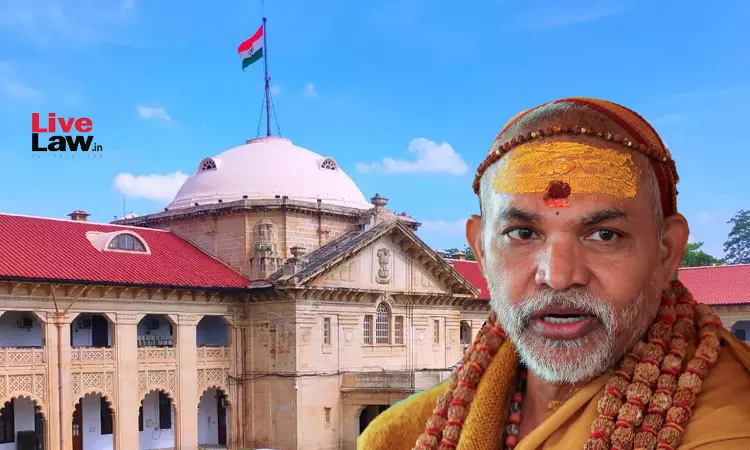
The Allahabad High Court today granted anticipatory bail to Swami Avimukteshwaranand Saraswati and his disciple in a case registered under the POCSO Act over the alleged sexual abuse of minors.In a detailed 22-page order, a bench of Justice Jitendra Kumar Sinha questioned the 'unusual' conduct of the minor victims in confiding about the alleged offence in a stranger, the first informant...
This is a premium content
Available exclusively to
Our subscribers
Subscribe Premium 
INR 1099+GST
Your support helps us to bring you more content at
an affordable subscription scheme !!!
All payment options available
The Allahabad High Court today granted anticipatory bail to Swami Avimukteshwaranand Saraswati and his disciple in a case registered under the POCSO Act over the alleged sexual abuse of minors.
In a detailed 22-page order, a bench of Justice Jitendra Kumar Sinha questioned the 'unusual' conduct of the minor victims in confiding about the alleged offence in a stranger, the first informant (Ashutosh Brahmachari), rather than in their natural guardians.
"The reason for confiding to the first informant as given by the victims is that the first informant used to visit the applicant no.1 and used to garland him and touch his feet, therefore, he was a right person to be informed about the commission of the offence. The above reasoning given by the victims also appears to be unusual and not consistent with a normal course of human conduct," the bench said.
The bench also rejected the state's submission that there is a statutory presumption of guilt under Section 29 of the POCSO Act against the accused, as it noted that the presumption cannot be invoked before the framing of charges at the pre-arrest stage.
The bench also rejected the State's argument challenging the maintainability of the anticipatory bail plea on the ground that the applicants should have approached the Sessions Court first.
Justice Sinha stated that since the FIR had been lodged on the specific directions of the Special Judge (POCSO)/Additional Sessions Judge, Prayagraj, on an application filed by the informant under Section 173(4) of the BNSS, there existed "special/extra-ordinary circumstances" to directly approach the HC.
Examining the facts, the High Court flagged another glaring inconsistency: the victims allegedly informed the first informant on January 18, 2026, yet the police were only notified six days later.
When queried as to why this delay had occurred, the informant claimed he was engaged in "Pooja/Yagya". The Court, however, noted that prior to this, on January 21, the informant had filed a separate application relating to an alleged incident involving the commission of an offence under Section 109 and other Sections of the BNS.
The Court further highlighted material improvements in the victims' statements. It noted that while the FIR stated the incidents occurred between January 2025 and February 2026 at the Mahakumbh and Magh Mela in Prayagraj, one victim later claimed the assault occurred in June 2024 at an ashram in Madhya Pradesh.
The Court also noted that educational certificates revealed the victims were institutional students in Hardoi, not ashram residents. Moreover, the medical examination found no external injuries on the victims, and the doctor only gave an inconclusive opinion that sexual assault "cannot be ruled out".
During the proceedings, the Additional Advocate General and the first informant heavily contested the applicant's credentials, submitting a 796-page Division Bench judgment and Supreme Court proceedings to argue that his claim to be the Shankaracharya of Jyotishpeeth is disputed.
Dismissing this argument, the High Court firmly clarified that it is not tasked with the duty to adjudicate whether the applicant no.1 is the real Shankaracharya or the disputed Shankaracharya of Jyotishpeeth.
The bench also took strong exception to the fact that after the lodging of the FIR, the statements of the victims were recorded and the victims were interviewed by various Hindi News Channels, "in violation of the established procedure of POCSO and Juvenile Justice Act".
The Court also added that since the date the first informant received information regarding the commission of the offence from the victims and the dispute that arose between the applicant no.1 and the administration regarding taking a bath in Sangam on the holy occasion of Mauni Amavasya is the same (i.e., 18.01.2026), therefore, the facts are required to be "looked into with greater care and caution".
Against this backdrop, the Court directed the release of the applicants on anticipatory bail upon furnishing a personal bond of Rs. 50,000.
Among other conditions, the bench has also directed the applicants, victims and the first informant not to give any interview to the media regarding the present case during the pendency of the investigation/trial.
Senior Counsel Dilip Kumar, assisted by Advocate Rajshri Gupta, Sudhanshu Kumar and Varad Nath, appeared for the applicants.
Additional Advocate General Manish Goyal, assisted by Government Advocate Patanjali Mishra and AGA-I Roopak Chaubey, appeared for the State respondents
Advocate Reena N. Singh appeared for the first informant through Video Conferencing.
Case title - Swami Avimukteshwaranand Saraswati Jagatguru Shankaracharya Jyotishpeethadheeshwar And Another vs. State Of U.P. And 5 Others 2026 LiveLaw (AB) 140
Case citation : 2026 LiveLaw (AB) 140

Sparsh Upadhyay
Sparsh Upadhyay is an Associate Editor with LiveLaw.

