



- Home
- /
- High Courts
- /
- Allahabad High Court
- /
- Mere Discrepancy In DOB Without...
Mere Discrepancy In DOB Without Intent To Deceive Isn't Fraud: Allahabad High Court Quashes Govt School Teacher's Dismissal
Sparsh Upadhyay
13 April 2026 5:05 PM IST
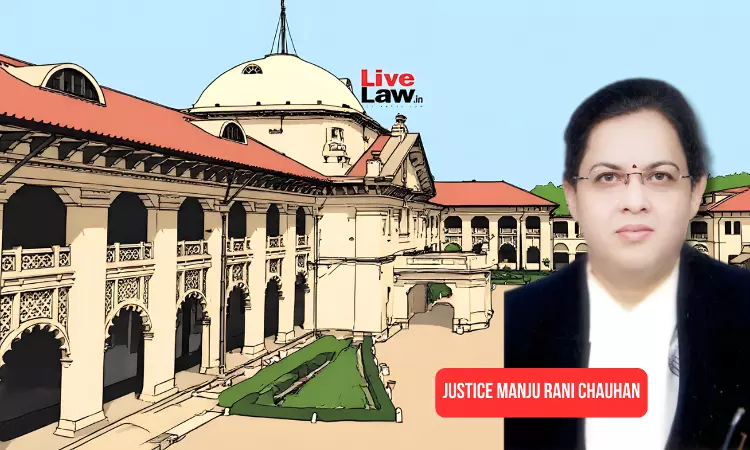
The Allahabad High Court has ruled that a mere discrepancy in the dates of birth in different educational records of a government servant, bereft of any element of fraud, misrepresentation, or deliberate concealment, won't be 'fraud or wilful misrepresentation' so as to nullify his appointment. A bench of Justice Manju Rani Chauhan thus quashed the June 2019 dismissal order passed against...
This is a premium content
Available exclusively to
Our subscribers
Subscribe Premium 
INR 1099+GST
Your support helps us to bring you more content at
an affordable subscription scheme !!!
All payment options available
The Allahabad High Court has ruled that a mere discrepancy in the dates of birth in different educational records of a government servant, bereft of any element of fraud, misrepresentation, or deliberate concealment, won't be 'fraud or wilful misrepresentation' so as to nullify his appointment.
A bench of Justice Manju Rani Chauhan thus quashed the June 2019 dismissal order passed against a Govt Assistant Teacher in Mau while directing the state authorities to permit him to resume his duties forthwith.
"The inference of fraud, which entails grave civil consequences, cannot be drawn on the basis of equivocal circumstances or mere inconsistencies in record, howsoever inconvenient they may appear", the single judge remarked.
Justice Chauhan also observed that fraud is not to be presumed but must be pleaded with specificity and established by cogent and unimpeachable evidence, which was not present in the present case.
Case in brief
Briefly, the petitioner (Vijai Kumar Yadav) was appointed as an Assistant Teacher in a Junior Basic School in 2014 (in Mau district) after his candidature was duly considered in accordance with the applicable rules and procedures governing the recruitment exercise for the post.
The petitioner possessed genuine degrees of Purva Madhyama examination, Uttar Madhyama examination and the Shastri degree, as well as a Basic Training Certificate (BTC) and UP-TET qualification.
However, in 2018, an RTI application was filed seeking his educational credentials. Pursuant to that, it was revealed that an earlier 1998 High School record showed his date of birth as July 2, 1984, whereas his Purva Madhyama certificate of 2001 recorded it as July 7, 1987.
Relying on this alleged discrepancy, the Basic Shiksha Adhikari in Mau dismissed him from service on June 27, 2019, and directed the lodging of an FIR against him.
Challenging the same, he moved the HC, contending that the said High School Certificate had neither been relied upon nor produced by the petitioner at any stage. It was submitted that the same was neither utilised for seeking admission to the BTC Training Course, 2010, nor furnished at the time of appointment.
Further, it was argued that since no benefit had been derived by the petitioner on the basis of the said certificate at any point in time, the dismissal order was wholly unjustified and legally unsustainable.
High Court's observations
Noting that the main allegation against the petitioner was the non-disclosure of an earlier High School certificate reflecting a different date of birth, the bench observed that a non-disclosure, to assume the character of misconduct, must be “purposeful, calculated, and actuated by a discernible intent to deceive”.
The bench added that in the absence of such mens rea, the omission remained, at best, an 'irregularity' and not a culpable act which could warrant the 'drastic' consequence of annulment of appointment.
The High Court noted that the certificates relied upon by the petitioner were never alleged to be forged or fabricated.
The Court stressed that even if the DOB as recorded in the High School certificate is accepted, the petitioner would still remain within the bounds of eligibility for appointment to the post in question.
Thus, the Court opined, the foundational requirement of gain or advantage, which is an indispensable concomitant of fraud, was wholly absent in the present case.
"The alleged discrepancy, therefore, does not translate into any prejudice either to the employer or to competing candidates", the Court held.
In this regard, the Court relied heavily on HC's judgment in Ashok Kumar Singh vs State of UP 2024, wherein it was observed that mere submission of a higher or additional qualification, which is neither essential nor shown to have been relied upon by the selection committee in conferring appointment, would not ipso facto establish fraud.
It was also held that unless it is shown that the alleged misrepresentation had a direct bearing on the selection process or conferred a tangible advantage upon the candidate, the extreme consequence of nullifying the appointment cannot be justified.
Against this backdrop, applying the doctrine of proportionality, Justice Chauhan noted that while suppression of a material fact is not to be appreciated, it cannot vitiate an appointment in a mechanical or pedantic manner when the selection process remains unaffected and no tangible advantage has accrued.
The Court held that visiting the petitioner with the extreme consequence of termination in such circumstances was unjust and inequitable.
Thus, the bench allowed the writ plea and ordered his immediate reinstatement.
However, applying the principle of “no work, no pay” the Court clarified that the petitioner would not be entitled to claim salary for the intervening period.
The bench also left it open for the authorities to initiate appropriate proceedings strictly in accordance with law if any of the relied-upon documents are subsequently found to be false or fabricated.
Case title - Vijai Kumar Yadav vs. State of U.P. and 3 others 2026 LiveLaw (AB) 214
Case citation: 2026 LiveLaw (AB) 214
Tags

Sparsh Upadhyay
Sparsh Upadhyay is an Associate Editor with LiveLaw.

