



- Home
- /
- High Courts
- /
- Allahabad High Court
- /
- 'Encounter Killings, Selective...
'Encounter Killings, Selective Crackdowns': Allahabad HC Slams UP Police Over Targeted Actions; Flags Misuse Of Gangsters Act
Sparsh Upadhyay
5 Jun 2026 10:26 PM IST
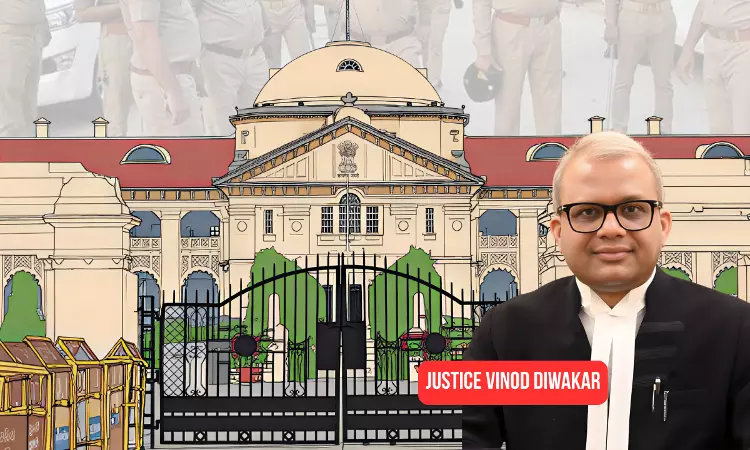
While quashing criminal proceedings initiated against 3 family members over a civil dispute, the Allahabad High Court on Wednesday delivered a scathing reprimand to the Uttar Pradesh Police for the targeted use of the Uttar Pradesh Gangsters and Anti-Social Activities (Prevention) Act, 1986.A bench of Justice Vinod Diwakar also flagged how the encounter killings and selective crackdowns...
This is a premium content
Available exclusively to
Our subscribers
Subscribe Premium 
INR 1099+GST
Your support helps us to bring you more content at
an affordable subscription scheme !!!
All payment options available
While quashing criminal proceedings initiated against 3 family members over a civil dispute, the Allahabad High Court on Wednesday delivered a scathing reprimand to the Uttar Pradesh Police for the targeted use of the Uttar Pradesh Gangsters and Anti-Social Activities (Prevention) Act, 1986.
A bench of Justice Vinod Diwakar also flagged how the encounter killings and selective crackdowns against individuals deemed inconvenient have periodically attracted judicial notice.
The most glaring instance of police overreach highlighted by the Court in this case was the treatment meted out to Lalita Tyagi, a 35-year-old homemaker.
The bench noted that although no incriminating evidence was stated against her in the charge sheets, she was arrested the very next day after the Gangsters Act FIR was lodged and she was compelled to remain in judicial custody for approximately 80 days.
Terming the arrest as "patently illegal, arbitrary, and wholly unwarranted in law", the bench expanded its scrutiny to the broader culture of institutional impunity in the State. The High Court observed that the vertical loyalty of officers runs not toward the Constitution but toward the ruling dispensation.
It added that the Field officers, acutely conscious of the transfer-posting economy, calibrate their conduct to satisfy political superiors.
It was within this context that Justice Diwakar pointed out that encounter killings, selective crackdowns and targeted use of the Gangsters Act against inconvenient individuals by the State machinery have periodically attracted judicial notice.
Highlighting the stark state of affairs of administrative accountability in UP, the Court referred to the infamous 2020 Bikru massacre, where slain gangster Vikas Dubey and his associates ambushed a police team and brutally killed 8 policemen, including a Deputy SP.
The Court expressed its dismay that the Police Officer, who was suspended after an SIT probe pointed to a nexus between the police and gangster Dubey, was meted out nothing more than a "formal caution" following the conclusion of a departmental enquiry.
"This Court finds it difficult to reconcile such a disproportionately lenient outcome with the gravity of the supervisory failure involved, and it is precisely this culture of institutional impunity that emboldens those in authority to remain unaccountable, perpetuating the feudal and politically patronised administrative ecosystem that this Court has adverted to hereinabove", the Court observed.
On the recurring misuse of police powers, the Court observed that stringent provisions of the Gangsters Act are often used against street-level and petty offenders, while actual gangsters and organized crime syndicates remain largely unaffected.
Furthermore, the bench highlighted that arrests are effected without due process, that many FIRs are registered or suppressed with ulterior motives, and that preventive detention provisions are invoked arbitrarily at the whims of officers.
"The procedural safeguards under the Code of Criminal Procedure, and now the Bharatiya Nagarik Suraksha Sanhita, are routinely bypassed. Judicial orders are complied with in form but defeated in substance," the bench observed.
Importantly, Justice Diwakar expressed "deep constitutional concern" about the role of the Home Secretary, the senior-most bureaucratic authority in the state's law enforcement system.
It noted that rather than functioning as an independent constitutional authority charged with implementing the government's vision, policies, and programmes through impartial executive action, certain officers who rose to the post of Home Secretary have, in practice, "served as conduits for self-serving interests".
The bench said that recommendations on postings, approvals of departmental proceedings, and responses to court proceedings have, in such instances, reflected considerations driven by “personal or extrinsic calculations rather than dispassionate and constitutionally informed administrative judgment”.
This fundamentally compromises the institutional integrity that the position demands, the Court further noted.
It is in this precise context that the Court issued a "solemn judicial reminder" that the Home Department must independently evaluate the suitability and operational effectiveness of its officers, a reminder that carries profound constitutional significance.
"…constitutional governance cannot be held hostage to individual expediency or an individual's convenience, and that the State apparatus must remain answerable to the law and to the Constitution, and not to any ruling establishment," the Court added.
Furthermore, on the merits of the case, the bench stated that the accused may have committed offences of cheating and forgery; however, this does not amount to, nor can it be construed as, running an organised gang.
Justice Diwakar observed that there was absolutely no material on record which could establish the use of violence, intimidation, coercion, or any other means with the object of disturbing public order or of gaining any undue temporal or pecuniary advantage.
Hence, the Court concluded that the ingredients to invoke Section 2(b) of the Gangsters Act were not satisfied.
In fact, the bench also found that there was no relevant material before the Commissioner of Police, Ghaziabad, and the Deputy Commissioner of Police before they approved the gang chart.
"On the basis of mere assertions, the provisions of the Gangsters Act cannot be invoked", the Court remarked as it quashed the proceedings.
Before parting, the Court also issued a strict warning to the then Commissioner of Police, Ghaziabad, Ajay Kumar Mishra.
Noting that the patently illegal arrest and the approval of the flawed gang chart occurred under his watch, the Court directed him to remain vigilant and circumspect in the discharge of his official functions, "befitting the responsibilities of a position that demands balanced judgment, institutional restraint, and scrupulous adherence to law".
It may be noted that earlier this year, a coordinate bench of the High Court had rebuked the Uttar Pradesh Police's modus operandi of 'Half-Encounters'. The HC had noted that it had come across several cases where police officers, just to get out of turn promotion or appreciation from the higher authority or to get fame in social media, "unnecessarily use firearms and caused firearm injury on the leg of the accused just below the knee".
Read more about Court's observations here : UP Cops Resort To 'Half Encounters' To Get Fame, Appreciation: High Court Warns SP/SSPs Of Contempt If SC's Guidelines Violated
In the same order, the High Court had sought to tighten the noose on the 'Police Encounter Culture' in the state by issuing and reiterating certain strict guidelines expressly prohibiting instant promotions or gallantry awards for police officers immediately following an encounter with an accused/criminal.
More details here: No Instant Rewards For UP Cops; Mandatory FIR & Medical Aid For Injured: Allahabad High Court Tightens Noose On 'Encounter Culture'
Advocate Ronak Chaturvedi appeared for the applicants.
Additional Advocate General Anoop Trivedi, assisted by AGA-I Paritosh Kumar Malviya, appeared for the State-respondent.
Case title - Rajendra Tyagi And 2 Others vs State of U.P. and Another 2026 LiveLaw (AB) 317
Case citation: 2026 LiveLaw (AB) 317
Tags

Sparsh Upadhyay
Sparsh Upadhyay is an Associate Editor with LiveLaw.

