



- Home
- /
- High Courts
- /
- Allahabad High Court
- /
- Forest Rights Act Recognizes...
Forest Rights Act Recognizes Existing Rights, Supersedes Prior Court Orders: Allahabad HC Grants Relief To Tharu Community
Sparsh Upadhyay
21 April 2026 7:55 AM IST
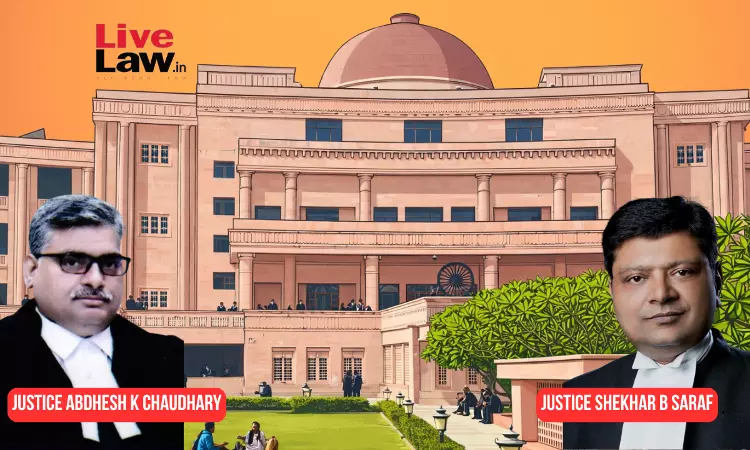
The Allahabad High Court recently observed that the authorities cannot short-circuit the existing statutory rights of the forest dwellers by blindly relying on court orders issued before the enactment of the Forest Rights Act, 2006.A bench of Justice Shekhar B Saraf and Justice Abdhesh Kumar Chaudhary thus quashed a 2021 order passed by the District Level Committee, Lakhimpur, refusing...
This is a premium content
Available exclusively to
Our subscribers
Subscribe Premium 
INR 1099+GST
Your support helps us to bring you more content at
an affordable subscription scheme !!!
All payment options available
The Allahabad High Court recently observed that the authorities cannot short-circuit the existing statutory rights of the forest dwellers by blindly relying on court orders issued before the enactment of the Forest Rights Act, 2006.
A bench of Justice Shekhar B Saraf and Justice Abdhesh Kumar Chaudhary thus quashed a 2021 order passed by the District Level Committee, Lakhimpur, refusing to finalise the claims of 107 'Tharu' community members for forest rights, specifically the right to collect and use minor forest produce for their livelihood.
Briefly put, in its order, the Committee, constituted under the Schedule Tribe and Other Traditional Forest Dwellers (Recognition of Forest Rights) Rules, 2007, had relied on an interim order passed by the Supreme Court in the year 2000 under the Forest (Conservation) Act, 1980, to reject the claim of the petitioners.
It was the case of the petitioners that the Forest Rights Act 2006 was enacted specifically for the benefit of the Scheduled Tribes and traditional forest dwellers. They contended that under Section 3 of the Act, their rights include the ownership, access, and use of minor forest produce traditionally collected within or outside village boundaries.
In this regard, they relied on a 2013 Ministry of Tribal Affairs circular clarifying that the 2006 Act, being a subsequent statute, supersedes all preceding court judgments or orders of prior date.
The bench found justification in their stance and noted that the 2006 Act aims to recognize and vest the forest and occupation in forest land to these forest dwelling Scheduled Tribes and to ensure their livelihood and food security.
The Court highlighted that Section 4 of the Act begins with a non-obstante clause, meaning that the central government recognizes and vests these rights notwithstanding anything contained in any other law for the time being in force.
In this regard, the Court clarified that with the enactment of this Act, the legislature had not created any new rights for these forest dwellers, rather it had recognized the existing rights and occupation of these people, who had been traditionally restricted to this place of dwelling in forest owing to various reasons.
Against this backdrop, the Court found fault with the impugned order, which the bench said had not taken into account the relevant provisions of the 2006 Act and had only dealt with the Supreme Court interim order passed in 2000, prior to the enactment of the Act.
In light of the same, the impugned order was quashed and set aside, with a direction to the authorities to grant an opportunity of hearing to the concerned persons and thereafter to pass a reasoned order.
In the meantime, to protect the immediate livelihood of the tribal community, the Court directed that until such time the order is passed by the District Level Committee, the forest dwellers shall be vested with all their existing rights as enumerated in the Act, in accordance with law.
With the above directions, the writ petition was disposed of.
Advocates Nandini Verma, Desh Deepak Singh and Rajat Srivastava apeared for the petitioners
Case title: Udasa and 106 others vs Union of India, Thru.the Secy. Ministry of Tribal Affairs New Delhi and 5 others 2026 LiveLaw (AB) 234
Case citation: 2026 LiveLaw (AB) 234
Tags

Sparsh Upadhyay
Sparsh Upadhyay is an Associate Editor with LiveLaw.

