



- Home
- /
- High Courts
- /
- Allahabad High Court
- /
- Failure To Disclose Specific...
Failure To Disclose Specific 'Grounds Of Arrest' In Memo Is Dereliction Of Duty; Errant Cops Must Be Suspended: Allahabad High Court
Sparsh Upadhyay
23 Jan 2026 8:23 PM IST
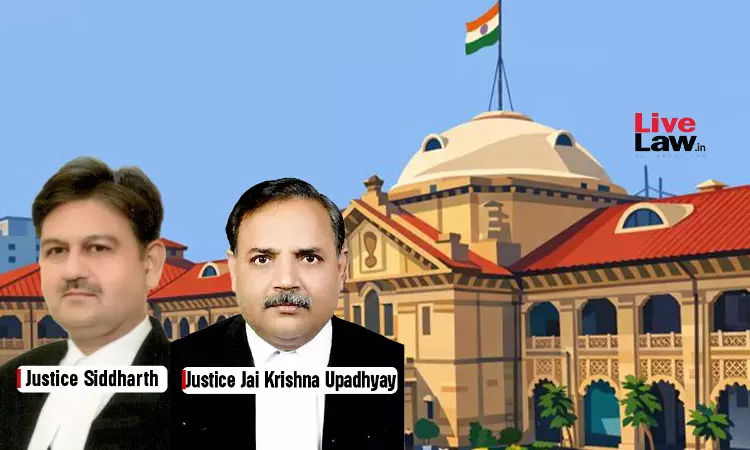
In a significant order passed on Thursday, the Allahabad High Court has directed that any police officer in the state who fails to disclose specific "grounds of arrest" in the arrest memo shall be liable for departmental proceedings after being placed under suspension. A bench of Justice Siddharth and Justice Jai Krishna Upadhyay observed that "empty compliance" of the law by...
This is a premium content
Available exclusively to
Our subscribers
Subscribe Premium 
INR 1099+GST
Your support helps us to bring you more content at
an affordable subscription scheme !!!
All payment options available
In a significant order passed on Thursday, the Allahabad High Court has directed that any police officer in the state who fails to disclose specific "grounds of arrest" in the arrest memo shall be liable for departmental proceedings after being placed under suspension.
A bench of Justice Siddharth and Justice Jai Krishna Upadhyay observed that "empty compliance" of the law by merely filling out forms without substance amounts to a dereliction of duty.
"It is high time that the police officials, who are not complying the requirements of the arrest memo and violating the constitutional mandate provided under Article 22(1) of the constitution of India and further violating Section 50 and 50A Cr.P.C / 47, 48 and B.N.S.S should be sternly dealt with", the Court remarked in its order and directed that the order be communicated to the Uttar Pradesh's Director General of Police.
The ruling came in a Habeas Corpus Writ Petition filed by Umang Rastogi and another, who moved the HC challenging the arrest and subsequent remand order passed by a Civil Judge in Gautam Buddha Nagar.
It was the case of the petitioners that their arrest was illegal as the mandatory grounds were not furnished to the accused in writing, which is a violation of the Supreme Court's mandate in Mihir Rajesh vs. State of Maharashtra 2025 LiveLaw (SC) 1066 and Priya Indoria vs. State of Karnataka 2023 LiveLaw (SC) 996.
Case background
Briefly put, on November 28, 2025, at about 05:40 pm, the petitioner's father was 'unlawfully' abducted by an SHO of Gautam Buddhanagar Police Station, from the business premises of the petitioners in Delhi.
The petitioners alleged that his father was kept in illegal custody at the Gautam Buddh Nagar Police Station for 5 days and during that period, an FIR was registered under Section 317(2) BNS and he was belatedly produced before the concerned Magistrate.
It was further alleged that when the petitioner's father filed a writ petition before the Delhi High Court, the police arrested petitioner no. 1 without providing him any ground of arrest on December 26, 2025, from Haldwani, Uttarakhand.
He was taken before the remand Magistrate in Gautam Buddhanagar on the next day, but no copy of the arresting memo was provided to him.
When his counsel moved an application for his release on the aforesaid ground on the same day, the Concerned Magistrate rejected the petition.
Hence, the petitioner moved the HC challenging the order of illegal remand and the illegal arrest memo.
The High Court found that while the Investigating Officer had used the correct proforma for preparing the arrest memo, the column related to the grounds of arrest was not properly filled.
It may be noted that Clause 13 of the standardised memo requires the police to record specific details, including the material demonstrating the accused's involvement, the necessity of arrest based on evidence collected and details of documentary or electronic evidence.
In this case, instead of providing these specifics, the Sub-Inspector merely noted that the accused was informed of the offence and the sections invoked and that his father had been informed telephonically.
High Court's observations
The Bench took strong exception to this lapse. Comparing the police's memo with the DGP's circular issued on July 25, 2025, the Court observed that the requirements of Clause 13 (i) to (vi) were wholly ignored.
The Court noted that the clause does not merely require informing the accused of the sections but mandates the disclosure of “all the material from which his involvement in the crime is clear”.
The Court stated thus:
"No details of the material collected by the investigating officer, till the time of arrest of petitioner no. 1, which necessitated his arrest was disclosed. Details of other material collected, documentary or electronic, relating to person arrested was also not disclosed".
The Bench termed the police action as “empty compliance of law” and a justification of illegality. The Court held that the purpose of the new arrest memo, circulated specifically to ensure transparency, was frustrated by the Sub-Inspector of Police.
Relying on the Supreme Court's Mihir Rajesh Shah judgment, which held that grounds of arrest must be furnished to the arrestee in writing, the High Court declared the arrest and the subsequent remand order dated December 27, 2025, as illegal, null and void.
The bench took a rigid stand against such procedural violations and issued a sweeping direction that the non-disclosure of grounds of arrest as per Clause 13, “would amount to the misconduct of dereliction of duty” by a police official.
The Court directed that such officials shall be liable to departmental proceedings after being placed under suspension, so that they may not perpetrate this illegality any further.
With this, the Court quashed the remand order passed by the Civil Judge (Senior Division)/FTC, Gautam Buddha Nagar and directed that the petitioner be set free forthwith.
Appearances
Advocates Anand Kumar, Aditya Giri and Raghav Dev Garg, for the petitioners
Additional Advocate General Kartikey Saran, assisted by AGA Manju Thakur, for the respondent
Case title - Umang Rastogi And Another vs. State Of U.P. And 3 Others 2026 LiveLaw (AB) 40
Case citation: 2026 LiveLaw (AB) 40
Tags

Sparsh Upadhyay
Sparsh Upadhyay is an Associate Editor with LiveLaw.

