



- Home
- /
- High Courts
- /
- Allahabad High Court
- /
- All Citizens Must Be Treated...
All Citizens Must Be Treated Equally: Allahabad High Court To UP Govt Over Namaz 'Restrictions' On Private Property
LIVELAW NEWS NETWORK
16 March 2026 1:40 PM IST
The Allahabad High Court on Monday once again questioned the Uttar Pradesh Government on whether restrictions could be imposed on members of the Muslim community offering Namaz on private property, as the HC orally remarked that the rule of law must treat all citizens equally.During the hearing of a writ petition challenging alleged restrictions on offering Namaz during Ramzan in...
This is a premium content
Available exclusively to
Our subscribers
Subscribe Premium 
INR 1099+GST
Your support helps us to bring you more content at
an affordable subscription scheme !!!
All payment options available
The Allahabad High Court on Monday once again questioned the Uttar Pradesh Government on whether restrictions could be imposed on members of the Muslim community offering Namaz on private property, as the HC orally remarked that the rule of law must treat all citizens equally.
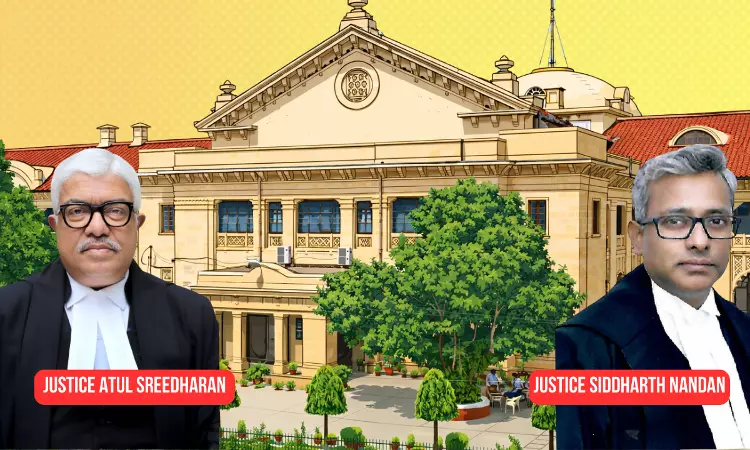
During the hearing of a writ petition challenging alleged restrictions on offering Namaz during Ramzan in Sambhal district, a bench of Justice Atul Sreedharan and Justice Siddharth Nandan drew parallels to Hindu religious practices and asked the State whether similar restrictions could be imposed on Hindus praying in their own homes.
"How can Muslims be stopped from offering Namaz on the roof of their homes? The rule of law must treat all citizens equally, and the constitution must prevail", Justice Sreedharan orally remarked.
Questioning the Additional Advocate General (AAG) Manish Goel, who was representing the UP Govt, Justice Sreedharan orally asked, "Are such restrictions placed in temples? A stampede occurred at the Maha Kumbh Mela (last year in Prayagraj), did you restrict 2 persons per 3 square feet? If the Hindus are praying in their houses, can they be stopped from doing so?”
The bench further clarified that the State has the authority to intervene only if religious activities or prayers spill over onto public roads, but not when they are conducted strictly within private property boundaries.
The oral remarks were made after the State's counsel submitted that the premises in question was not a mosque, as claimed by the petitioner, but rather a private house.
For context, the petitioner in this case, one Munazir Khan, had approached the High Court alleging that the administration was preventing him from performing Namaz at a site where he claimed a mosque exists.
Hearing his case just days back, the High Court had rejected the Uttar Pradesh administration's decision restricting the number of persons offering Namaz during Ramzan at a mosque in Sambhal district, observing that maintaining law and order is the responsibility of the State.
Read more about the case here : Can't Restrict Number Of Namaz Worshipers On Law & Order Ground; Resign If Unable To Do Duty : Allahabad High Court To Sambhal SP, Collector
However, today the bench noted significant discrepancies in the petitioner's claims.
Perusing the affidavit filed by the petitioner, the Court observed that the plot area and descriptions of the property in question did not match.
When asked what currently stands on the land, the petitioner's counsel stated that photographs had been annexed. Justice Sreedharan, however, noted that only newspaper cuttings had been submitted and not actual photographs of the site.
The bench pulled up the petitioner as it prima facie noted that the property in question was not a mosque. The bench also cautioned that the petition could be dismissed with a heavy costs due to the lack of clarity.
However, when the AAG submitted that the structure was in fact a house, the bench made its remarks regarding the right to pray on private property. Justice Sreedharan further noted that the structure was not a mosque and could not even be called a house, but was just a room.
During the hearing, Justice Nandan also orally remarked that it must be ensured that, after the offering of Namaz, no 'incendiary' speeches are made, and that such speeches are punishable under the BNS.
As stated earlier, the bench was dealing with a writ petition filed alleging that the UP Administration was causing hindrance to the conduct of prayers during the month of Ramzan.
According to the petitioner, authorities had permitted only twenty persons to offer Namaz at the premises, even though a larger number of worshippers were expected to gather during Ramzan.
On February 27, the Court had outrightly rejected the UP-administration's decision to restrict the number of worshippers offering Namaz at the disputed site to just 20 persons on the grounds of perceived law-and-order concerns.
It was the case of the State government that, as per the revenue records, the property in question was registered in the names of private individuals.
However, rejecting the State's justification regarding the law-and-order concern, the High Court had severely reprimanded the local administration.
"If the local authorities i.e. Superintendent of Police and Collector feels that the law and order situation could arise because of which they want to limit the number of worshipers within the premises, they should either resign from their post or seek transfer outside Sambhal if they feel they are not competent enough to enforce the rule of law," the bench had stated in its February 27 order.
"It is duty of the State to ensure that every community is able to offer worship peacefully in the designated place of worship and if it is a private property as already been held by the Court earlier, to perform worship without any permission from the State," the Court had added.
[The report was published based on oral observations of the Court made on March 17. For our report on the written order of the High Court released on March 18, please refer to this link.]
Case title - Munazir Khan vs. State Of U.P. And 4 Others 2026 LiveLaw (AB) 114
Case Citation: 2026 LiveLaw (AB) 114
Tags


