



- Home
- /
- High Courts
- /
- Allahabad High Court
- /
- Fracture Of Hyoid Bone Not...
Fracture Of Hyoid Bone Not Mandatory To Prove Strangulation: Allahabad High Court Denies Bail To Husband
Sparsh Upadhyay
9 April 2026 2:05 PM IST
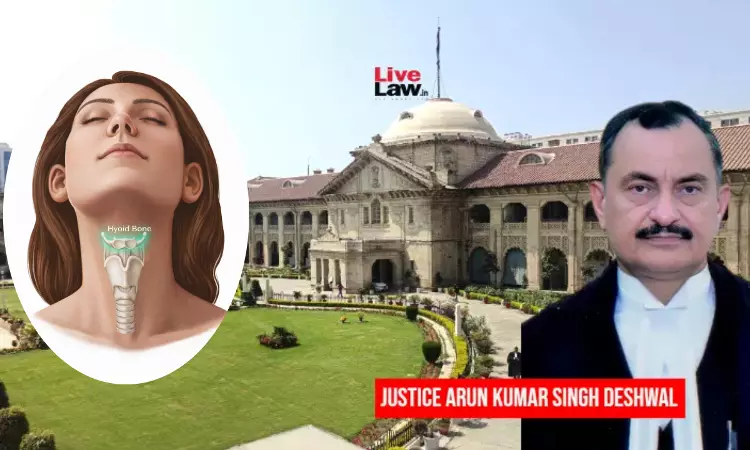
The Allahabad High Court has observed that it is not necessary in the case of strangulation that there should be a fracture in the hyoid bone, and there may be cases of strangulation without a fracture in the hyoid bone, which is a small U-shaped floating bone in the neck. A bench of Justice Arun Kumar Singh Deshwal further ruled that delay in recording the statement of witnesses is...
This is a premium content
Available exclusively to
Our subscribers
Subscribe Premium 
INR 1099+GST
Your support helps us to bring you more content at
an affordable subscription scheme !!!
All payment options available
The Allahabad High Court has observed that it is not necessary in the case of strangulation that there should be a fracture in the hyoid bone, and there may be cases of strangulation without a fracture in the hyoid bone, which is a small U-shaped floating bone in the neck.
A bench of Justice Arun Kumar Singh Deshwal further ruled that delay in recording the statement of witnesses is not always fatal to the prosecution case and other surrounding evidence should also be considered.
“If there is sufficient explanation for the delay in recording the statement then delayed recording of statements during investigation will not affect the prosecution's case and such explanation can be given during trial by the Investigating Officer or can be gathered from the facts of the case,” the bench held.
These observations were made by the bench while dismissing the bail application of a man accused of murdering his wife by strangulation.
During the hearing, the counsel for the accused raised two objections. First, while the postmortem report cited strangulation as the cause of death, the victim's hyoid bone was intact.
Second, it was submitted that the statements of the victim's daughter and nephew were recorded after a significant delay under Section 180 BNSS.
On the other hand, the State and the first informant opposed the bail plea as they argued that the postmortem report showed additional injuries which proved that the victim had resisted the assault.
They also justified the delay in recording the witness statements as due to severe shock suffered by the children after discovering their mother had died.
High Court's observations
Dealing with the first objection of the accused, the bench referred to Modi's Medical Jurisprudence and Toxicology as well as the Supreme Court's judgments in Ponnusamy Vs. State of Tamil Nadu reported in (2008) and Ravirala Laxmaiah Vs. State of Andhra Pradesh 2013 to hold thus:
"…though there are more chances of fracture in hyoid bone in older victims of strangulation but when the victims of homicide strangulation is of younger age (30±10 years) then hyoid bone may remain unfractured. Therefore, it is not necessary in the case of strangulation that there should be fracture in hyoid bone and there may be cases of strangulation without fracture in hyoid bone".
Regarding the second objection, the bench referred to the Supreme Court's judgments in Goutam Joardar Vs. State of West Bengal LL 2021 SC 558 as well as Firoz Khan Akbarkhan Vs. State of Maharashtra 2025 LiveLaw (SC) 349 to note that mere delay in recording statements does not warrant an outright rejection of witness testimonies.
"…delay in recording the statement of witnesses is not always fatal to the prosecution case and other surrounding evidence should also be considered. If there is sufficient explanation for the delay in recording the statement then delayed recording of statements during investigation will not affect the prosecution's case and such explanation can be given during trial by the Investigating Officer or can be gathered from the facts of the case", the bench remarked.
In the present case, the High Court noted that the young children were traumatised by the murder of their mother. The Court said that the delay in recording their statements was reasonably explained and could not be considered fatal to the prosecution's story at the bail stage.
On the merits of the case, the Court found that the postmortem confirmed strangulation and documented struggle marks and as per the statements of the children, the husband was inside the house at the time of the incident.
Thus, the Court said that the presumption under Section 109 BSA would be attracted and the burden of proof shifted to the applicant, who had special knowledge of the facts, to explain the circumstances of his wife's death.
Since the applicant-husband failed to offer any valid explanation and merely denied his presence at the crime scene, the Allahabad High Court found no grounds for relief and rejected the bail application.
Case title - Rohit Patel vs State of UP 2026 LiveLaw (AB) 194
Case citation: 2026 LiveLaw (AB) 194
Tags

Sparsh Upadhyay
Sparsh Upadhyay is an Associate Editor with LiveLaw.

