Limited Grounds For Judicial Review, 20-Year Delay: High Court Rejects Challenge To Ambedkar Nagar Constituency Delimitation
Sparsh Upadhyay
14 Oct 2026 7:25 PM IST
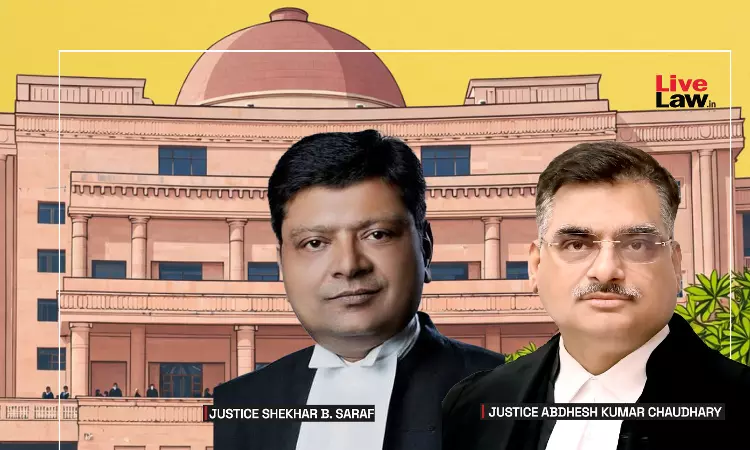
The Allahabad High Court today dismissed a petition challenging the delimitation of Assembly constituencies in Uttar Pradesh's Ambedkar Nagar district, including the reservation of the Alapur constituency for Scheduled Castes.
The bench said the plea failed to establish grounds for judicial interference and was filed nearly two decades after the delimitation order was passed.
A Bench of Justice Shekhar B. Saraf and Justice Abdhesh Kumar Chaudhary clarified that judicial review of an order passed by the Delimitation Commission is confined to only two limited grounds
• Want of legislative competence; and
• Violation of any fundamental right guaranteed under Part III of the Constitution, or of any other Constitutional provision.
The Court also found merit in the respondents' objection regarding the delay in filing the petition. The Court noted that the delimitation order was published in December 2006, and successive Uttar Pradesh Assembly elections were since conducted on its basis.


Case in brief
The petitioner (Dileep Kumar), a resident of Jahangirganj in Ambedkar Nagar district and an elector in one of its Assembly constituencies, sought directions to revise and correct the delimitation and reservation of the district's Assembly constituencies.
He challenged the population distribution among the constituencies, alleging that it violated Article 170(2) of the Constitution and the Delimitation Act, 2002. He also questioned the reservation of Alapur as a Scheduled Caste constituency.
Relying on the 2001 Census, the petitioner submitted that Uttar Pradesh had a population of approximately 16.62 crore and 403 Assembly constituencies, which resulted in an average population of around 4,12,402 per constituency.
He relied on internal delimitation guidelines permitting a deviation of plus or minus 10% from the average population and argued that the permissible population range should have been approximately 3,71,178 to 4,53,642.
According to the petitioner, Jalalpur had a population of 4,60,245, which exceeded the said upper limit, while Akbarpur had a population of 3,68,722.
He alleged that territorial areas had been transferred from smaller constituencies, including Akbarpur and Alapur, to larger constituencies such as Jalalpur and Katehari, which aggravated the population imbalance.
The petitioner further argued that Alapur's Scheduled Caste population was 26.90%, compared with 26.43% in Jalalpur.
He contended that if Alapur had included Ashrafpur Kichhauchha Nagar Panchayat, its Scheduled Caste population percentage would have been 26.39%, and the constituency should therefore have been treated as a general seat.
High Court's observations
Examining the scope of judicial review, the Bench referred to Section 10(2) of the Delimitation Act, 2002, which gives finality to delimitation orders published in the Gazette and provides that such orders cannot ordinarily be called into question before a court.
The Court clarified that this does not completely exclude judicial review. However, it observed that judicial scrutiny is confined to two grounds: lack of legislative competence and violation of a fundamental right guaranteed under Part III of the Constitution or another constitutional provision.
Relying on the Allahabad High Court's earlier decision in Jagdish Singh v. Election Commission of India, the Bench reiterated that an order of the Delimitation Commission is in the nature of law rather than a mere administrative order and is not amenable to a writ of mandamus or certiorari except within the permissible limits of judicial review.
Against this backdrop, the Court found that the petitioner had neither pleaded nor demonstrated any lack of legislative competence on the Commission's part.
His case rested primarily on recalculations of population figures and Scheduled Caste percentages across constituencies.
The Bench held that such an exercise was essentially a matter of methodology and technical determination falling within the Delimitation Commission's domain and did not, by itself, disclose a violation of a fundamental right or another constitutional provision.
The Court noted that Article 170(2) requires the ratio between population and seats to be maintained "so far as practicable", giving the Commission latitude to account for geographical contiguity, administrative boundaries and other relevant considerations.
It held that the internal guidelines permitting a deviation of plus or minus 10% were guidelines, not statutory mandates enforceable as a strict right through a writ of mandamus.
The Bench observed that even a mere deviation, if demonstrable, does not automatically render delimitation unconstitutional unless it violates a specific constitutional guarantee.
It also rejected the contention that the comparative Scheduled Caste population percentages of constituencies should determine which seat must be reserved.
Referring to Jagdish Singh and Chandra Mani Prasad v. Union of India, the Court observed that rotating or reallocating reserved seats based on comparative population considerations fell within Parliament's legislative domain and could not be directed by the High Court in the exercise of its writ jurisdiction.
The Bench further refused to accept the allegation that the transfer of territorial units demonstrated a mala fide or unconstitutional exercise of power.
It noted that delimitation inherently involves reconstituting territorial units and that the exercise could not be reopened merely because an elector arrived at a different calculation he considered more equitable.
The Bench observed that it would be inequitable and contrary to public interest to unsettle an electoral arrangement that had remained in force for two decades, particularly when the 2026 Census was stated to be nearing completion and a fresh delimitation exercise could follow in the ordinary course.
Finding no merit in the petition on maintainability or on merits, the High Court dismissed it without any order as to costs.