



- Home
- /
- High Courts
- /
- Allahabad High Court
- /
- Lok Adalats Can't Grant Divorce;...
Lok Adalats Can't Grant Divorce; Have No Adjudicatory Jurisdiction: Allahabad HC Slams DLSA For Usurping Family Court Powers
Sparsh Upadhyay
31 May 2026 1:13 PM IST
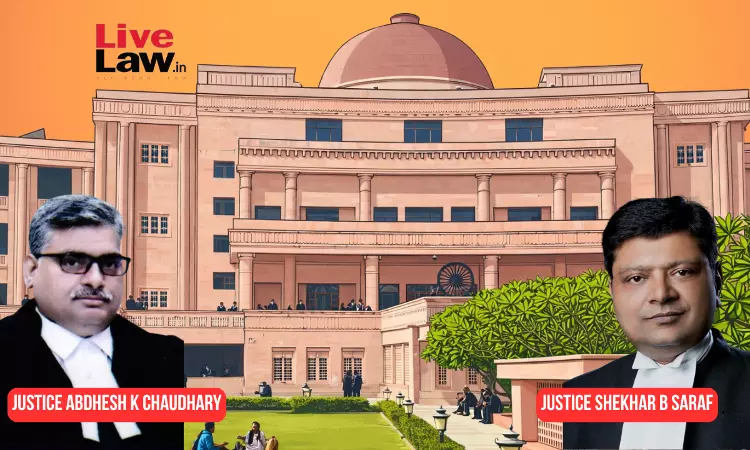
In a significant order, the Allahabad High Court recently observed that a Lok Adalat or District Legal Services Authority (DLSA) has no legal competence or jurisdiction to grant a decree of divorce, as this power lies exclusively within the jurisdiction of regular civil and family courts. In its 11-page order, a bench of Justice Shekhar B Saraf and Justice Abdhesh Kumar Chaudhary...
This is a premium content
Available exclusively to
Our subscribers
Subscribe Premium 
INR 1099+GST
Your support helps us to bring you more content at
an affordable subscription scheme !!!
All payment options available
In a significant order, the Allahabad High Court recently observed that a Lok Adalat or District Legal Services Authority (DLSA) has no legal competence or jurisdiction to grant a decree of divorce, as this power lies exclusively within the jurisdiction of regular civil and family courts.
In its 11-page order, a bench of Justice Shekhar B Saraf and Justice Abdhesh Kumar Chaudhary heavily criticised the DLSA, Unnao, for 'usurping' the Family Court's power to grant divorce by passing 'cryptic' orders that allowed a husband to illegally treat a mediation settlement as a valid divorce.
The Court underscored that while Lok Adalats play a very significant role in dispensing Justice, they cannot dilute or tweak the Rules and Regulations of the Legal Services Authorities Act, 1987, and must remain within the four corners of the law.
"It is expected that these Lok Adalats/ DLSA, who are harbingers of early disposal should exercise their powers strictly within the four corners of law as provided under the provisions of the Act and the Regulations framed therein and should not wander into the realms, which is exclusively reserved for regular courts/tribunals", the Court said.
The bench made these observations while dealing with a writ petition filed by Sushma Devi, who challenged a July 2018 order passed by the DLSA ratifying a divorce between the petitioner and the private respondent No. 3/husband on the basis of a report submitted by a Mediator.
The DLSA had essentially disposed of the pre-litigation matter based on a mediation settlement, which the husband later interpreted as a ratified divorce.
Case in brief
Briefly put, the respondent-husband preferred a pre-litigation suit before the DLSA, Unnao, in June 2018. The matter was later sent for mediation.
The wife alleged that the husband fraudulently obtained her signature to prepare a settlement term for divorce, and the DLSA mechanically disposed of the matter based on this purportedly fraudulent settlement.
Thereafter, the issue arose between the parties, as the husband, relying on this settlement, which stated that “parties are free to remarry,” began to justify his second marriage.
The wife strongly objected, arguing that the settlement was a complete farce because, even after the DLSA proceedings, they had continued to live together as husband and wife.
To substantiate her claim, she pointed out that a baby girl was born out of their wedlock in November 2019, around a year after the alleged divorce/settlement.
However, her review application was dismissed by the DLSA in June 2026. Now challenging the July 2018 settlement/order as well as the review order, the wife moved the High Court.
High Court's observations
The bench took strong exception to the DLSA's cryptic orders to entertain a matrimonial dispute in a pre-litigation matter and to mechanically approve the settlement that allowed both parties to 'remarry'.
The Court categorically clarified that the Lok Adalat had not actually granted a formal decree of divorce, noting that the mediator himself admitted he had no adjudicatory jurisdiction to pass such an order
The bench observed that the secretary of DLSA belongs to the cadre of Senior Judicial Officers, who are expected to be well-versed in the law and the judicial process; however, the Court found shortcomings in the manner in which the Authority had handled it.
Referring to the Legal Services Authorities Act, 1987 and the National Legal Services Authority (Lok Adalats) Regulations, 2009, the division bench pointed out that the role of the Lok Adalat is limited to negotiation and/or entering into a settlement agreement, but it cannot issue binding directions or adjudicatory orders.
The bench specifically referred to the proviso to Regulation 10(2), which explicitly mandates that matters relating to divorce simply cannot be referred to a Lok Adalat.
“This Court fails to comprehend that when a divorce matter itself cannot be referred to Lok Adalat, how a decree of divorce could have been expected to be granted by any Lok Adalat in a prelitigation matter,” the bench observed.
"The Lok Adalat/ Authority should be conscious and remember that when Regulation 17(7) specifically proscribes grant of divorce by mutual consent, which means it was not within the legal competency of the Lok Adalat to grant any such prayer of divorce, it is starting to see this kind of cryptic orders passed under the Regulations",”the bench further remarked.
Regarding the use of terms such as "each party are free to remarry" in the settlement agreement, the bench called it absolutely illegal and forbidden by law.
Expressing strong dismay over the same, the bench observed thus:
"This court is unable to understand as to how and in what manner the said settlement could had been signed and would had passed the eye-test of the members of the Lok Adalat in the first place, especially when it is quite understandable from the facts that parties had approached the Lok Adalat and/or Authority under a prelitigation suit and had not been divorced as per law as on that date".
The bench added that the agreement failed to even pass the basic test of being reasonable and understandable. Any such terms allowing remarriage, the Court noted, should have explicitly stated that they would take effect only after a divorce is granted by a competent court.
Therefore, the bench held that the ground taken by the respondent No.3(Husband) that the settlement/orders of the Authority or the Lok Adalat were assumed to be a divorce is without any basis or force of law.
The Court further said that while Lok Adalats are crucial for fostering an accessible, affordable, and swift justice delivery system, their “tearing hurry” in resolving sensitive matters must be avoided in all circumstances.
"It is expected that these Lok Adalats/ DLSA, who are harbingers of early disposal, should exercise their powers strictly within the four corners of law as provided under the provisions of the Act and the Regulations framed therein and should not wander into the realms, which is exclusively reserved for regular courts/tribunals", the Court stated.
In view of this, the writ petition was disposed of by clarifying that to date, there has been no formal divorce decree between the petitioner and respondent No.3.
It provided that the petitioner shall be at liberty to proceed in accordance with law against respondent No.3/husband as legally advised.
Importantly, the Court further directed that a copy of this order be circulated among the Lok Adalats/DLSA of the State of UP for its necessary compliance and future reference.
Case Title: Sushma Devi vs. State Of U.P. Thru. Prin. Secy. Deptt. Of Law Lko. And 2 Others 2026 LiveLaw (AB) 303
Case Citation: 2026 LiveLaw (AB) 303
Tags

Sparsh Upadhyay
Sparsh Upadhyay is an Associate Editor with LiveLaw.

