



- Home
- /
- High Courts
- /
- Allahabad High Court
- /
- Caught Red-Handed Accepting ₹300...
Caught Red-Handed Accepting ₹300 Bribe In 1977, Allahabad High Court Upholds Lekhpal's Conviction 49 Years After Crime
Sparsh Upadhyay
6 July 2026 6:04 PM IST
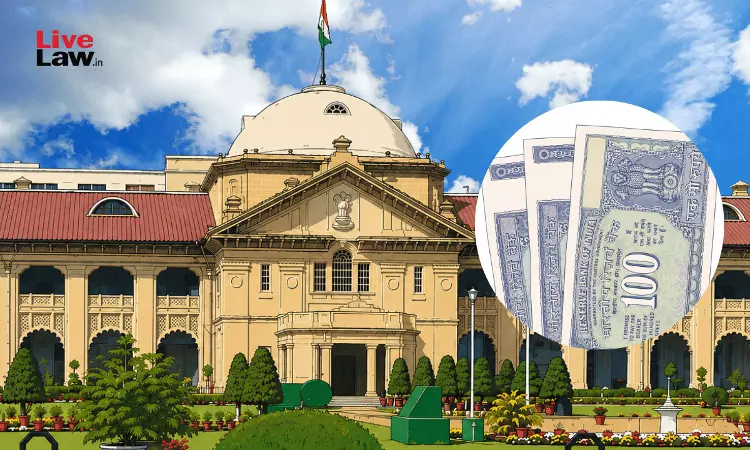
The Allahabad High Court last week dismissed a 41-year-old criminal appeal, upholding the 1985 conviction of a Consolidation Lekhpal who was caught red-handed accepting a bribe of ₹300, nearly half a century ago. A bench of Justice Sanjiv Kumar thus upheld the 1-year rigorous imprisonment sentence awarded to him. He was directed to surrender before the Trial Court within 4 weeks...
This is a premium content
Available exclusively to
Our subscribers
Subscribe Premium 
INR 1099+GST
Your support helps us to bring you more content at
an affordable subscription scheme !!!
All payment options available
The Allahabad High Court last week dismissed a 41-year-old criminal appeal, upholding the 1985 conviction of a Consolidation Lekhpal who was caught red-handed accepting a bribe of ₹300, nearly half a century ago.
A bench of Justice Sanjiv Kumar thus upheld the 1-year rigorous imprisonment sentence awarded to him. He was directed to surrender before the Trial Court within 4 weeks to serve the remainder of his sentence.
In this case, the Court clarified that the non-examination of the primary complainant is not fatal to a corruption case if the trap proceedings are otherwise fully corroborated by vigilance officers and independent public witnesses.
The appellant (Mahesh Chand), who was posted as a Lekhpal in the Consolidation Department at Tehsil in Kanpur, moved the High Court challenging the 1985 order of conviction passed by the Vth Additional Sessions Judge, Kanpur.
The trial court had found him guilty under Section 161 of the Indian Penal Code (IPC) and Section 5(2) of the Prevention of Corruption Act, 1947.
Background
Briefly put, a villager (Virendra Singh) had a pending litigation against a woman from the same village. Both were allotted different Chaks by the Consolidation Officer during consolidation proceedings. An appeal on the same matter was pending before the Settlement Officer (Consolidation).
On the morning of April 1, 1977, Lekhpal Mahesh Chand (Appellant) and Kanoongo Chandra Sen boarded the same bus as Singh and demanded a bribe of ₹400, promising to get the opposite party's appeal dismissed.
Singh paid ₹100 on the spot to the Kanoongo. However, he subsequently approached his son in Kanpur. Together, they met with the Superintendent of Police, Vigilance, Kanpur, and filed a formal complaint.
A trap was orchestrated and 3 currency notes of ₹100 denomination were marked with phenolphthalein powder.
Later that afternoon, Virendra Singh handed over those three currency notes to Mahesh Chand at a Hotel, who kept them in his pants pocket and told him that "his chak would not be disturbed".
The vigilance team immediately arrived there, conducted a personal search of Mahesh Chand, and recovered 3 currency notes from his possession, along with a wrist watch.
When his hands and pockets were washed with a sodium carbonate solution, it turned red, confirming his contact with the marked notes.
While the trial court acquitted the co-accused Kanoongo, it convicted Chand in October 1985. Chand subsequently secured bail and filed an appeal before the High Court, which remained pending for over four decades.
Arguments advanced
It was the appellant's contention that the prosecution's case had no legs to stand on because the primary star witness, the complainant (Virendra Singh), from whom the bribe was directly demanded, was never examined in court.
It was also submitted that the alleged place of recovery (a hotel) was a public place, and it was highly improbable that the accused would choose such a public place to accept illegal gratification.
The State, on the other hand, submitted that the prosecution had proved its case beyond a reasonable doubt and that the testimony of the prosecution witnesses was consistent, reliable, and trustworthy.
It was also argued that independent public witnesses to the recovery were examined by the prosecution, thereby justifying the dismissal of the appeal.
High Court's observations
The High Court, at the outset, noted that even though the complaint had not been examined, his son (P.W.4) had produced medical evidence proving his father was suffering from unstable mental health and was unfit to depose.
Justice Sanjiv Kumar heldthat a well-corroborated trap raid cannot be discarded merely because the complainant could not take the stand:
"Even, if for the sake of argument, it is accepted that Virendra Singh was deliberately withheld by the prosecution to depose before the court then it has no adverse effect over the prosecution case because the alleged taking of illegal gratification has taken place not only before Jai Vijai Singh, son of Virendra Singh, but also before the Inspector of Vigilance Department under whose leadership the raid party was formed by the Vigilance and also before the public witness who has been examined before the court. Therefore, the argument advanced on behalf of the appellant has no force."
The bench also rejected the argument that bribery was improbable in a crowded public place.
"…because such kind of trap are laid in secrecy and the information is kept secret between the members of raiding party and the place is arranged in such a manner that the accused would not have any apprehension of his being caught red handed", the single judge observed.
The Court further pointed out that the appellant himself, in his Section 313 CrPC statement, admitted to being present at the hotel with the complainant for a cup of tea and to having signed the recovery memo (fard baramadagi).
His further argument that he was framed due to an aggressive anti-bribery drive by the vigilance department was also rejected as entirely unconvincing and completely lacking in evidence.
Against this backdrop, finding the consistent and trustworthy testimonies of the vigilance inspectors (P.W.1), the constable (P.W.2), and the independent public witness (P.W.3) to be reliable, the High Court upheld the trial court's order and adjudgment.
Thus, dismissing the appeal, the High Court cancelled Mahesh Chand's personal and bail bonds and ordered him to surrender and serve out his remaining sentence.
Should he fail to comply, the trial court has been directed to execute coercive measures to secure his presence.
Case title - Mahesh Chand vs State of U.P. 2026 LiveLaw (AB) 356
Case Citation: 2026 LiveLaw (AB) 356
Tags

Sparsh Upadhyay
Sparsh Upadhyay is an Associate Editor with LiveLaw.

