



- Home
- /
- High Courts
- /
- Allahabad High Court
- /
- 'Plea Of Alibi' Must Be Proved In...
'Plea Of Alibi' Must Be Proved In Trial, IO Cannot Unilaterally Accept It To Be True To File Final Report: Allahabad High Court
Sparsh Upadhyay
12 July 2026 8:40 PM IST
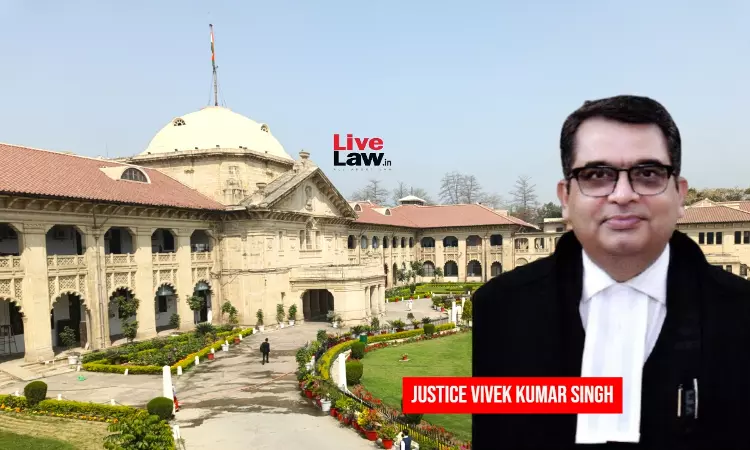
The Allahabad High Court has explicitly ruled that an accused's “plea of alibi” must be proved by leading evidence during a criminal trial and the Investigating Officer (IO) cannot unilaterally accept it to be true to file a Final Report. A bench of Justice Vivek Kumar Singh held that it would be "gross illegality” if the IO files a final report relying on the statements...
This is a premium content
Available exclusively to
Our subscribers
Subscribe Premium 
INR 1099+GST
Your support helps us to bring you more content at
an affordable subscription scheme !!!
All payment options available
The Allahabad High Court has explicitly ruled that an accused's “plea of alibi” must be proved by leading evidence during a criminal trial and the Investigating Officer (IO) cannot unilaterally accept it to be true to file a Final Report.
A bench of Justice Vivek Kumar Singh held that it would be "gross illegality” if the IO files a final report relying on the statements of witnesses who supported the applicants' plea of alibi.
The Court made these observations while dismissing an application filed under Section 528 BNSS by two accused who challenged a February 2025 summoning order passed by a Special Judge (POCSO Act) in Aligarh.
Case in brief
An FIR was lodged against an unknown person on December 23, 2023, in respect of an alleged incident of December 21 regarding the kidnapping of a 16-year-old girl.
The IO recorded the statement of the first informant (the victim's mother), who supported the prosecution's case. The victim was recovered by the police on January 13, 2024.
In her statement recorded under Section 161 CrPC, she stated that she was forcibly kidnapped by the applicant no. 2 in a car and thereafter, she was gang raped by both the applicants.
The victim's statement was recorded under Section 164 CrPC on January 29, 2024, and she reiterated her earlier statement.
During the investigation, the IO collected Call Detail Records (CDRs) and mobile location data, which purportedly indicated that the accused were in Delhi and Bulandshahr at the time of the alleged incident.
Relying on these CDRs and statements from independent witnesses who supported the alibi, the IO submitted a final closure report by completely ignoring the victim's statements.
The informant-mother challenged the filing of the final report by filing a protest petition. The Special Judge (POCSO Act)/Additional District and Sessions Judge, Aligarh, allowed her petition, and the police's final report was rejected.
The accused were summoned to face a criminal trial under Sections 363, 366, 376D, and 342 IPC, and Sections 3 and 4 of the POCSO Act. This very summoning order was challenged in the present petition before the High Court.
High Court's observations
At the outset, the High Court observed that upon receipt of a police report under Section 173(2) CrPC, a Magistrate is entitled to take cognizance of an offence under Section 190(1)(b) CrPC even if the police report is to the effect that no case is made out against the accused.
The single judge added that the Magistrate can take into account the statements of the witnesses examined by the police during the investigation and take cognizance of the offence complained of and order the issuance of process to the accused.
“Section 190(1)(b) does not lay down that a Magistrate can take cognizance of an offence only if the investigating officer gives an opinion that the investigation has made out a case against the accused. The Magistrate can ignore the conclusion arrived at by the investigating officer and independently apply his mind to the facts emerging from the investigation and may take cognizance of the case, if he thinks fit in exercise of his powers under Section 190(1)(b) and direct the issue of process to the accused,” the High Court remarked.
Regarding the IO's act of filing a final report by relying upon the statements of the witnesses who supported the plea of alibi of the applicants, the bench took exception to the same.
The bench observed thus:
“The investigation cannot unilaterally decide an alibi is true just because a few witnesses say so, especially if there is prima facie evidence linking the accused to the crime”.
It added that the burden to prove the 'plea of alibi' is upon the accused, who would do so by adducing evidence at the trial proceedings, and not by filing affidavits or statements purportedly recorded under Section 161 CrPC.
The Court further stressed the prosecution's right to test such claims, noting that a plea of alibi can only be proved in the trial court where the prosecution is given the opportunity to cross-examine defence witnesses "to demonstrate that his testimony was not correct".
Therefore, finding no jurisdictional error or illegality in the trial court's summoning order, the High Court dismissed the application.
The High Court, however, clarified that its judgment is purely tentative and ought not to be regarded by the Trial Court as any comment or evaluation on evidence that has yet to surface during the trial.
"The truth of the prosecution case has to be established beyond doubt at the trial in accordance with law", the bench said.
Counsel for Applicant(s): Anupama Parashar, Satendra Kumar Upadhyay
Counsel for Opposite Party(s) : Devesh Kumar Shukla, Dharmesh Kumar Shukla, G.A.
Case title - Rajvir And Another vs. State Of U.P. And 3 Others 2026 LiveLaw (AB) 388
Case citation: 2026 LiveLaw (AB) 388
Tags

Sparsh Upadhyay
Sparsh Upadhyay is an Associate Editor with LiveLaw.

